
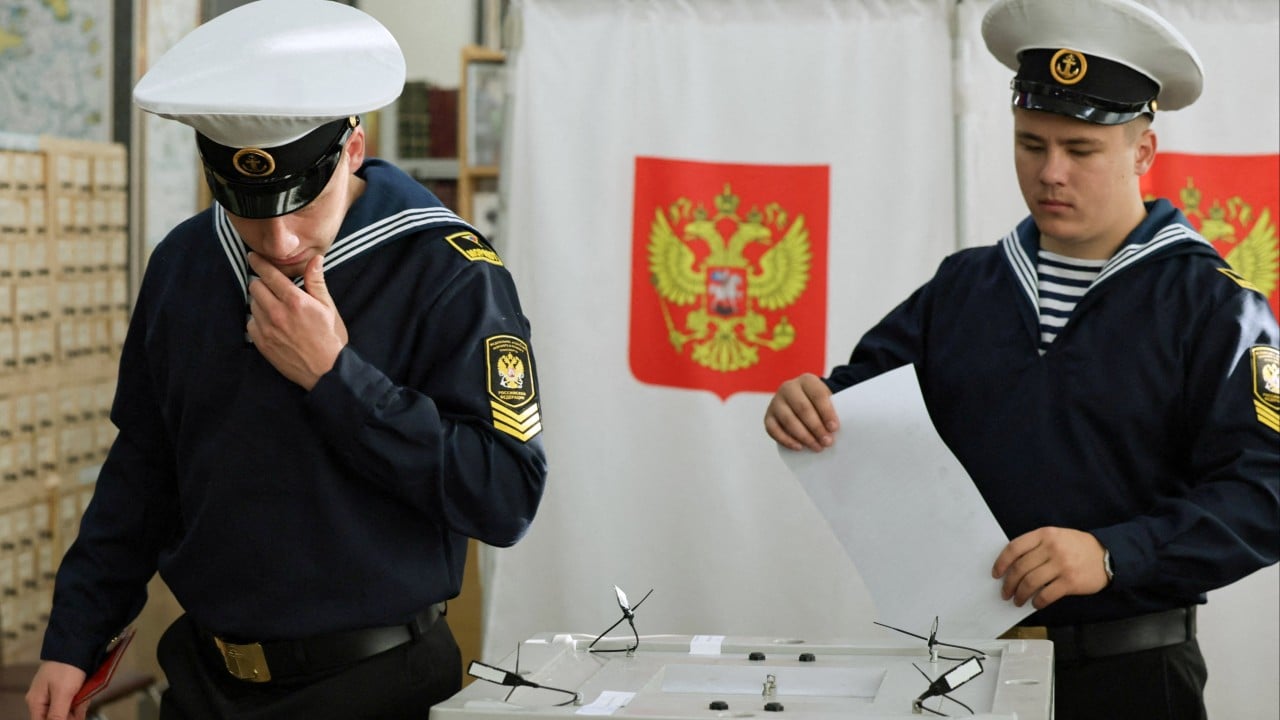
Kremlin-run Sept 18–20 Duma vote to cement United Russia majority amid war in Ukraine
Coveragetap to expand ▾Spectrum: Mostly Center🌍Asia: 2 · Other: 1
- Voting began on Sep 18 in a three-day parliamentary election in Russia that President Vladimir Putin has framed as a barometer of support for Russia's war in Ukraine.
- This is the first parliamentary election since Russia launched its full-scale war in Ukraine in February 2022.
- The vote will determine the make-up of the 450-seat lower house of parliament, the State Duma.
- The ruling pro-Putin United Russia party is widely expected to retain its dominance in what the article calls a tightly controlled political system.
- Putin said in a televised address that casting a vote would help secure Russia's victory in Ukraine and demonstrate national resolve in the face of external pressure.
- The Kremlin said national unity is vital because of what it says are increasingly dangerous efforts by Ukraine's intelligence services and other enemies to stir unrest inside Russia.
- Voting for a new Lower House (State Duma) will be held Sept 18 to Sept 20.
- Most anti-war candidates have been excluded from the ballot after the Supreme Court ruled that the liberal Yabloko party had breached electoral rules, though some Yabloko candidates are still running in individual constituencies.
Russian authorities are holding voting from Sept 18 to Sept 20 for a new State Duma, a tightly managed campaign designed to cement United Russia’s parliamentary majority amid the ongoing war in Ukraine.
Kremlin-controlled media and officials are treating the three-day election as both a legitimacy exercise and a demonstration of regime resilience, with United Russia broadly expected to keep the majority it has held for 23 years (per straitstimes.com).
Election planners have extended voting into territories Russia occupies in Ukraine, a move framed by Moscow as an affirmation of its territorial claims but described by critics as further entrenching control over contested populations (per straitstimes.com).
The single source in this brief reports that the Kremlin maintains strict oversight of candidates and campaigning, leaving no credible opposition that openly challenges President Vladimir Putin or the war in Ukraine (per straitstimes.com).
Turnout is a central preoccupation for the Kremlin: the piece cites the roughly 52 percent turnout in 2021 as a benchmark and suggests Moscow will push for higher participation to bolster the narrative of stability (per straitstimes.com).
Observers quoted in the reporting argue the election’s primary function is symbolic — to show continuity of governance and to present domestic unity despite the economic and social strains the war has imposed (per straitstimes.com).
Because the available reporting comes from a single outlet, claims about public sentiment, the strength of opposition activity inside Russia, and the effects of holding polls in occupied territories are presented as the outlet documents them rather than independently verified.
The article does not provide independent vote-monitoring results, detailed turnout projections, or casualty figures tied to the vote; it focuses on the Kremlin’s framing and the expected endurance of United Russia (per straitstimes.com).
What happens at the ballot over these three days will shape the Kremlin’s ability to claim domestic legitimacy as it continues its wartime governance; Moscow’s decision to include occupied Ukrainian territories in the vote ensures the ballot will also serve as a political claim on those areas regardless of international recognition (per straitstimes.com).