
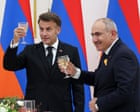
Macron Endorses Armenia's Pashinyan Amidst Russian Criticism
Coveragetap to expand ▾Spectrum: Mostly Center🌍Other: 4 · Europe: 1
- Emmanuel Macron has publicly supported Armenia's Prime Minister Nikol Pashinyan, emphasizing a European future for the country (per theguardian.com).
- The 2020 Nagorno-Karabakh war resulted in Azerbaijan displacing tens of thousands of Armenians (per theguardian.com).
- Pashinyan is facing a challenging re-election campaign against three pro-Russia or nationalist parties (per theguardian.com).
- Macron's support is likely to be criticized by these parties as interference in Armenia's internal politics (per theguardian.com).
- France hosts one of the largest Armenian expatriate communities in Europe, which Macron has historically supported (per theguardian.com).
French President Emmanuel Macron has made a significant political move by endorsing Armenia's Prime Minister Nikol Pashinyan, asserting that Armenia's future is aligned with Europe. This endorsement comes at a critical time as Pashinyan faces a tough re-election campaign, challenged by three pro-Russia or nationalist parties.
These parties are critical of Pashinyan's approach towards Azerbaijan, accusing him of making excessive concessions in pursuit of peace. Macron's support is seen as an attempt to bolster Pashinyan's pro-European stance, amidst accusations from opposition parties of foreign interference in Armenia's domestic affairs.
Macron's visit to Armenia and his vocal support for Pashinyan underscore France's strategic interest in strengthening ties with Armenia, a country with a significant Armenian . Macron's criticism of Russia, accusing it of abandoning Armenia after the 2020 Nagorno-Karabakh conflict, highlights the geopolitical tensions influencing the region.
The conflict, which resulted in the displacement of tens of thousands of Armenians by Azerbaijan, remains a sensitive issue in Armenian politics. Pashinyan's openness to aligning with Europe contrasts with the more cautious approach of neighboring Georgia's leaders.
His pro-European stance is a central theme of his campaign, but it also makes him a target for opposition parties that favor closer ties with Russia. These parties are likely to leverage Macron's endorsement as evidence of undue foreign influence, potentially swaying nationalist sentiments against Pashinyan.
Macron's visit and endorsement are part of a broader effort to demonstrate that a European alignment is not merely theoretical but offers tangible benefits for ordinary Armenians. This message is particularly resonant given the historical and cultural ties between France and Armenia, reinforced by the large Armenian community in France.
As the election approaches, the outcome will not only determine Armenia's domestic leadership but also its geopolitical orientation. The stakes are high, with implications for Armenia's international alliances and its approach to regional conflicts.
Macron's intervention is a bold statement of support for Pashinyan, but it also risks backlash from those wary of external influence in Armenia's political affairs.
- Armenian citizens face the concrete cost of potential political instability if pro-Russia parties gain power, which could shift the country's foreign policy away from Europe.
- Nikol Pashinyan benefits from Macron's endorsement, which may bolster his pro-European campaign amidst strong opposition.
- Whether Nikol Pashinyan secures re-election amidst strong opposition from pro-Russia parties.
- Reactions from Armenian opposition parties to Macron's endorsement and potential accusations of foreign interference.
- The impact of Macron's criticism of Russia on Armenia's geopolitical alliances and future relations with Europe.
Left- and right-leaning outlets are covering this story differently — in which facts to emphasize, which context to include, and how to frame causes and consequences.
2 specific areas where coverage diverges — see below.
- Theguardian.com emphasizes Macron's criticism of Russia and support for Pashinyan, while potential opposition reactions are noted but not detailed.
- No source mentions the specific economic or military support France may offer Armenia as part of its European alignment strategy.
- The potential impact on Armenia's relations with neighboring countries, particularly Azerbaijan, is not explored in detail.