
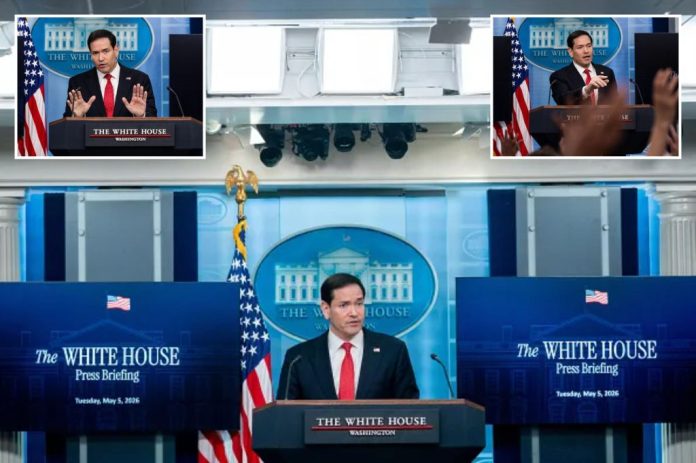
Marco Rubio Criticizes Cuba's Leadership at White House Press Conference
Coveragetap to expand ▾Spectrum: Right Only🌍US: 1
- Marco Rubio on Cuba: "Their economic model doesn't work, and the people in charge can't fix it, and the reason they can't fix is not just because they're communists—that's bad enough.
- The only thing worse than a communist is an incompetent one.” “Their economic model doesn’t work, and the people in charge can’t fix it,” Rubio told reporters.
- “And the reason they can’t fix is not just because they’re communists — that’s bad enough, but they’re incompetent communists.
In a recent White House press conference, Secretary of State Marco Rubio took the opportunity to address a range of foreign policy issues, with a particular focus on Cuba. Filling in for White House press secretary Karoline Leavitt, Rubio responded to questions about the island nation's economic difficulties.
He dismissed the notion of a formal oil blockade, instead pointing to Venezuela's decision to stop providing free oil to Cuba as a significant factor exacerbating the country's economic woes. Rubio, whose parents immigrated from Cuba, offered a scathing critique of the Cuban government's economic management.
He argued that the island's economic model is fundamentally flawed and that its leaders are not only communists but also incompetent ones. This, he suggested, is the root cause of Cuba's persistent economic struggles. The press conference, which lasted about an hour, allowed Rubio to elaborate on issues that have not been at the forefront of international discourse recently.
His remarks on Cuba were particularly pointed, reflecting his personal connection to the country and his long-standing criticism of its government. Rubio's comments come at a time when Cuba is facing significant economic challenges, partly due to the loss of subsidized oil from Venezuela.
This development has intensified the island's energy crisis and added pressure on its already struggling economy. The Secretary of State's remarks also touched on other international topics, including relations with Iran and the Vatican, though his statements on Cuba were among the most detailed and critical.
Rubio's critique of Cuba's leadership underscores the U.S. administration's stance on the island nation, highlighting governance issues as a primary obstacle to economic recovery. His comments suggest a continued hardline approach towards Cuba, focusing on the need for systemic change rather than temporary solutions.
Overall, the press conference provided a platform for Rubio to articulate his views on Cuba and other foreign policy matters, reinforcing his position as a vocal critic of the Cuban government.
- Cuban citizens face worsening economic conditions due to the cessation of Venezuelan oil shipments, which exacerbates energy shortages and economic instability.
- The U.S. administration, represented by Marco Rubio, benefits from reinforcing a hardline stance on Cuba, aligning with Rubio's personal and political background.
- Venezuela's decision to stop providing free oil to Cuba highlights the geopolitical dynamics affecting the region, impacting both Cuban and Venezuelan populations.
- Whether Venezuela resumes oil shipments to Cuba, which could alleviate some economic pressures.
- Any changes in U.S. policy towards Cuba following Rubio's statements, potentially affecting diplomatic relations.
- Reactions from the Cuban government to Rubio's critique, which could influence future U.S.-Cuba interactions.
- The Washington Examiner emphasizes Rubio's critique of Cuba's leadership, while omitting broader geopolitical context.
- No source disputes Rubio's claims about Venezuela's oil shipments to Cuba.
- No source mentions the historical context of U.S.-Cuba relations, including past embargoes and their impact on the current situation.
- The source attributes Cuba's economic issues to governance failures rather than external factors like U.S. sanctions.
- The Washington Examiner attributes Cuba's economic struggles primarily to internal governance issues, as stated by Rubio.
- Rubio described Cuban leaders as 'incompetent communists' during the press conference.