
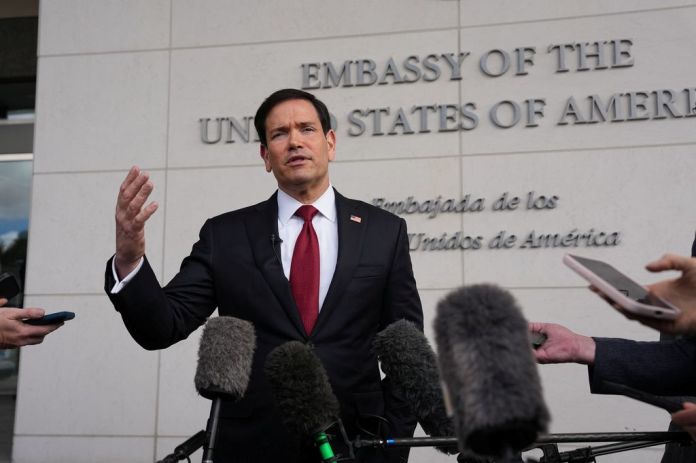
Secretary of State Marco Rubio skips GOP midterm convention; attendees praise him in Dallas
Coveragetap to expand ▾Spectrum: Mixed🌍US: 1 · Other: 1
- A State Department spokesperson said it is a 'long-standing' policy to 'prohibit Senate-confirmed Presidential appointees from attending partisan conventions,' making Rubio's absence expected and partly institutional (per Washington Examiner)
- Scott Singer, running against Rep. Jared Moskowitz (D-FL), said he was 'not disappointed at all' because Rubio is 'delivering results for Florida and for the entire nation' (per Washington Examiner)
- Doug Stauffer, Okaloosa County GOP chairman and Florida delegate, said the delegation would have loved to see Rubio and joked about wanting 'another meme of him' (per Washington Examiner)
- Conswello Davis of Tennessee said Rubio's travel and business commitments likely kept him from attending and that the absence was planned at the last minute (per Washington Examiner)
Secretary of State Marco Rubio did not attend the Republican midterm convention in Dallas, and delegates at the event told the Washington Examiner his absence did not dent his standing with the party.
A State Department spokesperson described the decision as consistent with a 'long-standing' policy that prohibits Senate-confirmed Presidential appointees from attending partisan conventions, framing Rubio’s absence as institutional rather than political (per Washington Examiner).
Delegates and GOP candidates at the convention framed the absence as unsurprising and kept the focus on Rubio’s record: Scott Singer, the former Boca Raton mayor running against Rep. Jared Moskowitz (D-FL), said he was 'not disappointed at all' because Rubio is 'delivering results for Florida and for the entire nation' (per Washington Examiner).
Florida delegate Doug Stauffer, chairman of Okaloosa County GOP, said the delegation would have liked to see Rubio and quipped about wanting 'another meme of him,' reflecting an informal, upbeat reception among attendees (per Washington Examiner).
Conswello Davis of Tennessee told the Examiner that Rubio’s travel and business commitments likely kept him away and that the absence was arranged at the last minute, underscoring the mix of institutional constraint and scheduling in play (per Washington Examiner).
The coverage from the convention emphasized continuity: delegates described Rubio’s policy work and visibility in the administration as more consequential to their evaluations than his physical presence in Dallas (per Washington Examiner).
Absent other outlets in this packet, the Washington Examiner’s account centers both the State Department policy reason cited and the overwhelmingly positive reactions from attendees, leaving open whether Rubio’s absence will affect broader voter perceptions beyond the convention floor (per Washington Examiner).
- Florida Republican voters on the convention floor bear the concrete political cost: delegates and candidates assess Rubio by policy deliverables rather than attendance, which can shift campaign messaging and voter outreach strategies (per Washington Examiner).
- The State Department policy limiting partisan-convention attendance benefits the administration by reducing optics risks tied to senior officials appearing at intra-party events (per Washington Examiner).
- Candidates like Scott Singer benefit politically when delegates publicly endorse Rubio’s record, as those endorsements signal unity to primary voters in Florida contests (per Washington Examiner).
Whether Secretary of State Marco Rubio appears at any upcoming Florida campaign events before the midterms (per Washington Examiner). 2) Whether Scott Singer’s campaign leverages public praise for Rubio in fundraising appeals or endorsements ahead of his race against Rep. Jared Moskowitz (per Washington Examiner). 3) Whether the State Department restates or clarifies its travel-and-attendance policy for Senate-confirmed appointees before other partisan conventions (per Washington Examiner).
Left- and right-leaning outlets are covering this story differently — in which facts to emphasize, which context to include, and how to frame causes and consequences.
7 specific areas where coverage diverges — see below.
- Only the Washington Examiner is in this pack; it frames Rubio’s absence as institutional (State Department policy) and politically inconsequential based on delegate praise (per Washington Examiner).
- No source disputes the State Department policy explanation, but it is unclear whether scheduling or policy was the primary driver because both are cited by delegates and the spokesperson (per Washington Examiner).
- No source in this pack provides independent confirmation of Rubio’s specific travel schedule or official calendar entries that would verify travel commitments mentioned by delegates (missing).
- No source in this pack cites broader public-opinion polling showing whether Rubio’s absence affects voter sentiment beyond convention attendees (missing).
- No source in this pack includes official text or a link to the State Department policy cited, which would allow readers to verify scope and exceptions (missing).
- No source in this pack mentions whether other Senate-confirmed appointees have attended past partisan conventions under the same policy, which would contextualize enforcement consistency (missing).
- Only qualitative attendee quotes appear; no competing numerical figures are provided by any source in this packet (per Washington Examiner).
- The State Department policy is presented as the institutional cause of the absence (per Washington Examiner), while delegates also cite travel and business commitments as immediate causes; the packet does not resolve which was primary (per Washington Examiner).
- The State Department spokesperson attributes Rubio’s absence to policy, and delegates attribute it to scheduling and to the same policy; both attributions come from the Washington Examiner (per Washington Examiner).