
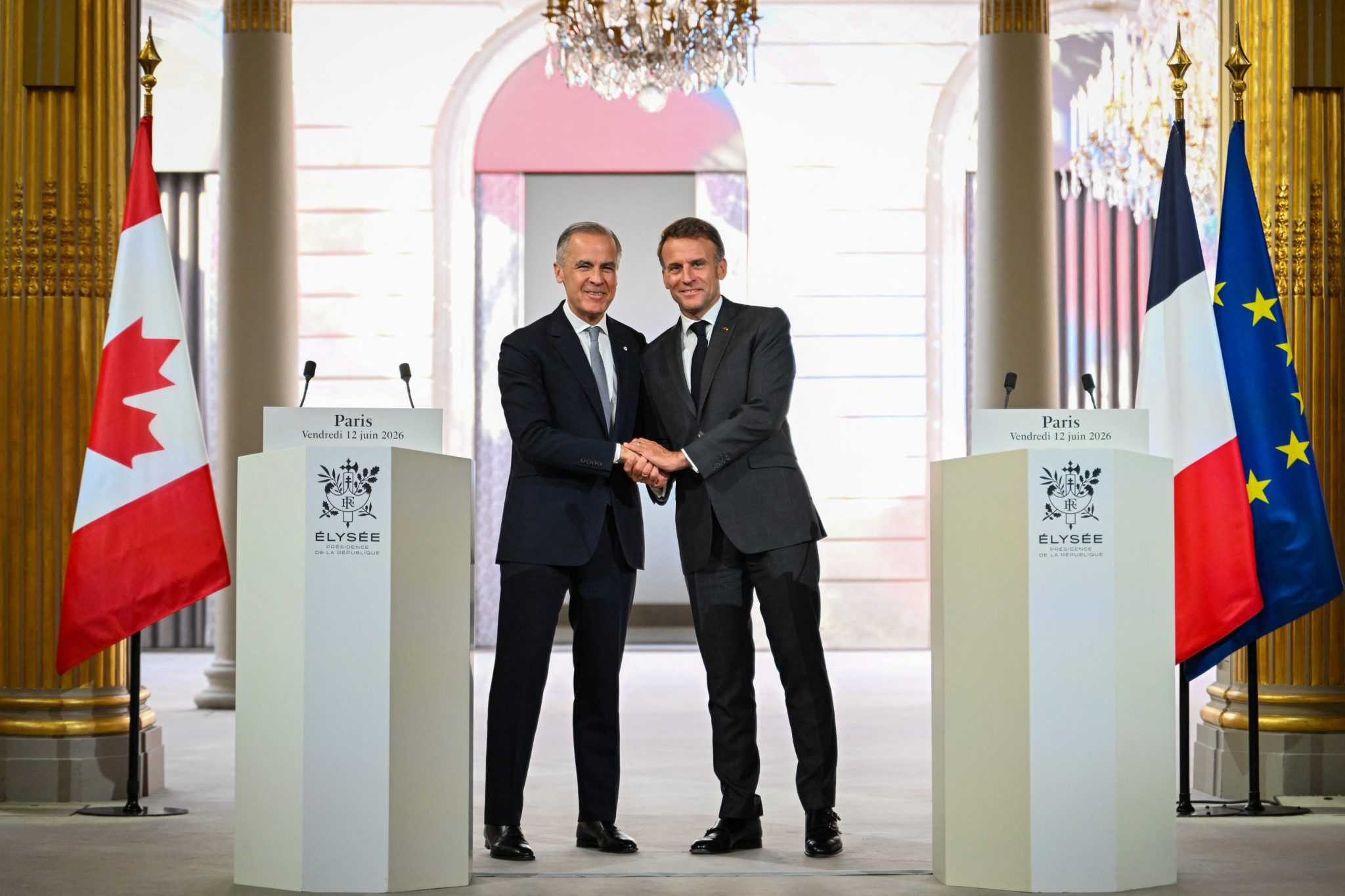
Mark Carney Proposes European
Topic: politicsRegion: north americaUpdated: i2 outletsSources: 5Spectrum: Center Only⏱ 4 min read
Story Summary
SITUATION
Canadian Prime Minister Mark Carney stated that a new world order will be built starting with Europe. He emphasized the importance of middle powers collaborating rather than competing for favor with the United States.
Coveragetap to expand ▾Spectrum: Center Only🌍Other: 2 · US: 1 · Europe: 1 · Asia: 1
Political Spectrum
Position is inferred from coverage mix.
i2 outlets · Center
Left
Center
Right
Left: 0
Center: 5
Right: 0
Geography Coverage
Distribution of where coverage is coming from.
i2 unique outlets · Dominant: Global
KEY FACTS
- Canadian Prime Minister Mark Carney says ‘new world order will be built starting with Europe’
- Carney said that Canada and the European Union have a combined population that is more than twice that of the United States, with a similarly sized economy and a collective defense budget that is twice that of China’s.
- “In a world of great power rivalry, middle powers have a choice — to compete for favor or to combine to create a third path with impact,” Carney said at Trinity College in Dublin.
HISTORICAL CONTEXT
The immediate backdrop to the current political climate is the ongoing geopolitical tension between major world powers, particularly the United States and China. This rivalry has intensified in recent years, with both nations vying for influence across various regions, including Europe and North America.
The United States, under President Donald Trump, has adopted a more unilateral approach to foreign policy since his inauguration on January 20, 2025, which has led to a reevaluation of alliances and partnerships, particularly among middle powers like Canada and European nations.
Brief
Canadian Prime Minister Mark Carney has articulated a vision for a new world order that he believes should be anchored in Europe. Speaking at Trinity College in Dublin, Carney emphasized the need for middle powers, like Canada and those in the European Union, to collaborate rather than compete for favor with the United States.
This statement comes as he met with the leader of Ireland on June 13, 2026, ahead of the G7 summit, highlighting a strategic pivot towards Europe amidst ongoing global tensions. Carney pointed out that Canada and the EU together boast a population more than twice that of the United States, alongside a similarly sized economy and a defense budget that surpasses that of China.
He argued that this collective strength can empower smaller nations to forge impactful alliances. In a world characterized by great power rivalry, Carney believes that these middle powers can choose to create a third path that enhances their influence on the global stage.
This approach reflects a growing sentiment among some leaders that collaboration among nations is essential for navigating the complexities of contemporary geopolitics.
Sources
5 of 5 linked articles
Canadian Prime Minister Mark Carney says ‘new world order will be built starting with Europe’
fortune.comJun 13Left
↗
‘Middle powers have a choice’: Canada's Carney calls for ‘third path’ beyond US
timesofindia.indiatimes.comJun 13Left
↗
Canada's Carney says middle-power countries shouldn't compete for favor with the U.S.
pbs.orgJun 13Left
↗
Carney says Europe, Canada ‘poised to be powerful force’ for good
globalnews.caJun 12Left
↗
Raj Chari: Mark Carney’s visit is not just about Mayo ancestry – Canadian prime minister sees Ireland as ally in new world order
independent.ieJun 12Left
↗