
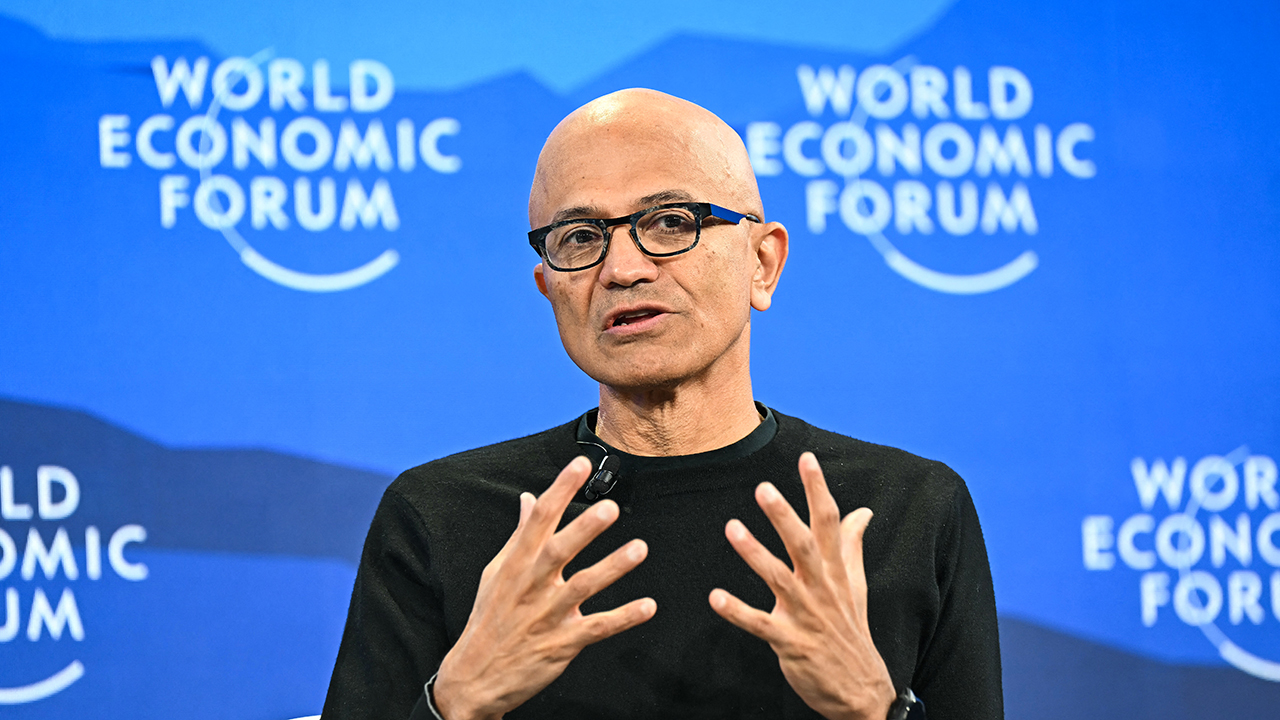
Microsoft CEO Satya Nadella urges human control over superintelligence to keep AI helping humanity
Topic: technologyRegion: north americaUpdated: i2 outletsSources: 5⚠ Bias gap — sources divergeSpectrum: Mostly Center⏱ 2 min read
Story Summary
SITUATION
Microsoft CEO Satya Nadella said the pursuit of superintelligence should focus on helping humanity and must remain under human control (per Fox Business). He urged developers and policymakers to prioritize human oversight so advanced AI benefits people rather than operating autonomously (per Fox Business).
Coveragetap to expand ▾Spectrum: Mostly Center🌍Asia: 1 · Other: 1
Political Spectrum
Position is inferred from coverage mix.
i2 outlets · Center
Left
Center
Right
Left: 0
Center: 1
Right: 1
Geography Coverage
Distribution of where coverage is coming from.
i2 unique outlets · Dominant: Asia
KEY FACTS
- Microsoft CEO Satya Nadella said the pursuit of superintelligence should focus on "helping humanity" (per Fox Business).
- Satya Nadella said superintelligence must remain "under human control" (per Fox Business).
- Nadella urged developers and policymakers to prioritize human oversight of advanced AI (per Fox Business).
- Nadella warned against advanced AI operating autonomously without human oversight (per Fox Business).
HISTORICAL CONTEXT
Since March 2026 the United States and Israel have carried out coordinated strikes on Iranian power plants, air defenses and military infrastructure, a campaign that has reshaped global security and accelerated calls for resilient critical systems. That conflict has intensified scrutiny of advanced technologies, emergency planning and export controls.
Structurally, contemporary AI governance rests on the OECD AI Principles (2019), the EU AI Act adopted in 2023, and a series of national executive orders and voluntary safety commitments by major technology firms dating from 2021–2023 aimed at transparency and risk management.
Brief
Microsoft CEO Satya Nadella told an audience Sunday that the race for superintelligence must be guided by a single priority: helping humanity. Nadella framed the problem plainly, saying superintelligence needs to remain "under human control" and urging both developers and policymakers to put human oversight at the center of advanced AI development (per Fox Business).
Those remarks put Nadella squarely in the camp of technology leaders who argue that unchecked autonomy in AI systems risks outcomes that would not benefit ordinary users.
Nadella did not, in the passage Fox Business reported, list specific regulatory proposals or firms besides Microsoft, nor did he quantify safety thresholds or timelines; instead he emphasized the principle that human control and oversight should govern system design and deployment (per Fox Business).
The CEO’s warning comes amid broader public and governmental scrutiny of powerful AI systems, as companies, lawmakers and regulators debate guardrails; Nadella’s intervention reinforces a corporate push for oversight while avoiding calls for particular legal instruments in the remarks Fox Business documented (per Fox Business).
His appeal asks both creators and policymakers to act, leaving the next steps — specific rules, enforcement mechanisms, and technical limits on autonomy — to other forums and future statements that Fox Business did not report (per Fox Business).
Why it matters
- - Ordinary users of AI-powered software and services bear concrete costs if systems operate autonomously without oversight — mistakes, biased outputs, or harmful automated decisions can directly affect customers, employees, and consumers who rely on Microsoft technologies (per Fox Business). - Developers and policymakers who set design and regulatory rules stand to gain influence and authority if human-control standards become the industry norm; Nadella’s push benefits large technology firms like Microsoft by shaping the governance agenda (per Fox Business). - Without specified legal mechanisms or thresholds from Nadella’s remarks, regulators and lawmakers — particularly those already debating limits on AI — will face pressure to define enforceable rules that determine when an AI system is considered "superintelligent" or beyond human control (per Fox Business).
What to watch next
Whether Microsoft publishes or endorses specific technical standards or governance proposals implementing "human control" over advanced AI within the next six months. 2) Whether national or regional regulators cite Nadella’s human-control framing in upcoming AI rulemaking or hearings. 3) Whether major AI developers issue joint commitments or industry codes that adopt Nadella’s language on oversight by a named deadline.
Where sources differ
7 dimensionsBias gap0.80 / 2.0
Left- and right-leaning outlets are covering this story differently — in which facts to emphasize, which context to include, and how to frame causes and consequences.
Center (4)
business-standard.comtimesnownews.comindiatoday.inirishsun.com
Right-leaning (1)
fox_business+0.75
Microsoft CEO Satya Nadella said Sunday that the pursuit of superintelligence should focus on "helping humanity" and must remain "under human control." He urged developers and poli…
7 specific areas where coverage diverges — see below.
Framing differences
?- Only Fox Business is in this pack; it frames Nadella’s remarks as a call for human oversight and an emphasis on helping humanity (per Fox Business).
Disputed or unclear
?- No other outlets are present to dispute or corroborate Nadella’s precise emphasis, timing beyond 'Sunday', or whether he proposed specific regulatory measures (per Fox Business).
Omitted context
?- No source here details specific regulatory proposals or technical thresholds that would implement "human control."
- No source here quantifies what Nadella or Microsoft would define as "superintelligence" or when an AI would be considered autonomous beyond human control.
- No source here reports reactions from policymakers, rival companies, independent experts, or affected user groups to Nadella’s call.
Conflicting figures
?- Only the timing 'Sunday' appears; no numerical thresholds, budgets, or casualty figures exist in the source (per Fox Business).
Disputed causality
?- The source does not attribute Nadella’s remarks to a specific triggering event or recent incident; it presents them as a general appeal rather than a response to a named action (per Fox Business).
Attribution disputes
?- Fox Business attributes the statements directly to Satya Nadella; no competing attributions appear in this pack (per Fox Business).
Sources
5 of 5 linked articles
AI must help humanity or it's 'not worth pursuing': Microsoft CEO Nadella
business-standard.comSep 14Left
↗
Microsoft CEO Satya Nadella Says AI Not Under Human Control Is ‘Not Worth Pursuing’
timesnownews.comSep 14Left
↗
Microsoft CEO says superintelligence must remain 'under human control'
foxbusiness.comSep 14Right
↗
AI must benefit humanity, stay under human control: Microsoft CEO Satya Nadella
indiatoday.inSep 13Left
↗
Microsoft CEO Satya Nadella backs need for evaluators for AI systems amid 'slowdown' debate - irishsun.com
irishsun.comSep 13Left
↗