
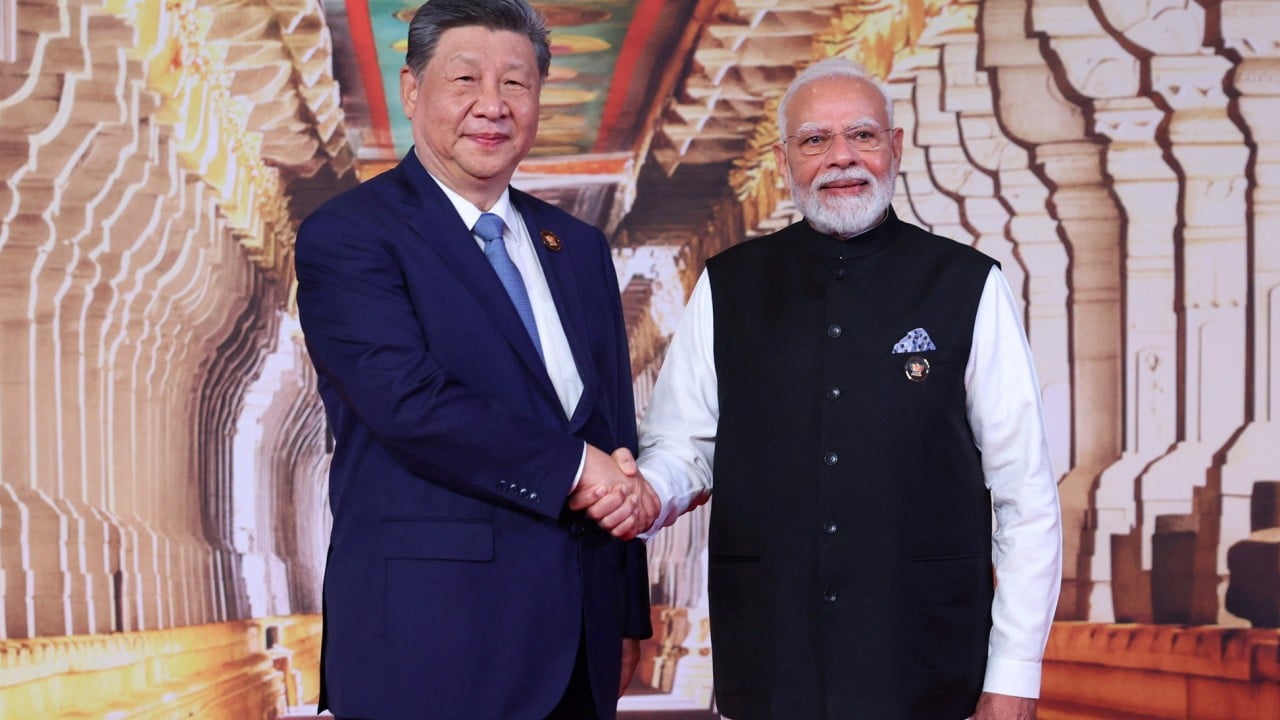
Modi tells Xi India is 'independent' of US influence; leaders pledge border peace in New Delhi
Topic: geopoliticsRegion: AsiaUpdated: i2 outletsSources: 3Spectrum: Center Only⏱ 3 min read⚠ 48h+ old
Story Summary
SITUATION
The Chinese official readout said Narendra Modi told Xi Jinping that India adheres to an "independent foreign policy" and that its ties with China are "not influenced by any third party", implying the United States. The statement followed their Brics summit meeting in New Delhi and both leaders reaffirmed maintaining peace at the disputed border and strengthening economic ties.
Coveragetap to expand ▾Spectrum: Center Only🌍Asia: 2
Political Spectrum
Position is inferred from coverage mix.
i2 outlets · Center
Left
Center
Right
Left: 0
Center: 2
Right: 0
Geography Coverage
Distribution of where coverage is coming from.
i2 unique outlets · Dominant: Asia
KEY FACTS
- Chinese official readout quoted Narendra Modi as saying India adheres to an "independent foreign policy" and that its ties with China are "not influenced by any third party".
- The phrasing in Beijing's statement was an apparent reference to the United States' role in India-China relations.
- The article notes that India’s relations with the United States have frayed over trade and tariffs recently, while strong defence ties between India and the United States still remain.
- After Beijing says PM Reiterated One-China Policy, India says Modi Raised Indian Concerns ‘As Well’ in Meeting With Xi - The Wire India
- After Beijing says PM Reiterated One-China Policy, India says Modi Raised Indian Concerns ‘As Well’ in Meeting With Xi - TheWire.in
- After the meeting, both sides said they would strengthen economic ties.
HISTORICAL CONTEXT
The immediate backdrop is the prolonged India–China border crisis that has produced periodic confrontations since 2020, most prominently the deadly Galwan Valley clash on June 15, 2020, which followed months of face-offs triggered by competing patrols and new infrastructure deployment along the Line of Actual Control.
Those 2020 tensions prompted large-scale troop mobilizations on both sides, repeated military-to-military talks, and a phased, contested disengagement process that included the February 2021 partial pullback at Pangong Tso and further local de‑escalation measures in subsequent bilateral corps‑level talks.
Brief
A Chinese readout of the BRICS sideline meeting says Narendra Modi told Xi Jinping that India follows an "independent foreign policy" and that its ties with China are "not influenced by any third party," language that signals New Delhi’s intent to avoid formal alignment with Washington.
According to the readout, both leaders also reaffirmed their commitment to maintain peace at the disputed India-China border. The Indian prime minister’s phrasing — quoted in the Chinese statement — directly addresses U.S.-India security cooperation without naming Washington, casting the relationship as transactional rather than alliance-driven in public diplomacy.
Beijing’s summary frames the encounter as mutually committted to de-escalation and stronger economic ties; the readout does not cite any specific security guarantees, troop movements, or new mechanisms to manage the Line of Actual Control.
The account comes from China’s official summary of the meeting and does not include a contemporaneous Indian-government readout in the texte provided.
That asymmetry matters because the precise intent and scope of Modi’s remarks — conciliatory reassurance to Beijing versus a public distancing from the United States — will be read differently in New Delhi, Beijing and Washington.
With both leaders stressing border peace at BRICS, the immediate consequence is diplomatic cooling of rhetoric; the readout offers no verification of operational changes on the ground at the disputed border.
Observers who worry about a future India-China border crisis will monitor whether India’s publicly stated "independent" posture translates into limits on U.S. security assistance or operational coordination should a new confrontation occur.
For now, the official Chinese account frames the summit exchange as a bilateral commitment to manage tensions rather than a shift in treaty or alliance structures.
Sources
3 of 3 linked articles
Will ‘transactional’ America assist India in a future border crisis with China?
scmp.comSep 15Center
↗
After Beijing says PM Reiterated One-China Policy, India says Modi Raised Indian Concerns ‘As Well’ in Meeting With Xi
m.thewire.inSep 15Left
↗
After Beijing says PM Reiterated One-China Policy, India says Modi Raised Indian Concerns ‘As Well’ in Meeting With Xi
thewire.inSep 15Left
↗