
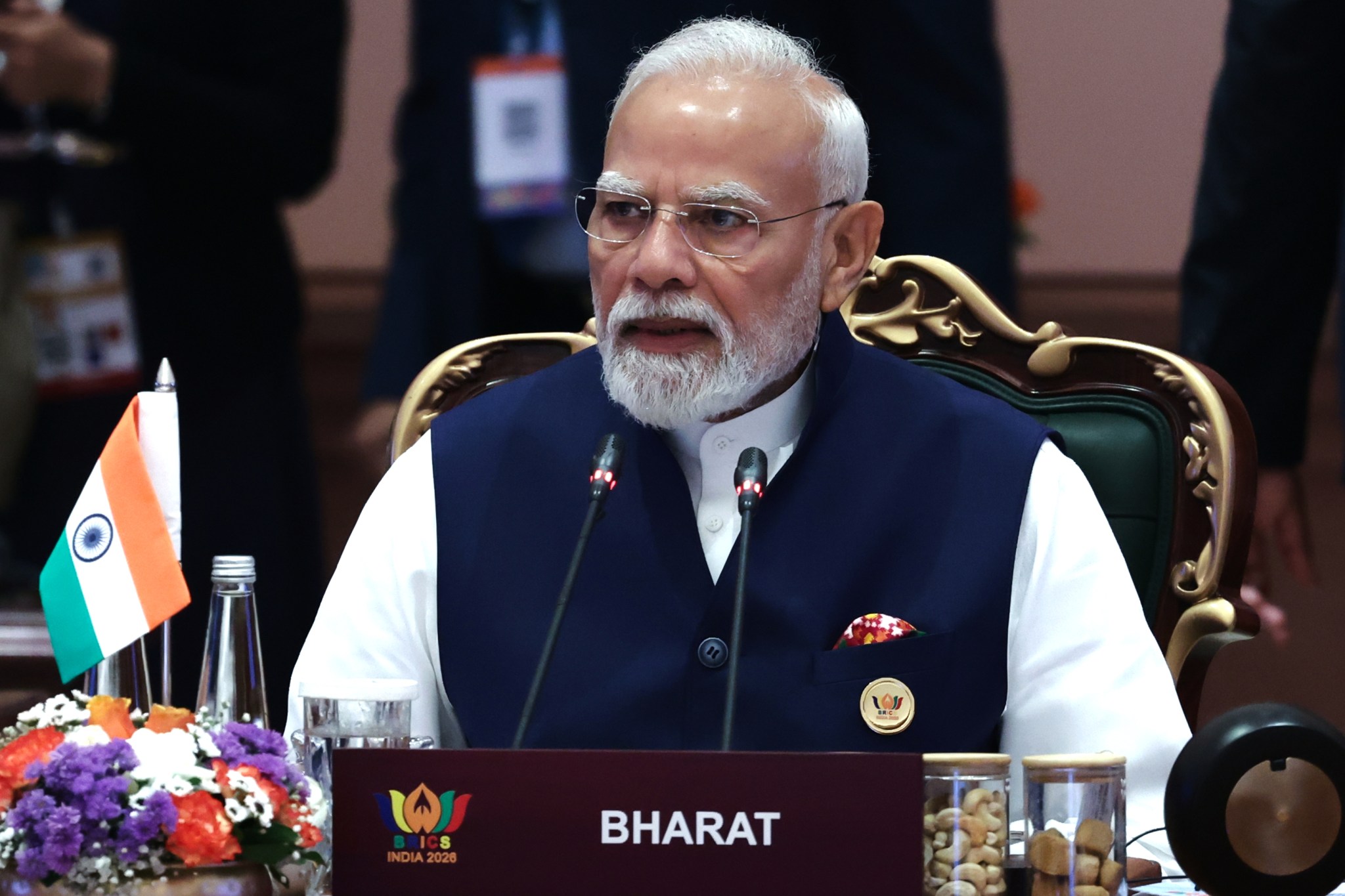
Modi urges BRICS to turn pacts into action, unveils infectious-disease early warning plan
Coveragetap to expand ▾Spectrum: Center Only🌍Other: 2
- Indian Prime Minister Narendra Modi urged BRICS nations to turn their agreements into concrete actions (per Fortune)
- Modi said BRICS agreed to establish an integrated early warning system for infectious diseases (per Fortune)
- Modi called for stronger cooperation across the Global South (per Fortune)
Indian Prime Minister Narendra Modi used his BRICS platform to press the bloc to turn paper agreements into operational programs and announced that BRICS members agreed to create an integrated early warning system for infectious diseases (per Fortune).
Modi said the move responds to what he described as rising geopolitical tensions, supply‑chain disruptions and climate crises that are harming ordinary people, and he urged stronger cooperation across the Global South (per Fortune).
The prime minister presented the early warning system as a collective BRICS project rather than an India-only program, linking it to the group's stated interest in practical cooperation on health security (per Fortune).
Modi framed the timing as necessary because geopolitical and economic stresses — specifically supply‑chain problems and climate impacts — are already affecting livelihoods, and he cast the early-warning pact as a tangible deliverable BRICS can implement to help vulnerable communities (per Fortune).
The source reports Modi’s statements and the BRICS agreement but does not supply operational details such as funding, governance, data‑sharing rules, or a rollout timetable; those details will determine whether the pledge becomes an effective tool for detecting outbreaks or remains declaratory (per Fortune).
Modi also used his remarks to call for deeper cooperation across the Global South, signaling that India wants BRICS to show practical results on issues beyond trade and finance (per Fortune).
- - Residents in low‑income urban and rural communities across BRICS countries who face weak local surveillance bear concrete costs if the system remains declaratory: delayed detection of outbreaks can increase infections and economic loss (per Fortune). - Public health systems in the Global South stand to benefit if the early warning system includes shared surveillance capacities and rapid alerts; Modi and BRICS framing positions member governments as potential beneficiaries (per Fortune). - Supply‑chain dependent workers and small exporters face ongoing disruption tied to the geopolitical and supply‑chain stresses Modi cited; successful early detection could reduce localized shutdowns that harm their livelihoods (per Fortune).
Whether BRICS members publish the governance structure and funding commitments for the integrated early warning system within the next six months (per Fortune). 2) Whether BRICS agrees specific technical standards or a secretariat to operate the early warning system at an upcoming BRICS meeting (per Fortune). 3) Whether India or another BRICS government proposes concrete data‑sharing protocols or pilot projects for the system by the end of the year (per Fortune).
- Only Fortune is in this pack; it frames Modi’s announcement as a BRICS agreement to build an integrated early warning system and emphasizes geopolitical and supply‑chain drivers (per Fortune)
- No source in this pack disputes any fact; operational details and timelines for the early warning system remain unclear (per Fortune)
- No source in this pack provided the system’s funding sources, governance arrangements, data‑sharing or privacy protocols — all are necessary to evaluate feasibility (per Fortune).
- No source in this pack named which BRICS governments will host or run the system, or whether non‑BRICS Global South partners will participate (per Fortune).
- No source in this pack described how the system would integrate with WHO or existing national surveillance networks (per Fortune).
- No source in this pack provided estimated costs or technical partners (per Fortune).
- No differing figures provided in the lone source (per Fortune)
- Fortune records Modi linking the early warning system push to rising geopolitical tensions, supply‑chain disruptions and climate crises as the motivating factors (per Fortune)
- Fortune attributes the announcement and the characterization of drivers directly to Narendra Modi (per Fortune)