
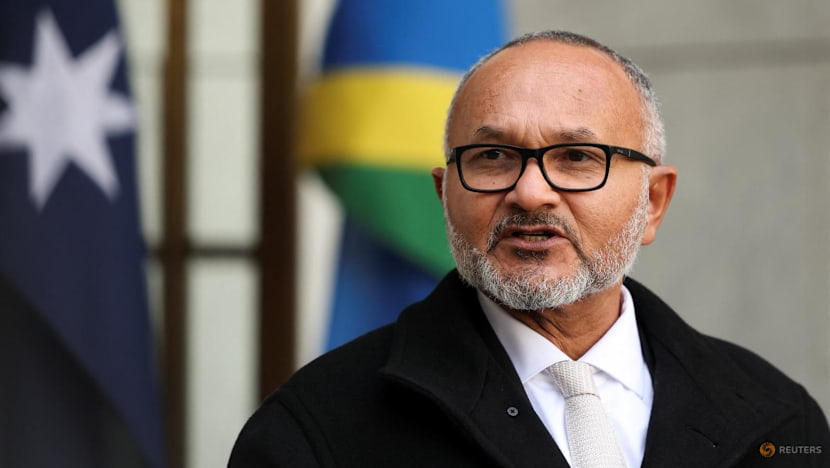
Albanese launches bid for ambitious Solomon Islands treaty to counter China
Coveragetap to expand ▾Spectrum: Mostly Center🌍Asia: 4
- Mr Wale has confirmed his government will review a security pact signed with China in 2022.
- The new Solomon Islands prime minister, Matthew Wale, says he wants to "reset" the relationship with Australia.
- Matthew Wale declared he wanted to "reset" the relationship with Australia after sitting down for talks with Prime Minister Anthony Albanese in parliament house.
- Solomon Islands had been on the front line of strategic competition between Australia and China in the Pacific ever since it signed a sweeping pact with China in 2022.
- Australia and the Solomons have had a bilateral security agreement in place since 2017, but officials believe there is scope for a more ambitious and significant pact following Wale’s election.
- Albanese and Wale are also expected to sign a memorandum of understanding to implement a $190 million Australian funding package to expand and train the Royal Solomon Islands Police Force.
- A new treaty with the Solomons would add to agreements the Albanese government has struck with Tuvalu, Nauru and Papua New Guinea to cement Australia as the security partner of choice in the Pacific.
Matthew Wale, the newly elected Prime Minister of the Solomon Islands, has confirmed that his government will review a security pact signed with China in 2022. This announcement comes as Wale seeks to reset relations with Australia, following discussions with Prime Minister Anthony Albanese.
The Solomon Islands has been at the center of strategic competition between Australia and China, particularly since the signing of the controversial security agreement with China, which has raised concerns about Beijing's influence in the Pacific region.
In response to Wale's election, Albanese is launching talks for a new treaty that aims to strengthen bilateral ties and enhance security cooperation. This treaty could potentially expand upon the existing security agreement established in 2017, with both leaders indicating a commitment to a more ambitious partnership.
Additionally, they are expected to sign a memorandum of understanding to implement a $190 million funding package aimed at bolstering the Royal Solomon Islands Police Force. This funding is intended to support the establishment of a new police training center in Honiara, although progress on previous agreements has been slow.
The developments signal a significant shift in the Solomon Islands' foreign policy direction, moving away from reliance on China and towards closer ties with Australia.