
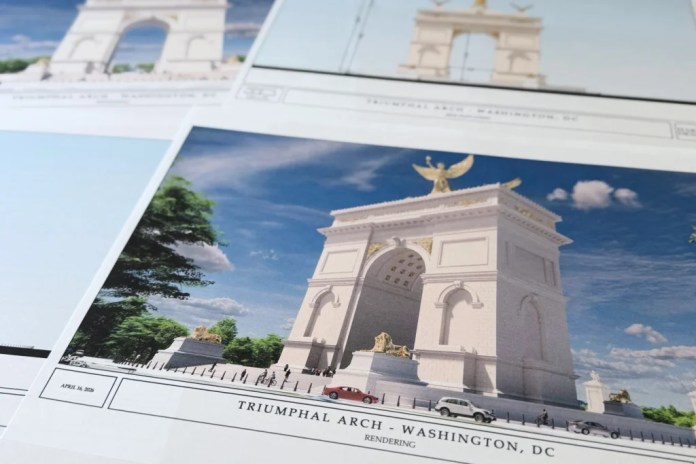
National Park Service: Trump’s planned 250-foot arch would cause unavoidable harm to D.C. historic sites
Topic: generalRegion: North AmericaUpdated: i2 outletsSources: 5⚠ Bias gap — sources divergeSpectrum: Mostly Center⏱ 2 min read⚠ 48h+ old
Story Summary
SITUATION
The National Park Service concluded President Donald Trump’s planned 250-foot triumphal arch would cause unavoidable “adverse effects” on historic sites around the nation’s capital (per WashingtonExaminer). The NPS sent a memorandum of agreement to historic preservation groups proposing mitigation measures and asking agencies to sign by Monday (per WashingtonExaminer).
Coveragetap to expand ▾Spectrum: Mostly Center🌍US: 2
Political Spectrum
Position is inferred from coverage mix.
i2 outlets · Center
Left
Center
Right
Left: 0
Center: 1
Right: 1
Geography Coverage
Distribution of where coverage is coming from.
i2 unique outlets · Dominant: US/Canada
KEY FACTS
- The National Park Service concluded President Donald Trump’s planned 250-foot triumphal arch would cause unavoidable “adverse effects” on historic sites around the nation’s capital (per WashingtonExaminer).
- The project is described in the source as a ‘triumphal arch’ planned by President Donald Trump (per WashingtonExaminer).
HISTORICAL CONTEXT
The immediate backdrop is the broader geopolitical crisis that has dominated U.S. government attention since March 2026, when the United States and Israel launched coordinated strikes on Iranian infrastructure and the conflict that followed produced sustained regional security demands.
Domestically, federal review of monuments is governed by the National Historic Preservation Act of 1966, which instituted the Section 106 consultation process and the Advisory Council on Historic Preservation.
Brief
The National Park Service concluded that President Donald Trump’s plan for a 250-foot triumphal arch would cause unavoidable “adverse effects” on historic sites around the nation’s capital and has moved to formalize mitigation commitments with preservation groups.
In a memorandum of agreement the NPS proposed specific mitigation measures and asked agencies and preservation organizations to sign by Monday, signaling the agency views damage to historic viewsheds and resources as inherent to the project rather than fully preventable (per WashingtonExaminer).
The memo frames the consequences as unavoidable adverse effects, a legal finding that typically requires documented mitigation commitments and can trigger review by preservation authorities; the source says the NPS circulated the draft agreement to historic preservation groups and set a near-term signing deadline (per WashingtonExaminer).
Supporters of the arch — framed in the coverage as tied to President Donald Trump — have argued for the monument as a civic or commemorative project, while preservationists worry a 250-foot arch would alter sightlines and the character of protected sites; the Washington Examiner report emphasizes the NPS’s formal finding and the proposed mitigation language rather than quoting preservation groups’ reactions directly (per WashingtonExaminer).
Why this is happening now: the NPS appears to have completed its formal review and issued the memorandum to move mitigation negotiations forward, imposing a Monday deadline for agency and stakeholder agreement as the legal next step in the review process (per WashingtonExaminer).
The agency’s characterization of effects as “unavoidable” elevates the dispute to a procedural phase where preservation law, mitigation promises and agency signoffs — not only public debate — will determine whether the arch can proceed in its proposed form (per WashingtonExaminer).
Why it matters
- Washington, D.C. historic sites and their preservationists bear the direct cost: the NPS found unavoidable adverse effects on viewsheds and protected resources (per WashingtonExaminer).
- The mechanism of harm is alteration of sightlines and character of protected historic areas caused by a 250-foot structure; the NPS required mitigation commitments to address legally recognized damage (per WashingtonExaminer).
- President Donald Trump and project backers benefit if the memorandum is signed because agency signoffs and mitigation agreements would clear procedural obstacles to proceeding with the arch (per WashingtonExaminer).
What to watch next
- Whether signatories — federal agencies and historic preservation groups named in the memorandum — sign the NPS memorandum of agreement by Monday (per WashingtonExaminer).
- Whether the memorandum’s proposed mitigation measures are accepted, amended, or rejected in follow-up agency or preservation-group meetings (per WashingtonExaminer).
- Whether preservation authorities use the NPS finding of unavoidable adverse effects to trigger additional legal review or conditions on the arch project (per WashingtonExaminer).
Where sources differ
7 dimensionsBias gap0.50 / 2.0
Left- and right-leaning outlets are covering this story differently — in which facts to emphasize, which context to include, and how to frame causes and consequences.
Center (4)
washingtonpost.comnytimes.comwral.comseattletimes.com
Right-leaning (1)
washington_examiner+0.70
The National Park Service concluded President Donald Trump’s planned 250-foot triumphal arch would cause unavoidable “adverse effects” on historic sites around the nation’s capital…
7 specific areas where coverage diverges — see below.
Framing differences
?- Only one source is provided: WashingtonExaminer frames the story around the NPS legal finding and the memorandum proposing mitigation measures; no other outlet framing is available to compare.
Disputed or unclear
?- No source disputes the NPS finding in this pack; broader claims about public support, political intent, or efficacy of proposed mitigations remain unreported in the provided source.
Omitted context
?- No source in this pack names which specific historic sites or viewsheds would be affected by the arch.
- No source in this pack lists the text of the proposed mitigation measures or who drafted them.
- No source in this pack reports which federal agencies or preservation groups received the memorandum or who would be asked to sign.
- No source in this pack provides public-opinion data, legal timelines, or likely judicial avenues if signatories refuse to sign.
Conflicting figures
?- Only one numeric figure appears across sources: the arch height, stated as 250 feet (per WashingtonExaminer).
Disputed causality
?- The NPS concluded the arch would cause unavoidable adverse effects and then circulated a memorandum proposing mitigation measures; the source links the finding to the memo but does not document prior triggering administrative steps beyond the review (per WashingtonExaminer).
Attribution disputes
?- The WashingtonExaminer attributes the conclusion and the memorandum to the National Park Service and names President Donald Trump as the planner of the arch (per WashingtonExaminer).
Sources
5 of 5 linked articles
Park Service quietly awards contracts to work on Trump’s takeover of East Potomac golf course
washingtonpost.comSep 16Left
↗
Park Service Steamrolls Through Review of Trump’s Arch
nytimes.comSep 16Left
↗
Park Service quietly awards contracts to work on Trump’s takeover of East Potomac golf course
wral.comSep 16Left
↗
Park Service quietly awards contracts to work on Trump’s takeover of East Potomac golf course
seattletimes.comSep 16Left
↗
National Park Service offers plan to mitigate ‘adverse effects’ of Trump arch
washingtonexaminer.comSep 16Center
↗