
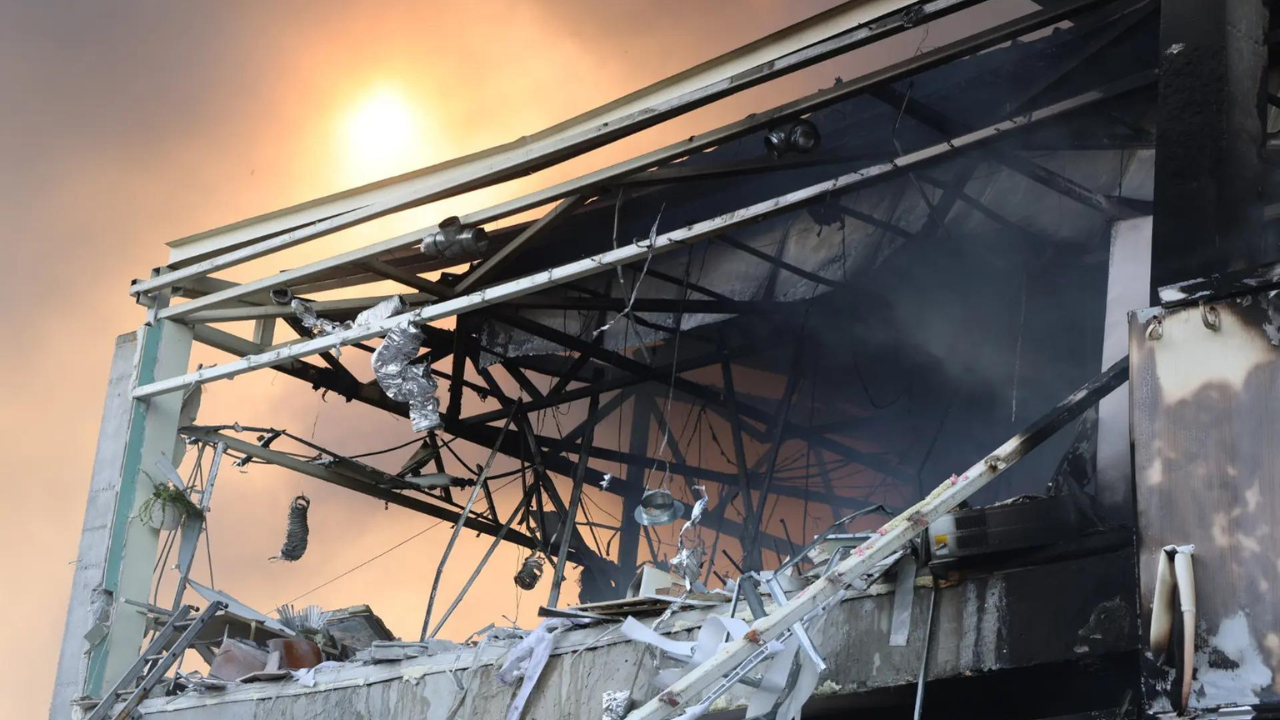
Russian missile and drone strikes kill four in Kyiv amid ongoing conflict
Topic: defense & securityRegion: EuropeUpdated: i5 outletsSources: 18⚠ Bias gap — sources divergeSpectrum: Mostly Center⏱ 4 min read📡 Wire pickup⚠ 3d+ old
Casualties — Confirmed Figures
(Casualty figures may vary as reports continue to emerge.)Russia4 killed · 60 injured(Ukrainian authorities)
Story Summary
SITUATION
Russian missile and drone strikes killed at least four people in Kyiv and the surrounding region, following a barrage that began just after 1am on May 9, 2026. Ukrainian authorities reported that over 60 people were wounded and significant damage occurred across 40 locations (per aljazeera.com).
Coveragetap to expand ▾Spectrum: Mostly Center🌍ME: 4 · Asia: 4 · Other: 4 · US: 1 · Europe: 1
Political Spectrum
Position is inferred from coverage mix.
i5 outlets · Center
Left
Center
Right
Left: 3
Center: 10
Right: 1
Geography Coverage
Distribution of where coverage is coming from.
i5 unique outlets · Dominant: Middle East
KEY FACTS
- Russian attacks on Kyiv killed at least four people and wounded more than 60 (per aljazeera.com).
- The barrage began just after 1am on May 9, 2026, following warnings from Ukraine’s air force about potential missile strikes (per aljazeera.com).
- This incident occurred amid ongoing hostilities despite a three-day ceasefire announced by US President Donald Trump on May 8, 2026 (per jpost.com).
- Ukrainian President Volodymyr Zelensky condemned the strikes, asserting that ground assaults continued despite the ceasefire (per jpost.com).
- Russia's Defense Ministry claimed that Ukraine violated the ceasefire by downing 57 Russian drones during the same period (per jpost.com).
- The recent attacks are part of one of the longest barrages in four years of conflict, according to reports (per timesofindia.indiatimes.com).
HISTORICAL CONTEXT
The recent Russian drone barrage that killed six people in Ukraine on May 9, 2026, is a stark reminder of the ongoing conflict that has its roots in the geopolitical upheavals following the dissolution of the Soviet Union.
The immediate backdrop to this tragic event is the persistent war between Russia and Ukraine, which escalated dramatically in February 2022 when Russia launched a full-scale invasion of Ukraine.
Brief
On May 9, 2026, Russian missile and drone strikes targeted Kyiv, resulting in the deaths of at least four individuals and injuries to over 60 others. The barrage, which began shortly after 1am, involved a significant deployment of military assets, including 600 drones and 90 missiles, marking one of the longest sustained attacks in the ongoing conflict.
Ukrainian President Volodymyr Zelensky condemned the strikes, emphasizing that they occurred despite a recently announced three-day ceasefire by US President Donald Trump, which was intended to reduce hostilities. Zelensky noted that while large-scale aerial attacks had diminished, ground assaults persisted, with over 200 clashes reported since the ceasefire was declared.
In a counter-claim, Russia's Defense Ministry accused Ukraine of violating the ceasefire by downing 57 Russian drones, illustrating the complex and contentious dynamics on the battlefield. The situation remains tense as both sides continue to engage in military operations, with the potential for further escalations in the conflict.
This latest round of violence underscores the ongoing volatility in the region, as both military actions and diplomatic efforts struggle to find a resolution.
Why it matters
- Kyiv residents face immediate danger from ongoing Russian strikes, with at least four killed and over 60 injured due to the recent attacks (per aljazeera.com).
- The conflict continues to disrupt civilian life in Ukraine, with significant damage reported across 40 locations in Kyiv (per aljazeera.com).
- The ceasefire announced by President Trump has not led to a reduction in ground assaults, indicating a failure of diplomatic efforts to stabilize the situation (per jpost.com).
- Russia's military actions, including the use of hypersonic missiles, demonstrate an escalation in their offensive capabilities, posing a greater threat to Ukrainian defenses (per aljazeera.com).
What to watch next
- Whether Russian forces continue their missile and drone attacks in Kyiv following the recent strikes.
- The response from Ukrainian forces and any potential military actions they may take in retaliation.
- Any statements or actions from President Trump regarding the effectiveness of the ceasefire announced on May 8, 2026.
Where sources differ
7 dimensionsBias gap0.95 / 2.0
Left- and right-leaning outlets are covering this story differently — in which facts to emphasize, which context to include, and how to frame causes and consequences.
Left-leaning (3)
scmp_world-0.80
Ukraine reports multiple casualties despite Trump-backed truce with Russia Ukraine reports multiple casualties despite Trump-backed truce with Russia Russian attacks wounded at lea…
aljazeera_en-0.20
Russian attacks on Ukraine’s Kyiv kill at least four people Russian attacks on Ukraine’s Kyiv kill at least four people. Two people are killed in the capital itself and two in the …
kyivindependent.com-0.20
Russia launches over 800 drones in daytime mass attack on Ukraine, at least 6 killed - The Kyiv Independent
Center (10)
i24news.tvaljazeera.commsn.comtimes_of_indiachannelnewsasia.comreuters.comyahoo.comminutemirror.com.pken.vijesti.memsn.com
Right-leaning (1)
jerusalem_post+0.75
Putin’s peace rhetoric clashes with Russia’s battlefield actions in Ukraine - analysis Putin’s peace rhetoric clashes with Russia’s battlefield actions in Ukraine - analysis Putin’…
7 specific areas where coverage diverges — see below.
Framing differences
?- Al Jazeera emphasizes the scale of the attack and the number of casualties, while JPost focuses on the ceasefire's failure and ongoing ground assaults.
Disputed or unclear
?- The exact number of casualties reported varies, with some sources stating four killed while others mention six in broader contexts.
Omitted context
?- No source mentions the specific military strategies or objectives behind Russia's use of hypersonic missiles in this attack.
Conflicting figures
?- Al Jazeera reports four fatalities, while other sources suggest six fatalities in related attacks, indicating discrepancies in casualty figures.
Disputed causality
?- Sources differ on the implications of the ceasefire, with some attributing continued violence to Ukraine's actions and others to Russia's military strategy.
Attribution disputes
?- Al Jazeera attributes the missile strikes directly to Russian forces, while JPost highlights accusations of ceasefire violations by both sides.
Sources
14 of 14 linked articles
Russian attacks on Ukraine’s Kyiv kill at least four people
aljazeera.comMay 24Center
↗
Putin’s peace rhetoric clashes with Russia’s battlefield actions in Ukraine - analysis
jpost.comMay 15Right
↗
Russia Kills Dozens In Largest Two-day Aerial Assault On Kyiv - i24NEWS
i24news.tvMay 15Left
↗
Russia launches hundreds more drones at Ukraine, killing 10 people
aljazeera.comMay 14Left
↗
Russia launches massive two-day aerial assault on Ukraine
msn.comMay 14Left
↗
‘One of the longest barrages in four years’: Russia launches massive missile and drone attack on Kyiv
timesofindia.indiatimes.comMay 14Left
↗