
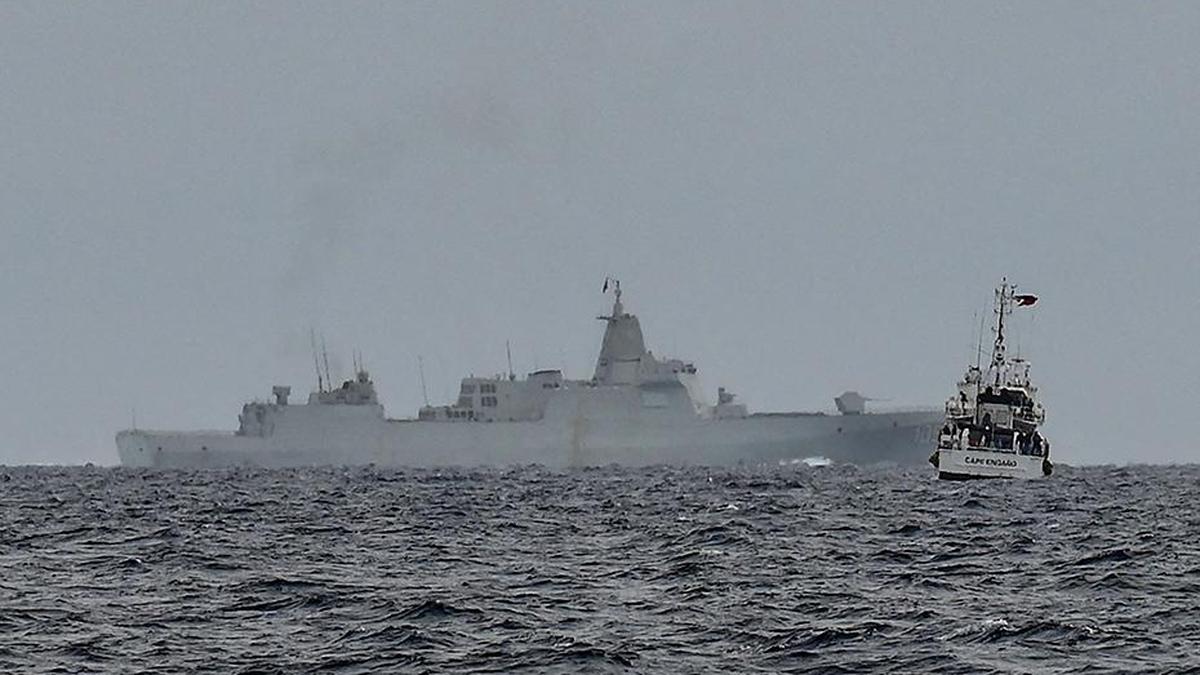
Philippines Confronts Chinese Ship Over Unauthorized South China Sea Activity
Coveragetap to expand ▾Spectrum: Center Only🌍Asia: 2 · Other: 1
- The Philippines warned a Chinese research ship for unauthorized operations in the South China Sea (per Malay Mail).
- The disputed area is a significant point of contention between China and several Southeast Asian nations (per Malay Mail).
- The South China Sea is a strategic maritime region with rich resources and crucial shipping lanes (per Malay Mail).
- China claims nearly the entire South China Sea, which is contested by the Philippines, Vietnam, Malaysia, Brunei, and Taiwan (per Malay Mail).
- The Philippines has previously accused China of violating its maritime rights in the region (per Malay Mail).
The South China Sea is a vital maritime area, rich in natural resources and home to some of the world's busiest shipping lanes. China asserts sovereignty over nearly the entire sea, a claim that overlaps with the territorial waters of the Philippines, Vietnam, Malaysia, Brunei, and Taiwan. These overlapping claims have led to frequent diplomatic and military tensions.
The Philippines' warning to the Chinese ship reflects Manila's ongoing efforts to assert its maritime rights and challenge China's activities in the region. The Philippine government has repeatedly accused China of violating its sovereignty and maritime rights, citing instances of Chinese vessels operating within its exclusive economic zone without permission.
This incident comes amid broader geopolitical tensions in the South China Sea, where the strategic interests of regional and global powers intersect. The United States, for instance, has conducted freedom of navigation operations in the area to challenge China's claims and support the rights of other nations to access these international waters.
The South China Sea disputes are not only about territorial sovereignty but also involve significant economic interests. The region is believed to contain vast reserves of oil and natural gas, making it a highly coveted area for resource exploration and extraction.
As the Philippines continues to confront China's maritime activities, the situation in the South China Sea remains a flashpoint for potential conflict. many governments closely watches these developments, given their implications for regional stability and global trade.
The Philippines' latest action underscores the persistent challenges in resolving the South China Sea disputes, as diplomatic efforts have so far failed to produce a lasting solution. The ongoing tensions highlight the need for continued dialogue and cooperation among the involved parties to prevent escalation and ensure peace in the region.
- The Philippines' warning to the Chinese ship underscores the ongoing risk of maritime conflict, directly affecting regional security and the livelihoods of Southeast Asian coastal communities reliant on the South China Sea's resources.
- China benefits from asserting its territorial claims, which could enhance its control over the South China Sea's strategic and resource-rich waters, impacting regional power dynamics.
- The incident highlights the geopolitical stakes for global powers like the United States, which has strategic interests in maintaining freedom of navigation and supporting allies in the region.
- Whether the Philippines escalates its diplomatic response to China's maritime activities.
- Potential increased military presence by the United States in support of freedom of navigation operations.
- Any formal diplomatic engagements or negotiations between China and Southeast Asian nations regarding the South China Sea.
- No source mentions the specific prior actions by China that led to the Philippines' warning.
- The economic impact on local fishing communities in the Philippines due to Chinese activities is not detailed.
- The role of international legal rulings, such as the 2016 Hague tribunal decision, is not mentioned.