
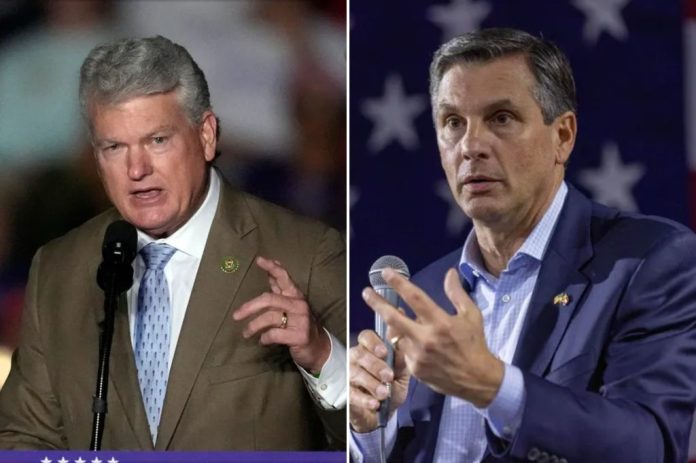
Candidates Struggle for Support as Trump Remains Silent on Georgia Senate Primary
Topic: politicsRegion: North AmericaUpdated: i3 outletsSources: 19⚠ Bias gap — sources divergeSpectrum: Mostly CenterFiltered: Global (0/15)· Clear⏱ 4 min read⚠ 3d+ old
Story Summary
SITUATION
The Georgia GOP Senate primary is heading to a runoff between Mike Collins and Derek Dooley, with Trump remaining silent on endorsements. This absence of guidance from Trump, a significant figure in GOP primaries, has left voters uncertain about their choices (per Washington Examiner).
Coveragetap to expand ▾Spectrum: Mostly Center🌍US: 8 · Other: 7
Political Spectrum
Position is inferred from coverage mix.
i3 outlets · Center
Left
Center
Right
Left: 1
Center: 11
Right: 3
Geography Coverage
Distribution of where coverage is coming from.
i3 unique outlets · Dominant: US/Canada
KEY FACTS
- The Georgia Senate GOP primary is heading to a runoff between Mike Collins and Derek Dooley (per Washington Examiner).
- Donald Trump has not endorsed any candidate in the Georgia Senate primary, which is unusual given his past involvement in state races (per Washington Examiner).
- Trump endorsed candidates in the state’s gubernatorial primary and has previously backed Senate candidates, raising questions about his current strategy (per Washington Examiner).
- Polling indicates Mike Collins is leading the GOP primary, while Derek Dooley has surpassed other candidates (per Fox News).
- Republican voters in Georgia are looking for clear guidance from Trump on where to place their ballots (per Washington Examiner).
- The runoff is set against a backdrop of heightened competition among candidates to unseat incumbent Senator Jon Ossoff (per Fox News).
- The lack of a Trump endorsement is seen as a significant factor affecting the dynamics of the primary race (per Washington Examiner).
HISTORICAL CONTEXT
The Georgia GOP Senate primary of 2026 is unfolding in a unique political environment shaped by the notable absence of an endorsement from former President Donald Trump.
This silence is particularly striking given Trump's historical influence over Republican primaries, especially in Georgia, where his endorsements have previously played a critical role in shaping electoral outcomes. To fully grasp the implications of this development, it is essential to explore the recent history of Georgia's political landscape and Trump's involvement in it.
Brief
The Georgia Senate GOP primary is intensifying as candidates Mike Collins and Derek Dooley prepare for a runoff, with Donald Trump's silence on the race leaving many Republican voters uncertain about their choices.
Trump's historical role as a kingmaker in GOP primaries has made his lack of endorsement particularly notable, especially since he has previously engaged actively in similar races within the state. Collins is currently leading in polls, but Dooley's recent surge indicates a competitive landscape as both candidates vie for the support of the MAGA base.
The absence of Trump's guidance has created a vacuum, prompting candidates to scramble for endorsements and consolidate their voter bases ahead of the runoff. This situation reflects broader tensions within the party as candidates navigate the complexities of aligning with Trump's brand while also appealing to a diverse electorate.
As the runoff approaches, the candidates will need to articulate clear platforms to attract undecided voters and those who may feel disconnected due to Trump's silence.
The outcome of this primary could significantly impact the Republican strategy in the upcoming general election against incumbent Senator Jon Ossoff, making it crucial for both Collins and Dooley to secure a strong foothold among Georgia Republicans.
Why it matters
- Republican candidates Mike Collins and Derek Dooley face pressure to secure voter support without Trump's endorsement, impacting their campaign strategies.
- The lack of clear guidance from Trump may lead to voter fragmentation among the GOP base, complicating efforts to unify support ahead of the runoff.
- The outcome of the primary could determine the Republican Party's chances of unseating incumbent Senator Jon Ossoff, affecting future legislative agendas.
What to watch next
- Whether Donald Trump decides to endorse a candidate before the runoff on May 19.
- The results of the runoff election between Mike Collins and Derek Dooley on May 19.
- Any shifts in polling data leading up to the runoff that may indicate changing voter sentiments.
Where sources differ
1 dimensionBias gap1.35 / 2.0
Left- and right-leaning outlets are covering this story differently — in which facts to emphasize, which context to include, and how to frame causes and consequences.
Left-leaning (1)
washingtonpost.com-0.35
Georgia Senate GOP primary heads to runoff where electability is a top issue - The Washington Post
Center (11)
wabe.orgajc.comnytimes.comgeorgiarecorder.compolitico_newsnewschannel9.comcbsnews.comnewsnationnow.comwjcl.comfox5atlanta.comnytimes.com
Right-leaning (3)
breitbart.com+1.00
Poll: Mike Collins Leads Georgia GOP Senate Primary, Dooley Surpasses Carter Poll: Mike Collins Leads Georgia GOP Senate Primary, Dooley Surpasses Carter Poll: Mike Collins Leads G…
foxnews.com+0.80
Georgia GOP Senate primary heads to runoff as Republicans battle to unseat Ossoff Georgia GOP Senate primary heads to runoff as Republicans battle to unseat Ossoff - Fox News
washington_examiner+0.70
Georgia GOP Senate primary heads to runoff between Mike Collins and Derek Dooley. Reporting is limited at this stage.
1 specific area where coverage diverges — see below.
Framing differences
?- The Washington Post emphasizes the issue of electability in the runoff, while Fox News focuses on the competition between Collins and Dooley.
Sources
0 of 15 linked articles · Filter: Global