
Radar-confusing chaff may also have been released alongside the flares.
Coveragetap to expand ▾Spectrum: Center Only🌍Asia: 1
- This was similar to a video released in 2023, which had offered a rare visual confirmation of its countermeasure capability that had been immensely discussed in Ukrainian and Western reports.
- Analysts suggested these may have been spectral flares, where the primary heat plume is invisible to the naked eye, or smaller flares with shorter burn durations.
- Chaff generally consists of thin metallic strips, metalised paper, or fibreglass threads designed to interfere with radar tracking, though its deployment is often difficult to observe from the ground.
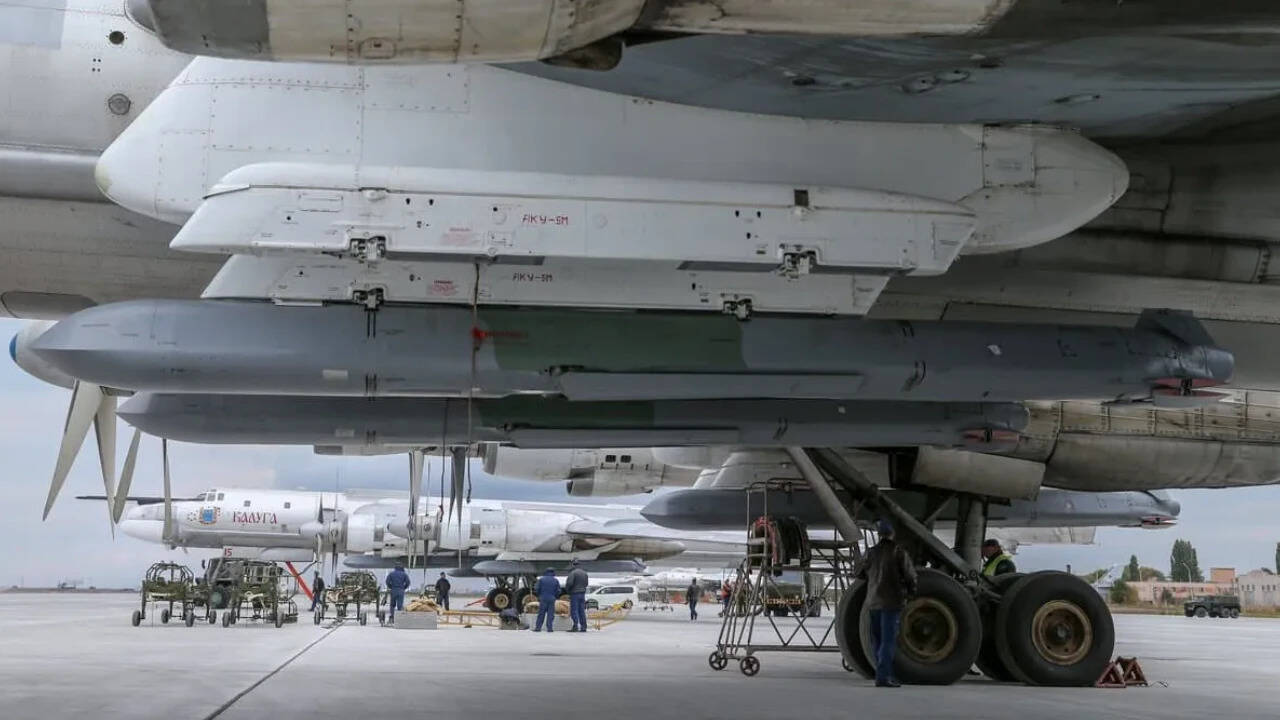
In a recent Russian assault on Ukraine, Kh-101 air-launched cruise missiles were observed deploying radar-confusing chaff alongside decoy flares, a tactic aimed at evading air defense systems. This deployment was captured in footage shared online, which analysts noted as a significant demonstration of the missile's countermeasure capabilities.
The Kh-101 missiles, known for their precision, have been increasingly utilized in the ongoing conflict, reflecting Russia's adaptation to counter Ukrainian air defenses. The use of chaff, which consists of thin metallic strips or metalized paper, is designed to interfere with radar tracking, complicating detection efforts by air defense systems.
Analysts have suggested that the flares released may include spectral types, which are less visible to the naked eye, or smaller flares that burn for shorter durations. This tactic is not new; a similar video from 2023 provided visual confirmation of the Kh-101's countermeasure capabilities, indicating a strategic evolution in Russian military tactics.
As the conflict continues, the effectiveness of these countermeasures will be closely monitored by military analysts and defense experts, particularly in light of Ukraine's ongoing efforts to bolster its air defense capabilities against such sophisticated threats.
- The use of radar-confusing chaff alongside decoy flares in Russia's Kh-101 missile system significantly enhances its ability to evade air defense systems, posing a direct threat to military installations and civilian infrastructure in the Asia Pacific region.
- This advancement could embolden aggressive military postures among regional powers, particularly affecting nations like Ukraine and its allies, who may face increased challenges in countering such sophisticated aerial threats.
- As a result, defense budgets may shift towards advanced countermeasure technologies, diverting resources from other critical areas and potentially escalating arms races in the region.
- Watch for the Russian military to potentially increase the deployment of Kh-101 missiles in upcoming exercises, with a focus on testing new decoy technologies, expected within the next month.
- Monitor the response from Asian Pacific nations, particularly Japan and South Korea, as they may enhance their air defense systems in reaction to the effectiveness of Russian missile tactics, likely within the next quarter.
- Anticipate a statement from NATO regarding joint defense strategies in the Asia Pacific region, which could be released during the upcoming defense ministers' meeting scheduled for next week.
- Keep an eye on developments from the U.S. Department of Defense as they may announce new partnerships or technology transfers aimed at countering missile threats in the region, expected within the next 72 hours.
- Expect China to conduct its own missile tests to demonstrate its capabilities in response to perceived threats from Russian missile technology, likely within the next two weeks.