
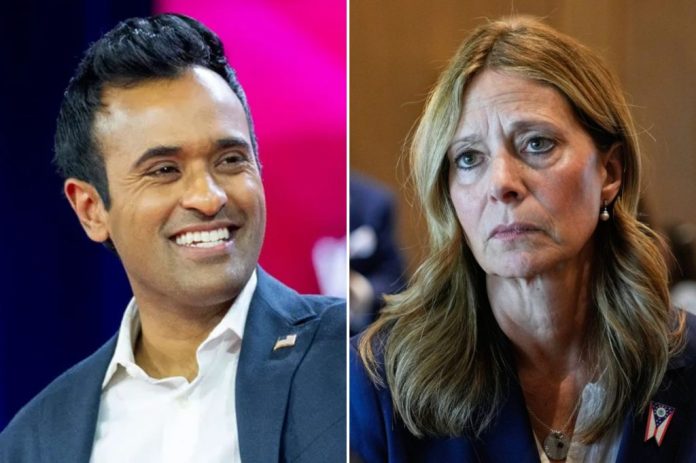
Ramaswamy and Acton Face Off in Ohio Governor's Race Amid Shifting Dynamics
Coveragetap to expand ▾Spectrum: Mixed🌍US: 3 · Other: 1
- Vivek Ramaswamy, a Republican and biotech entrepreneur, is running against Democrat Amy Acton for Ohio governor (per washingtonexaminer.com, washingtontimes.com).
- Amy Acton was unopposed in the Democratic primary, receiving 762,457 votes (per washingtonexaminer.com).
- Ramaswamy's campaign is heavily funded by himself and political action committees, posing a challenge for Acton (per washingtonexaminer.com).
- Every statewide executive office in Ohio is open this year due to term limits, but the governor's race is the primary focus (per washingtontimes.com).
- Ramaswamy has been endorsed by Donald Trump, which could influence voter turnout and support (per washingtontimes.com).
The Ohio gubernatorial race is shaping up to be a significant political contest between Republican Vivek Ramaswamy and Democrat Amy Acton. Ramaswamy, a biotech entrepreneur with a substantial personal fortune, has been endorsed by Donald Trump, adding a national dimension to the state race.
His campaign is characterized by significant self-funding and support from political action committees, which has allowed him to define his candidacy early and launch attacks on Acton. Acton, a former state health director, enters the race with the advantage of having been unopposed in the Democratic primary, securing over 762,000 votes.
Despite this, the structural dynamics of Ohio politics, which have favored Republicans in recent years, present a challenge for her campaign. Political analysts suggest that while the race is competitive, it is tilted in favor of the GOP.
The broader context of the race includes every statewide executive office being open due to term limits, but the governor's race has captured the most attention. This election is seen as a test of whether shifting national dynamics can disrupt the Republican dominance in Ohio.
Ramaswamy's campaign strategy has focused on leveraging his financial resources to gain an early advantage. His ability to self-fund and attract PAC money has been a significant factor in his campaign, allowing him to run extensive advertising campaigns.
Acton, on the other hand, is likely to focus on her public health credentials and her leadership during the COVID-19 pandemic as key aspects of her campaign. Her challenge will be to counter Ramaswamy's financial advantage and to appeal to a broad base of voters in a state that has leaned Republican in recent elections.
As the race progresses, both candidates will need to navigate the complex political landscape of Ohio, where national issues often intersect with local concerns. The outcome of this race could have implications beyond Ohio, potentially signaling shifts in voter sentiment ahead of the 2028 presidential election.
- Ohio voters face a choice between two distinct political visions, with potential impacts on state policies and national political trends.
- Ramaswamy's significant self-funding and PAC support highlight the role of money in politics, potentially influencing the electoral outcome.
- Acton's campaign will test the appeal of public health leadership in a post-pandemic political environment.
- Whether Ramaswamy continues to leverage his financial resources to maintain an advertising advantage.
- Acton's strategy to counter Ramaswamy's financial edge and appeal to a broad voter base.
- The impact of Trump's endorsement on Ramaswamy's campaign and voter turnout.
Left- and right-leaning outlets are covering this story differently — in which facts to emphasize, which context to include, and how to frame causes and consequences.
2 specific areas where coverage diverges — see below.
- Washington Examiner emphasizes Ramaswamy's financial advantage and early campaign definition, while Washington Times highlights Trump's endorsement and its potential impact.
- No source mentions the specific policy platforms of Ramaswamy and Acton, which are crucial for understanding voter decisions.
- The broader national political climate and its influence on Ohio's political dynamics are not detailed.