
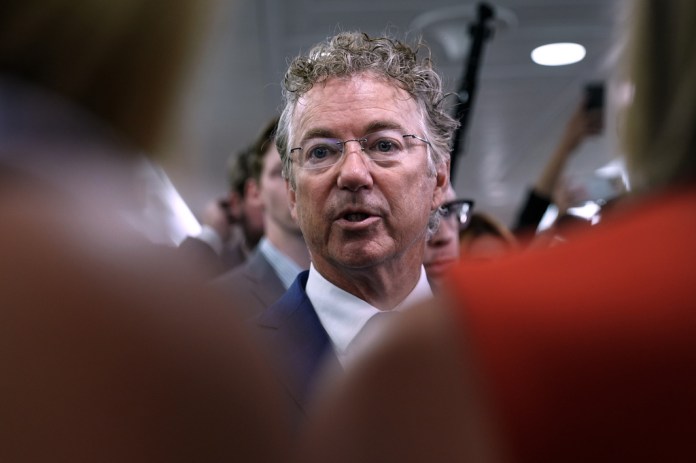
Rand Paul blocks John Kennedy’s AI 'kill switch' bill, killing unanimous-consent push
Topic: technologyRegion: north americaUpdated: i2 outletsSources: 2⚠ Bias gap — sources divergeSpectrum: Mixed⏱ 2 min read
Story Summary
SITUATION
Sen. Rand Paul blocked Sen. John Kennedy's unanimous-consent measure in the Senate that would have required artificial intelligence companies to build a "kill switch" (per Washington Examiner). Sen. Rand Paul said his move could stifle innovation, offering that as his rationale for blocking the measure (per Washington Examiner).
Coveragetap to expand ▾Spectrum: Mixed🌍US: 1 · Other: 1
Political Spectrum
Position is inferred from coverage mix.
i2 outlets · Center
Left
Center
Right
Left: 0
Center: 1
Right: 1
Geography Coverage
Distribution of where coverage is coming from.
i2 unique outlets · Dominant: US/Canada
KEY FACTS
- Sen. Rand Paul blocked Sen. John Kennedy's unanimous-consent measure in the Senate that would have required artificial intelligence companies to build a "kill switch" (per Washington Examiner).
- Sen. Rand Paul said his move could stifle innovation, offering that as his rationale for blocking the measure (per Washington Examiner).
HISTORICAL CONTEXT
An active crisis is the ongoing March 2026 war that began when the United States and Israel launched coordinated strikes on Iranian power plants, air defenses and military infrastructure in March 2026, a campaign that has heightened U.S. political attention to technology risks in wartime.
The structural backdrop includes a patchwork of national and international regulatory efforts that governments accelerated after large commercial AI models became widely used: U.S. federal scrutiny intensified under the Trump administration, which took office on January 20, 2025, and Congress opened repeated inquiries and draft bills through 2025–2026.
Brief
Sen. Rand Paul blocked Sen. John Kennedy's unanimous-consent measure in the Senate that would have required artificial intelligence companies to install a so-called "kill switch," stopping the chamber from advancing the proposal (per Washington Examiner).
The procedural objection from Paul ended the immediate chance to pass Kennedy's measure on the floor and prompted an on-the-record rebuke from Kennedy, who had sought the unanimous-consent shortcut to impose the new requirement (per Washington Examiner).
Paul defended his objection by arguing the mandate risked stifling innovation in the AI industry, framing his move as a protection of technological development rather than opposition to safety measures (per Washington Examiner).
Kennedy, by contrast, framed the proposal as a routine safety step and publicly criticized Paul's tactic after the objection ended the unanimous-consent effort (per Washington Examiner).
The exchange played out as a purely Senate procedural fight: Kennedy pursued unanimous consent to fast-track the rule while Paul used an objection to force further debate or to block the measure’s immediate passage (per Washington Examiner).
At least in the Washington Examiner account, the clash leaves the substantive idea — whether to require AI companies to include a remote "kill switch" — unresolved in the Senate and signals that similar safety proposals will face political pushback on grounds of innovation and regulatory overreach (per Washington Examiner).
Why it matters
- Concrete costs fall on congressional prospects for immediate regulation: Kennedy's safety measure was killed at the floor level, denying pro-regulation lawmakers a quick statutory win (per Washington Examiner).
- AI companies face continued regulatory uncertainty because the Senate did not advance the kill-switch requirement, leaving firms without a new federal mandate and preserving current voluntary or market-driven approaches (per Washington Examiner).
- Senators who prioritize rapid tech oversight lose momentum when a single senator blocks unanimous consent; that procedural power benefits individual senators like Rand Paul who seek to shape outcomes (per Washington Examiner).
What to watch next
- Whether Sen. John Kennedy reintroduces the kill-switch language as standalone legislation or attaches it to larger tech or safety bills in the coming Senate session.
- Whether Sen. Rand Paul sustains his opposition in future procedural votes or negotiates changes to the measure to address his innovation concerns.
- Any formal floor vote on AI safety provisions in the Senate calendar this term that would force members to record positions on kill-switch mandates.
Where sources differ
7 dimensionsBias gap0.50 / 2.0
Left- and right-leaning outlets are covering this story differently — in which facts to emphasize, which context to include, and how to frame causes and consequences.
Center (1)
tech-insider.org
Right-leaning (1)
washington_examiner+0.70
Sen. Rand Paul blocked Sen. John Kennedy's unanimous-consent measure on September 16, 2026 that would have required artificial intelligence companies to build a "kill switch", kill…
7 specific areas where coverage diverges — see below.
Framing differences
?- Only the Washington Examiner is in this pack; it frames the action as Paul blocking Kennedy's unanimous-consent measure and highlights Paul's innovation argument (per Washington Examiner).
Disputed or unclear
?- No source in this pack disputes the basic sequence of events; the single-source account leaves unclear whether Kennedy planned other paths to advance the proposal after the objection (per Washington Examiner).
Omitted context
?- No source mentions prior hearings, industry lobbying, campaign contributions from AI firms, or specific technical standards for a "kill switch," all of which would help readers evaluate the proposal's feasibility and political prospects.
- No source provides data on AI-related incidents that might have motivated the bill, or any existing regulatory frameworks at federal agencies that touch on AI safety.
- No source discusses potential enforcement mechanisms, penalties, or which federal agency would oversee a mandated kill switch.
Conflicting figures
?- Only a single date is given for the Senate action: September 16, 2026 (per Washington Examiner).
Disputed causality
?- The Washington Examiner reports Paul objected and that objection prevented the unanimous-consent passage; it does not report any prior action by Kennedy beyond filing the measure that triggered Paul's objection (per Washington Examiner).
Attribution disputes
?- The Washington Examiner attributes the blocking action to Sen. Rand Paul and the rebuke to Sen. John Kennedy, and it attributes Paul's rationale to his warning that the requirement could stifle innovation (per Washington Examiner).
Sources
2 of 2 linked articles