
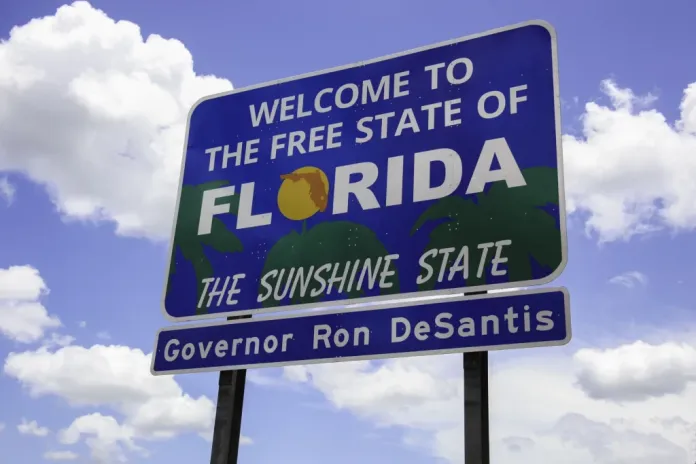
Florida was the top stated destination for released migrants, Border Patrol data show
Topic: healthRegion: north americaUpdated: i1 outletsSources: 1Spectrum: Right Only⏱ 3 min read
Story Summary
SITUATION
A Washington Examiner analysis found that migrants released after illegal entry most often told Border Patrol they planned to settle in Florida. The dataset covers Border Patrol apprehensions from October 2018 through July 2025 and shows 4.5 million non-U.S.
Coveragetap to expand ▾Spectrum: Right Only🌍US: 1
Political Spectrum
Position is inferred from coverage mix.
i1 outlets · Right
Left
Center
Right
Left: 0
Center: 0
Right: 1
Geography Coverage
Distribution of where coverage is coming from.
i1 unique outlets · Dominant: US/Canada
KEY FACTS
- Border Patrol apprehended 4.5 million non-U.S. citizens who were permitted to remain in the United States temporarily through court proceedings from October 2018 through July 2025 (per Washington Examiner).
- A Washington Examiner report identified Florida as the top stated destination that immigrants released from the U.S.-Mexico border told federal law enforcement they planned to settle in (per Washington Examiner).
HISTORICAL CONTEXT
The immediate backdrop is the broader national security crisis of 2026: in March 2026 the United States and Israel launched coordinated strikes against Iranian infrastructure, initiating an ongoing exchange of military and diplomatic actions that has diverted federal attention and resources to international security and contingency planning.
Domestically, migration enforcement has long been shaped by a framework of statutes and settlements: the Immigration and Nationality Act (1952, revised repeatedly), the Illegal Immigration Reform and Immigrant Responsibility Act (IIRIRA) of April 1, 1996, and the Flores Settlement Agreement of 1997, which together constrain detention, removal, and treatment of asylum seekers.
Brief
A Washington Examiner analysis of Border Patrol data shows Florida was the most frequently named destination by migrants released after illegal entry.
The Examiner says the underlying dataset covers Border Patrol apprehensions from October 2018 through July 2025 and records 4.5 million non-U.S. citizens who were permitted to remain temporarily in the United States through court proceedings (per Washington Examiner).
The piece frames Florida’s prominence in the data as a concrete indicator of where released migrants report plans to settle, citing the agency’s encounter records as the basis for that conclusion (per Washington Examiner). The report covers the period that includes most of President Joseph R.
Biden Jr.’s administration and treats the 4.5 million figure as the total number of noncitizens apprehended and released into the U.S. immigration process during that window (per Washington Examiner).
The Examiner’s write-up does not appear, in the excerpt provided, to include breakdowns by county, by migrant nationality, or by the outcomes of subsequent court proceedings; it emphasizes the stated destination field in Border Patrol records as the metric of interest (per Washington Examiner).
Observers drawing different policy lessons could point to the concentration of stated destinations to argue for state-level resource planning or for stricter federal enforcement, but the available reporting here focuses strictly on the data point that Florida led all states as the most common named destination among released migrants (per Washington Examiner).
The Washington Examiner published this data-based report on September 17, 2026 and frames its finding as part of a larger scrutiny of migration flows and enforcement outcomes during the covered period (per Washington Examiner).
Why it matters
- Florida residents and state agencies bear concrete costs: state-level services (housing, education, health) may see increased demand tied to migrants who reported settling there, based on the dataset showing Florida as the top stated destination (per Washington Examiner).
- Federal immigration courts and Border Patrol bear administrative costs from the 4.5 million apprehensions that were routed into temporary release and court proceedings between October 2018 and July 2025 (per Washington Examiner).
- Policy actors who favor stricter border enforcement can cite the Florida destination data to argue for targeted federal resources or enforcement changes; conversely, local Florida officials and service providers may press for federal funding to absorb arriving migrants (per Washington Examiner).
What to watch next
- Whether federal agencies publish more granular breakdowns of the Border Patrol dataset by state, county, nationality, and case outcome that cover October 2018–July 2025 (per Washington Examiner).
- Whether Florida state officials request or receive additional federal aid tied to migrant arrivals after the Washington Examiner report (per Washington Examiner).
- Whether Congress or the Department of Homeland Security cites the 4.5 million apprehension figure in legislative or funding debates over immigration policy in the coming budget cycle (per Washington Examiner).
Where sources differ
7 dimensionsFraming differences
?- Only the Washington Examiner source is provided; therefore no cross-outlet framing differences can be listed from this pack (per Washington Examiner).
Disputed or unclear
?- No other source in this pack disputes the Washington Examiner’s characterization that Florida was the top stated destination or the 4.5 million apprehension total (per Washington Examiner).
Omitted context
?- No source here provides the county-level distribution within Florida, migrant nationalities, or final immigration court outcomes for the released migrants.
- No source in this pack documents the fiscal tallies of state or local costs in Florida tied to migrants who reported settling there.
- No source here mentions federal or state policy actions that directly preceded or triggered the release patterns in the dataset.
Conflicting figures
?- Only one figure is provided: 4.5 million apprehensions permitted to remain temporarily from October 2018 through July 2025 (per Washington Examiner).
Disputed causality
?- The Washington Examiner reports the stated destination field in Border Patrol records but does not assert a causal mechanism explaining why migrants most often named Florida (per Washington Examiner).
Attribution disputes
?- The Washington Examiner attributes the dataset and the analysis to Border Patrol encounter records and to its own reporting (per Washington Examiner).
Sources
1 of 1 linked articles