
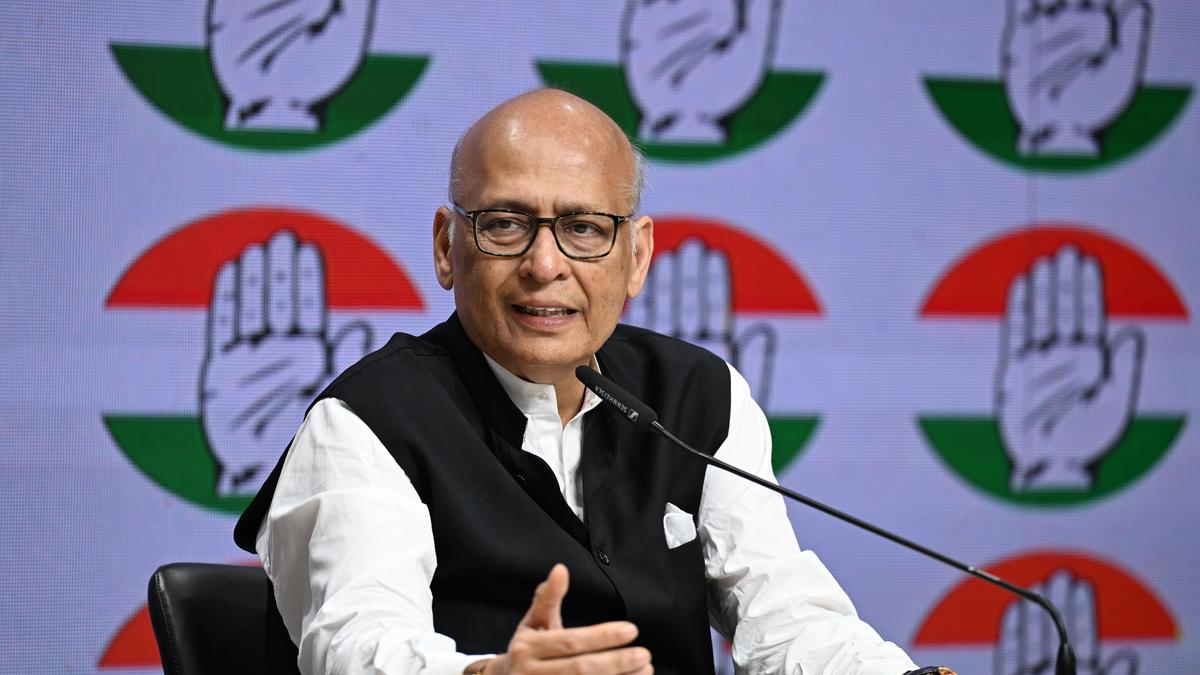
‘Respectfully disagrees’ with Supreme Court order on SIR, says Congress
Coveragetap to expand ▾Spectrum: Center Only🌍Asia: 2 · Other: 2
- Congress party expressed disagreement with the Supreme Court's ruling on the special intensive revision (SIR) of electoral rolls on October 2023.
- Jairam Ramesh, Congress communication chief, stated that the Supreme Court's judgement raised more questions than it answered.
- Ramesh emphasized that while the Supreme Court provided a legal finding, the Congress party can 'respectfully disagree' with the verdict.
- The Supreme Court's ruling pertains to the electoral rolls revision process, which is crucial for upcoming elections in India.
- This statement from Congress was made public via a post on social media platform X (formerly Twitter).
On May 27, 2026, Congress publicly expressed its disagreement with the Supreme Court's ruling that upheld the legality of the special intensive revision (SIR) of electoral rolls. Congress communication chief Jairam Ramesh stated that the judgement raised more questions than it answered, emphasizing the party's concerns about the implications of the ruling on electoral fairness.
He accused the Narendra Modi government of facing significant public discontent due to its governance failures, suggesting that the SIR has become a tool for exclusion rather than inclusion. Ramesh further claimed that the government is manipulating voter lists to skew electoral outcomes in its favor, undermining the integrity of the electoral process.
This criticism comes at a time when the political landscape is increasingly contentious, with Congress positioning itself against what it perceives as undemocratic practices by the ruling party.
The Supreme Court's decision, while legally sound according to its findings, has sparked a debate about the ethical implications of such electoral revisions, highlighting a growing divide between the government and opposition parties regarding electoral integrity.
As Congress continues to challenge the ruling, the implications for upcoming elections remain uncertain, with both sides preparing for a heated political battle.
- The Congress party's disagreement with the Supreme Court's ruling on the special intensive revision (SIR) of electoral rolls highlights significant concerns about electoral integrity and transparency in India.
- This ruling could impact millions of voters, particularly in regions like West Bengal, where electoral dynamics are already contentious.
- If the SIR process is perceived as flawed or biased, it may lead to increased public distrust in the electoral system and could influence voter turnout in upcoming elections, potentially altering the political landscape.
- Congress plans to hold a press conference within 72 hours to outline its strategy for challenging the Supreme Court's ruling on the SIR and to mobilize public support.
- The Election Commission is expected to release a statement clarifying its position on the implementation of the Supreme Court's decision and its impact on the upcoming electoral rolls.
- Opposition parties are likely to convene a meeting before the next parliamentary session to discuss a unified response to the Supreme Court's ruling and potential legislative actions.
- Political analysts anticipate that the ruling may influence voter sentiment leading up to the next general elections, prompting parties to adjust their campaign strategies accordingly.