
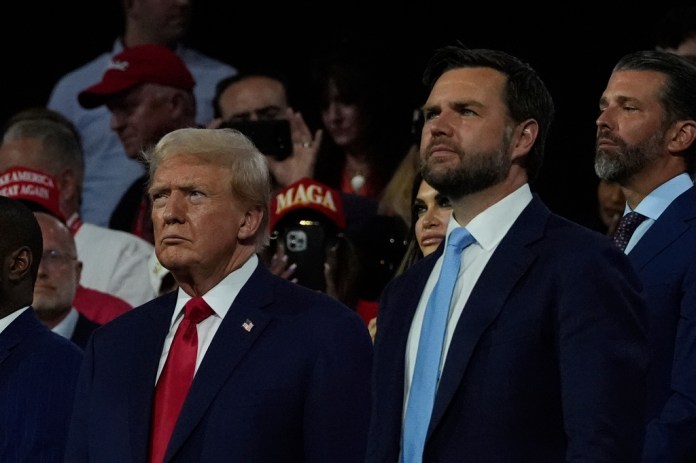
RNC releases Dallas midterm convention lineup headlined by Trump and Vance
Topic: politicsRegion: North AmericaUpdated: i2 outletsSources: 6⚠ Bias gap — sources divergeSpectrum: Mostly Center⏱ 5 min read⚠ 3d+ old
Story Summary
SITUATION
The Republican National Committee announced the full keynote speaker list for the Dallas midterm convention, naming President Donald Trump as the Night One keynote and Vice President JD Vance as the Night Two headliner. The schedule commits the Wednesday-Thursday event to Republican messaging and lists multiple administration and GOP figures to stump for candidates.
Coveragetap to expand ▾Spectrum: Mostly Center🌍US: 1 · Other: 1
Political Spectrum
Position is inferred from coverage mix.
i2 outlets · Center
Left
Center
Right
Left: 0
Center: 1
Right: 1
Geography Coverage
Distribution of where coverage is coming from.
i2 unique outlets · Dominant: US/Canada
KEY FACTS
- The Republican National Committee released the full list of speakers for its first-ever midterm convention in Dallas.
- President Donald Trump and Vice President JD Vance are the keynote speakers for the two-night event.
- Each day will last six hours, with each hour focused on a different topic in Trump’s vision for America.
- Trump is expected to speak both nights, and members of his Cabinet, GOP candidates, and others will speak across the event.
- The Republican National Committee announced the full list of keynote speakers for the midterm convention in Dallas, Texas.
- President Donald Trump will be the keynote speaker on Night One of the convention.
- Vice President JD Vance will be the Night Two keynote speaker, with Trump delivering closing remarks.
- Texas Attorney General and Republican Senate nominee Ken Paxton and Michigan Senate nominee Mike Rogers are also scheduled to give speeches.
HISTORICAL CONTEXT
The practice of national party conventions in the United States began as an institutional mechanism for nominating candidates when state party caucuses yielded to national coordination: delegates met at the first widely recognized national convention in 1831, and the Republican National Committee (RNC) emerged after the Republican Party organized its first national convention in 1856 to coordinate nominations and platform decisions.
Congress created the modern federal campaign regulation framework when it passed the Federal Election Campaign Act (FECA) in 1971 and Congress established the Federal Election Commission (FEC) in 1975 to register campaigns, limit contributions, and require disclosure — a legal regime that enabled parties and candidates to raise and report money for national conventions and associated fundraisers.
Brief
The Republican National Committee unveiled the full keynote lineup for its two-night midterm convention in Dallas, naming President Donald Trump as the Night One keynote and Vice President JD Vance as the Night Two headliner, with Mr. Trump slated to deliver closing remarks (per washingtonexaminer.com).
The announcement frames Dallas as a concentrated effort to marshal Republican messaging for the midterms: senior administration figures, former and current campaign operatives, and high-profile family members will fill a schedule designed to showcase both national leaders and state-level nominees (per washingtonexaminer.com).
The Examiner’s account supplies the most complete roster: it lists Health and Human Services Secretary Robert F.
Kennedy Jr., Treasury Secretary Scott Bessent, former White House press secretary Karoline Leavitt, and Donald Trump Jr. among the scheduled speakers, and names Texas Attorney General and Senate nominee Ken Paxton and Michigan Senate nominee Mike Rogers as state-level surrogates who will appear to support Republican Senate bids (per washingtonexaminer.com).
The piece also notes Speaker of the House Mike Johnson and Sen. Ted Cruz will play messaging roles, while Senate Majority Leader John Thune is expected in Dallas for fundraisers though he will not attend the convention itself (per washingtonexaminer.com).
Aggregated event listings referenced in headline aggregators emphasize the event dates and local scheduling details but provide less reporting on strategic staffing and who will carry the party’s message (per news.google.com).
Party strategists describe the lineup as an effort to fuse presidential authority with vice-presidential and congressional endorsements to sharpen Republican appeals to voters ahead of the midterms; the Examiner presentation makes that strategic purpose explicit by cataloging which national and state actors will headline each night (per washingtonexaminer.com).
The inclusion of administration cabinet members and high-profile family figures signals an attempt to broaden the spectacle beyond a single speech and to create multiple media moments across the two nights (per washingtonexaminer.com). The media accounts in this package diverge on emphasis rather than core facts.
The aggregator headline indexed by news.google.com focuses on the event listing — dates, location, and that a keynote lineup exists — while the Washington Examiner provides names, internal context about who will highlight nominees, and notes about individual absences and side events such as fundraisers (per news.google.com, washingtonexaminer.com).
Neither source in this packet attributes motive beyond conventional campaign aims, and neither source includes polling data tying the convention directly to measurable shifts in voter intention.
What is documented is straightforward: the RNC has positioned President Donald Trump and Vice President JD Vance as the marquee speakers to anchor a concentrated, two-night midterm push in Dallas, supported by cabinet officials, party leaders, and Senate and House surrogates (per washingtonexaminer.com).
The practical consequence is a high-profile, media-focused event intended to consolidate Republican messaging and to put prominent names on stage for state-level nominees; outlets in this set differ mainly in whether they foreground calendar details or the political composition of the roster (per news.google.com, washingtonexaminer.com).
Where sources differ
Bias gap0.50 / 2.0
Left- and right-leaning outlets are covering this story differently — in which facts to emphasize, which context to include, and how to frame causes and consequences.
Center (4)
ladailypost.comcbsnews.comdallasnews.comchristianpost.com
Right-leaning (1)
washington_examiner+0.70
RNC unveils midterm convention speaking order headlined by Trump and Vance
Related Developments1 story
Sources
5 of 5 linked articles
RNC releases Dallas midterm convention lineup headlined by Trump and Vance
washingtonexaminer.comSep 8Center
↗
Keynote Speaker Lineup Announced For Republican National Convention Sept. 9-10 In Dallas, Texas - ladailypost.com
ladailypost.comSep 6Left
↗
Trump, Vance to speak at RNC Midterm Convention in Dallas
cbsnews.comSep 5Left
↗
Trump Jr., Cabinet members join Dallas GOP lineup; Melania Trump to skip it
dallasnews.comSep 4Left
↗
Dallas pulls permit from liberal, anti-Trump protest group ahead of RNC Midterm Convention
christianpost.comSep 4Left
↗