
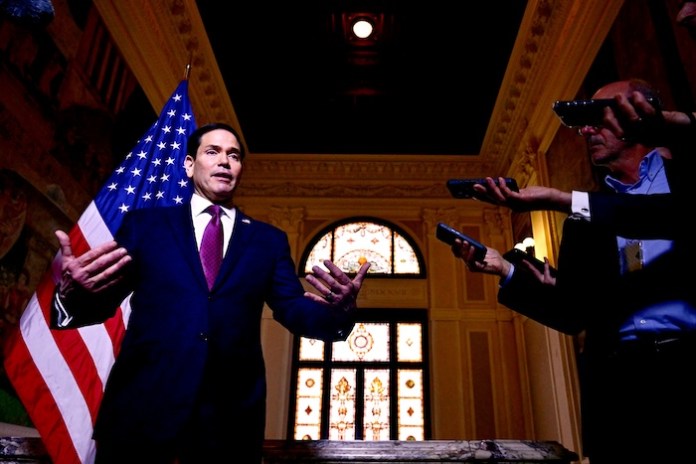
destroyers moving through international waters being fired upon by the Iranians, and the U.S.
Topic: geopoliticsRegion: north americaUpdated: i2 outletsSources: 19⚠ Bias gap — sources divergeSpectrum: Mostly CenterFiltered: Global (0/20)· Clear⏱ 4 min read📡 Wire pickup: 3⚠ 3d+ old
Story Summary
SITUATION
Iran fired upon U.S. destroyers moving through international waters, prompting a defensive response from the U.S.
Coveragetap to expand ▾Spectrum: Mostly Center🌍US: 8 · Other: 8 · Europe: 2 · ME: 1 · Asia: 1
Political Spectrum
Position is inferred from coverage mix.
i2 outlets · Center
Left
Center
Right
Left: 3
Center: 15
Right: 1
Geography Coverage
Distribution of where coverage is coming from.
i2 unique outlets · Dominant: US/Canada
KEY FACTS
- The United States is hoping to receive a response from the Iranians on Friday that will allow for the start of a “serious process of negotiation,” Secretary of State Marco Rubio said.
HISTORICAL CONTEXT
The incident involving Iran firing upon US destroyers in international waters is a significant escalation in the ongoing US-Iran conflict that has been intensifying since early 2026. This event is part of a broader geopolitical struggle that has its roots in the historical animosities and strategic confrontations between the United States and Iran.
The immediate backdrop to this incident is the ongoing military operations that the US has been conducting against Iran since March 2026. These operations were initiated as part of a coordinated effort with Israel to curb Iran's nuclear ambitions and its support for regional proxy groups.
Brief
In a significant escalation of tensions, Iran fired upon U.S. destroyers navigating through international waters, prompting a defensive response from the United States. Secretary of State Marco Rubio indicated that the U.S. is awaiting a response from Iran that could pave the way for serious negotiations, reflecting the complexities of the current diplomatic landscape.
Rubio noted that Iran's leadership is experiencing fractures, which may hinder the negotiation process. This incident occurs against the backdrop of ongoing military actions between the U.S. and Iran, which have intensified since the coordinated strikes launched by the U.S. and Israel in early March 2026.
While Rubio has expressed hope for a constructive dialogue, he also faces criticism from conservative factions regarding the potential Iran deal, complicating the U.S. position. The outcome of Iran's response is crucial, as it may determine the future of U.S.-Iran relations and the broader regional stability.
As both sides navigate this precarious situation, many governments watches closely for developments that could either escalate or de-escalate the ongoing conflict.
Where sources differ
Bias gap1.10 / 2.0
Left- and right-leaning outlets are covering this story differently — in which facts to emphasize, which context to include, and how to frame causes and consequences.
Left-leaning (3)
huffpost.com-0.65
Marco Rubio Says Iran Deal Could Take Days After U.S. Launches Fresh Strikes Marco Rubio Says Iran Deal Could Take Days After U.S.
washingtonpost.com-0.35
Rubio fends off conservative critics of Iran deal as agreement appears imminent Rubio fends off conservative critics of Iran deal as agreement appears imminent - The Washington Pos…
cnn.com-0.30
Rubio on Iran: 'We should know something today'. Reporting is limited at this stage.
Center (15)
apnews.comfox11online.comreuters.comiranintl.comfinance.yahoo.commsn.comthenews.com.pkturkiyetoday.comfrance24.comcnbc.comaljazeera.comtheguardian.comnews.futunn.comapnews.comtimesfreepress.com
Right-leaning (1)
washington_examiner+0.70
destroyers moving through international waters being fired upon by the Iranians, and the U.S. Rubio: US hopes incoming Iranian response sets up ‘serious process of negotiation’ Rub…
Sources
0 of 20 linked articles · Filter: Global