
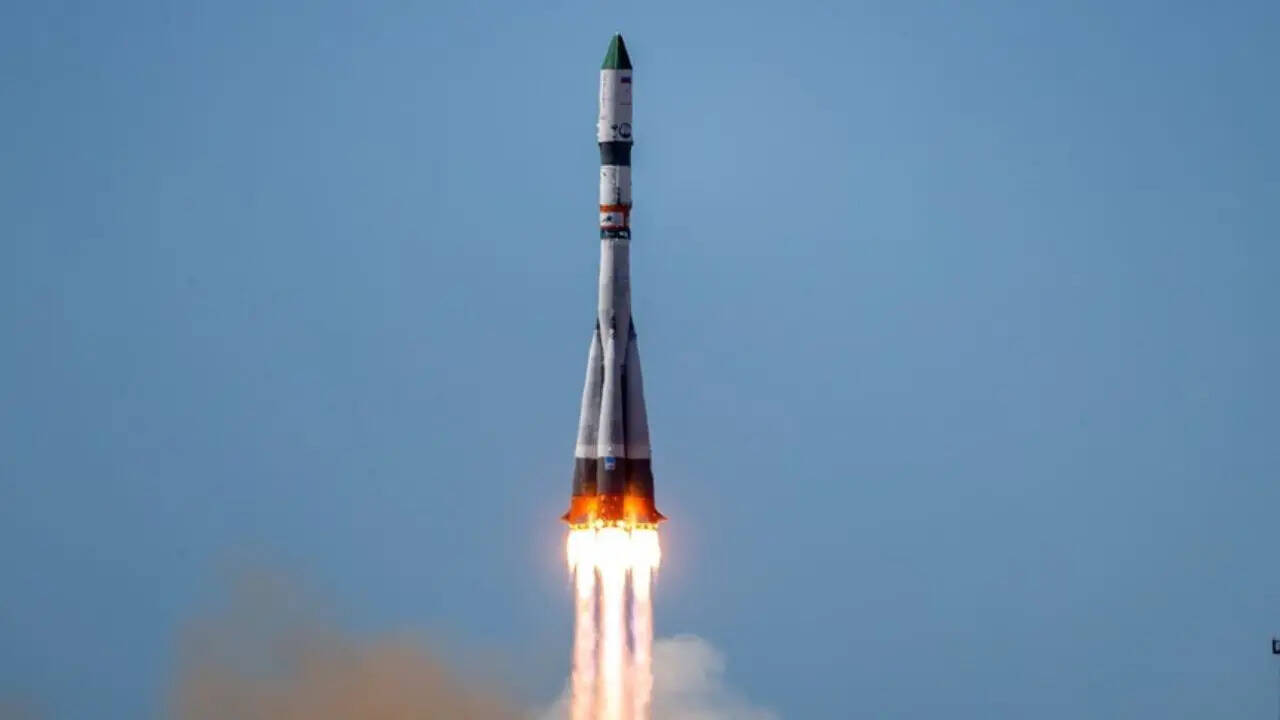
Russia and Kazakhstan Successfully Launch Soyuz-5 with Advanced Engine
Coveragetap to expand ▾Spectrum: Center Only🌍Asia: 2 · US: 1 · ME: 1 · Other: 1
- Russia and Kazakhstan launched the Soyuz-5 rocket from the Baikonur Cosmodrome (per timesofindia.indiatimes.com).
- The launch occurred on April 30 at 2100 Moscow time without any reported issues (per timesofindia.indiatimes.com).
- The Soyuz-5 rocket is equipped with the world's most powerful liquid-fueled engine (per timesofindia.indiatimes.com).
- This development is part of Russia's efforts to modernize its space infrastructure and remain competitive globally (per timesofindia.indiatimes.com).
- The project is expected to create employment opportunities in both Russia and Kazakhstan (per timesofindia.indiatimes.com).
- The Soyuz-5 is the first new launch vehicle developed by Russia since 2014 (per timesofindia.indiatimes.com).
Russia and Kazakhstan have successfully launched the Soyuz-5 rocket from the Baikonur Cosmodrome, marking a pivotal moment in Russia's space program. The launch, which took place on April 30 at 2100 Moscow time, proceeded without any reported issues, according to Roscosmos, Russia's space agency.
This mission is a significant step in Russia's efforts to modernize its space infrastructure and maintain its competitiveness in the global space sector. The Soyuz-5 rocket is notable for its powerful liquid-fueled engine, which is touted as the world's most powerful of its kind.
This capability allows the rocket to carry payloads of up to 17 metric tonnes, enhancing the efficiency of placing satellites and other payloads into near-Earth orbit. The development of the Soyuz-5 is seen as a strategic move to reduce launch costs and improve payload capacity, crucial factors in the increasingly competitive space industry.
This launch is part of the Baiterek project, a collaborative effort between Russia and Kazakhstan, which aims to advance space exploration capabilities and foster economic growth in the region. The project is expected to generate employment opportunities in both countries, highlighting the broader economic impact of the space sector.
The Soyuz-5 is the first new launch vehicle developed by Russia since 2014, underscoring its importance in the country's long-term space ambitions. The successful test launch is a testament to the technical advancements and collaborative efforts between the two nations.
While the launch has been widely reported as a success, it also reflects the broader geopolitical context in which space exploration is becoming an arena for technological and economic competition. As countries strive to enhance their space capabilities, projects like the Soyuz-5 play a critical role in shaping the future of space exploration.
The collaboration between Russia and Kazakhstan on this project highlights the strategic partnerships that are forming in the space sector, as nations seek to leverage shared resources and expertise to achieve common goals. This launch not only advances Russia's space capabilities but also strengthens its ties with Kazakhstan, a key partner in the region.
- The successful launch of the Soyuz-5 rocket enhances Russia's ability to place satellites into orbit more efficiently, impacting global satellite deployment strategies.
- The collaboration between Russia and Kazakhstan strengthens economic ties and creates job opportunities, benefiting local economies in both countries.
- The development of the world's most powerful liquid-fueled engine positions Russia as a competitive player in the global space industry, influencing future space exploration projects.
- Whether Russia and Kazakhstan will announce further collaborative space missions in the coming months.
- The impact of the Soyuz-5 launch on global satellite deployment strategies and competition.
- Potential economic developments in Kazakhstan as a result of increased space sector activity.
- timesofindia.indiatimes.com emphasizes the technological advancements and economic benefits, while other sources focus on the successful launch itself.
- No source mentions the broader geopolitical implications of Russia's advancements in space technology.