
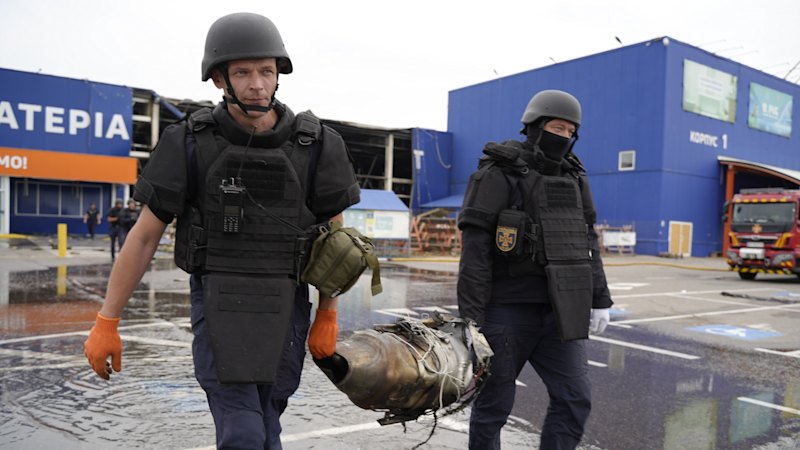
Russian jet-powered drones kill two and wound six at Kyiv petrol stations, officials say
Topic: generalRegion: EuropeUpdated: i2 outletsSources: 4Spectrum: Center Only⏱ 3 min read
Story Summary
SITUATION
Russian drones fitted with jet engines struck petrol stations in Kyiv, killing two people and wounding six (per smh.com.au). Ukrainian officers say the new high-speed, jet-powered drones have deepened fears and prompted frequent air-raid alerts across the city (per smh.com.au).
Coveragetap to expand ▾Spectrum: Center Only🌍Europe: 1 · Asia: 1
Political Spectrum
Position is inferred from coverage mix.
i2 outlets · Center
Left
Center
Right
Left: 0
Center: 2
Right: 0
Geography Coverage
Distribution of where coverage is coming from.
i2 unique outlets · Dominant: Europe
KEY FACTS
- Russian drones fitted with jet engines struck Kyiv petrol stations, killing two people and wounding six (per smh.com.au)
- Colonel Skurativskyi, chief of the air defence directorate of Ukraine’s 7th Rapid Response Corps, said 'Kyiv is being terrorised day and night with the jet-powered drones from Russia' (per smh.com.au)
- Air-raid alerts have altered daily routines in Kyiv as residents monitor risks via social media (per smh.com.au)
HISTORICAL CONTEXT
The immediate backdrop is the ongoing Russia–Ukraine war that began with Russia’s full-scale invasion on 24 February 2022, after Moscow’s formal recognition of the self‑proclaimed Donetsk and Luhansk “people’s republics” on 21 February 2022; that invasion set a pattern of long‑range missile and drone strikes against Ukrainian cities and infrastructure.
International responses that shaped the campaign’s legal and economic framework included sweeping Western sanctions announced in February–March 2022 by the United States, the European Union and G7 partners, successive packages of military aid to Kyiv authorized across 2022–2024, and the suspension of Russia from some international financial and trade institutions beginning in early 2022.
Brief
Russian jet-powered drones struck petrol stations in Kyiv, killing two people and wounding six, according to reporting by smh.com.au.
Ukrainian air-defence officers, including Colonel Skurativskyi of the 7th Rapid Response Corps, described the attacks as part of a recent wave of high-speed drone strikes that have 'terrorised day and night' and forced repeated air-raid alerts across the capital (per smh.com.au).
The weapons, fitted with jet engines, travel at roughly 600km/h and — the Ukrainian officers say — can outrun the interceptors currently deployed to protect cities (per smh.com.au).
SMH reports that Russia has deployed these jet-powered drones in large numbers over the past month, a tempo of attacks that has set off multiple air-raid alerts and altered Kyiv residents' daily routines, who now track threats partly via social media (per smh.com.au).
The article quotes Colonel Skurativskyi directly to convey Ukrainian defenders' assessment of both the tactical problem — very high speeds — and the psychological impact on civilians across the city (per smh.com.au).
SMH's account is specific about the immediate human toll at petrol stations but does not provide further detail on which Russian units launched the drones or on any claims of responsibility or intent from Russian authorities (per smh.com.au).
Confirmed facts in the reporting are limited to the strike outcomes, the quoted Ukrainian assessment, the drones' reported speed, and the sequence of increased alerts; SMH attributes the operational shift to 'Russia' unleashing the weapons without naming Moscow's exact units or political statements.
That leaves open operational questions — which Russian forces carried out the campaign, whether the petrol stations were the intended targets, and how air-defence systems will be adapted to engage the faster drones — none of which the article documents (per smh.com.au).
For now, Kyiv faces a tactical challenge: defending urban infrastructure and civilians from weapons that move faster than many existing interceptors, while residents cope with repeated alarms and the immediate human cost recorded in the reported petrol-station strikes (per smh.com.au).
Why it matters
- Civilians in Kyiv bore the concrete costs: two people were killed and six wounded at petrol stations when the jet-powered drones struck (per smh.com.au).
- Kyiv residents face the specific mechanism of harm of faster drones outrunning current interceptors, increasing the risk to urban infrastructure such as petrol stations (per smh.com.au).
- Ukraine’s 7th Rapid Response Corps, represented by Colonel Skurativskyi, faces degraded air-defence effectiveness against ~600km/h jet-powered drones, undermining existing protective measures (per smh.com.au).
- Russia benefits tactically from deploying high-speed jet-powered drones en masse, a capability that has heightened alarm and forced frequent air-raid alerts in Kyiv (per smh.com.au).
What to watch next
- Whether Ukraine’s air-defence units, including the 7th Rapid Response Corps, deploy upgraded interceptors or tactics to counter ~600km/h jet-powered drones within the coming weeks (per smh.com.au).
- Whether Russian forces continue launching large numbers of jet-powered drones and maintain the reported tempo over the next month (per smh.com.au).
- Whether Kyiv authorities change civil-defence procedures for petrol stations and other vulnerable urban infrastructure after repeated air-raid alerts (per smh.com.au).
Where sources differ
7 dimensionsFraming differences
?- Only one source (smh.com.au) is in this pack and it frames the strikes as Russian jet-powered drones 'terrorising' Kyiv and emphasizes speed and psychological impact (per smh.com.au).
Disputed or unclear
?- No source in this pack disputes the casualty numbers, but details such as which Russian units launched the drones and whether the petrol stations were deliberate targets remain unclear (per smh.com.au).
Omitted context
?- No source in this pack names the specific Russian unit or command that launched the jet-powered drones.
- No source provides detailed civilian-impact breakdown (locations, victim identities) beyond the totals at the petrol stations.
- No source mentions any international or legal accountability processes (ICC/ICJ/UN) related to the strikes.
- No source identifies the manufacturers or suppliers of the jet engines or drones involved, or economic interests behind the deployment.
Conflicting figures
?- Only smh.com.au reports the casualty figures: two killed and six wounded (per smh.com.au).
Disputed causality
?- SMH attributes the strikes to Russia unleashing jet-powered drones in massive numbers over the past month; there is no competing account in this pack about who acted first or why (per smh.com.au).
Attribution disputes
?- SMH attributes responsibility for the drone campaign to Russia and quotes Ukrainian officers asserting that the jet-powered drones are coming from Russia (per smh.com.au).
Sources
4 of 4 linked articles
The new terror stalking Kyiv day and night
smh.com.auSep 13Center
↗
At least 11 killed in Russian attacks on Ukraine as Kyiv strikes Russia's 'shadow fleet'
euronews.comSep 12Left
↗
Russian attacks on Kyiv petrol stations kill two, Ukrainian strikes kill three in Russia
yahoo.comSep 11Left
↗
Ukraine war latest: Russia targets Kyiv gas stations for second day
kyivindependent.comSep 11Left
↗