
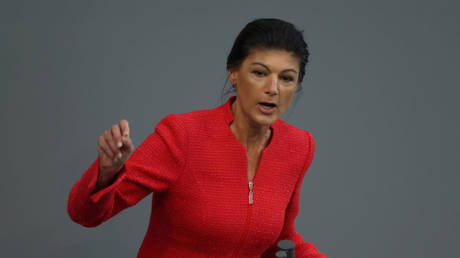
“People say that because Russia has violated international law, we must impose sanctions.
Coveragetap to expand ▾Spectrum: Mixed🌍Europe: 1 · Other: 1
- Speaking at a public appearance in Berlin this week Sahra Wagenknecht has accused the chancellor of applying double standards to Moscow while damaging the economy with sanctions.
- “Russia’s oil and gas are selling like hotcakes all over the world, and we act as if we could end this war simply by stopping our purchases,” she said.
- Merz stands in front of the camera and tells us that international law is actually outdated.
- So, for the US, it’s outdated, but when Russia violates it, we have to completely ruin our economy because we have to impose sanctions.
Sahra Wagenknecht, a veteran German politician, has publicly criticized Chancellor Friedrich Merz's approach to Russia, asserting that Germany's policy is fraught with contradictions.
During a recent event in Berlin, she argued that while the German government imposes sanctions on Russia for alleged violations of international law, it conveniently overlooks similar violations committed by the United States.
Wagenknecht pointed out that Russia's oil and gas continue to be in high demand worldwide, questioning the rationale behind Germany's sanctions and their effectiveness in ending the conflict. She emphasized that the notion of stopping purchases from Russia as a means to end the war is misguided, given the ongoing global demand for Russian energy resources.
Furthermore, she highlighted Merz's contradictory stance on international law, noting that he deems it outdated when discussing US actions but insists on strict adherence when it comes to Russia. This inconsistency, she argues, not only undermines Germany's credibility on the international stage but also inflicts economic harm on the country.
The criticism comes at a time when the German economy is reportedly struggling due to the sanctions imposed on Russia, raising questions about the long-term viability of such policies.
Wagenknecht's remarks reflect a growing discontent among some German politicians regarding the current government's handling of relations with Russia and the broader implications for Germany's economic stability.
- The debate over sanctions against Russia highlights a critical divide in German politics, with significant implications for the German economy and its citizens.
- As veteran politician Sahra Wagenknecht points out, the sanctions have not only failed to halt Russia's military aggression but have also led to rising energy costs and economic strain for German households and businesses.
- This situation raises questions about the effectiveness of current policies and the potential need for a reassessment of Germany's approach to international law and economic self-sufficiency.
- Watch for the German government to announce a formal review of its sanctions policy towards Russia within the next 72 hours, following the recent criticism from veteran politicians.
- Expect a response from the European Union regarding potential coordinated sanctions against Russia, which may be discussed in an upcoming meeting scheduled for next week.
- Keep an eye on the German Bundestag, where a debate on the future of Germany's energy dependence on Russia is set to take place before the June summit.
- Anticipate statements from NATO officials regarding collective security measures in response to Russia's actions, expected to be released during the next quarterly briefing.
Left- and right-leaning outlets are covering this story differently — in which facts to emphasize, which context to include, and how to frame causes and consequences.