
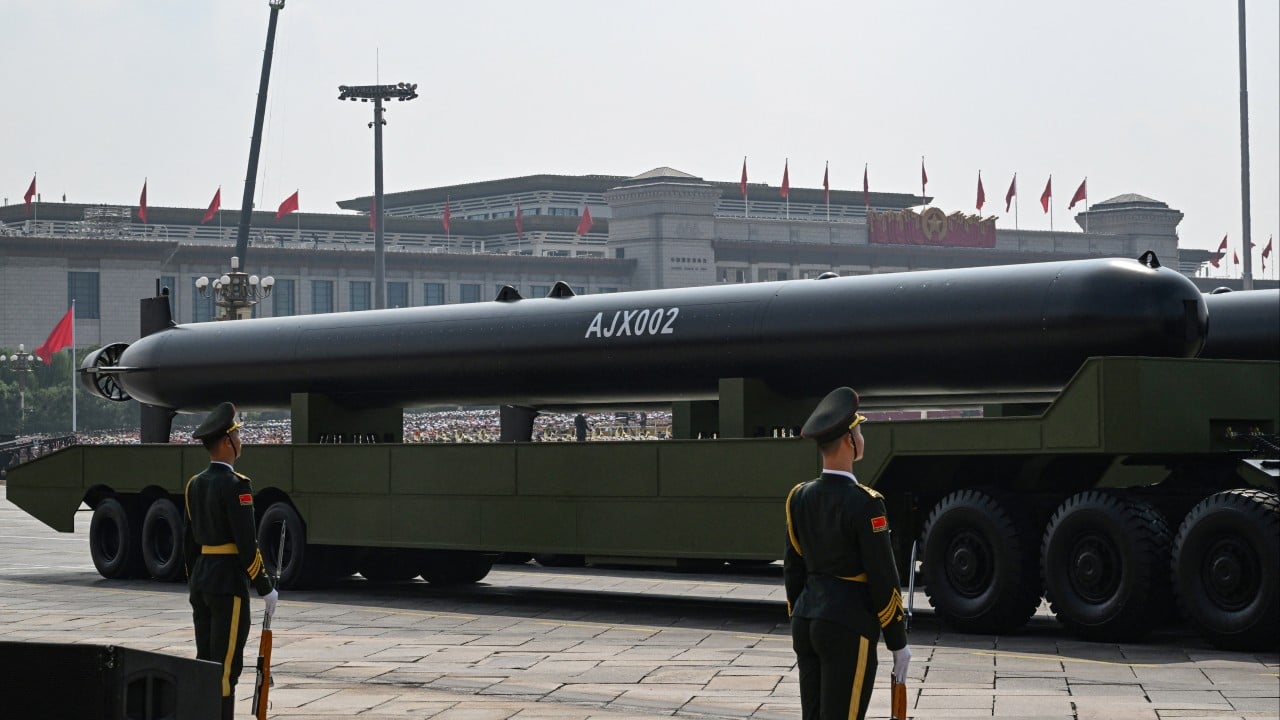
China building 200m hull at Hudong-Zhonghua that analysts say could mothership for XXL UUVs
Topic: geopoliticsRegion: AsiaUpdated: i2 outletsSources: 2Spectrum: Center Only⏱ 3 min read
Story Summary
SITUATION
Satellite imagery shows a roughly 200-metre hull under construction at Hudong-Zhonghua that analysts led by H.I. Sutton assessed could be a dedicated mothership for extra-extra-large uncrewed underwater vehicles (XXLUUVs) (per scmp.com).
Coveragetap to expand ▾Spectrum: Center Only🌍Europe: 1 · Asia: 1
Political Spectrum
Position is inferred from coverage mix.
i2 outlets · Center
Left
Center
Right
Left: 0
Center: 2
Right: 0
Geography Coverage
Distribution of where coverage is coming from.
i2 unique outlets · Dominant: Europe
KEY FACTS
- Analysts led by H.I. Sutton assessed the hull could be a dedicated mothership for extra-extra-large uncrewed underwater vehicles (XXLUUVs) (per scmp.com).
- If used as a mothership, the ship would let Beijing deploy XXLUUVs far from its coast for sustained periods (per scmp.com).
- The assessment that the hull is a XXLUUV mothership is an analyst conclusion and has not been confirmed by Chinese authorities (per scmp.com).
HISTORICAL CONTEXT
The immediate backdrop is an intensified great-power security competition in the Indo‑Pacific driven by a broader military crisis that has redirected attention to undersea warfare: in March 2026 the United States and Israel coordinated strikes against Iranian power plants, air-defence sites and military infrastructure, touching off an ongoing campaign in which Iranian forces have mounted responsive operations; that regional shock has sharpened allied focus on sea control, long‑range unmanned systems and platforms capable of extended forward presence.
Structurally, the present environment rests on a web of legal and policy frameworks that govern maritime behavior and military procurement: the United Nations Convention on the Law of the Sea (UNCLOS, 1982) sets norms for exclusive economic zones and passage yet provides no treaty limits on the deployment of uncrewed submersibles; national export controls and sanctions regimes dating from the 1990s and expanded in the 2010s affect transfer of marine propulsion and sensor technologies; and formal alliance arrangements — most notably AUKUS, announced in September 2021, and successive U.S.
Brief
Satellite imagery analysts identified a roughly 200-metre hull under construction at Hudong-Zhonghua shipyard and concluded it could serve as a dedicated mothership for extra-extra-large uncrewed underwater vehicles (XXLUUVs). The lead analyst named in the report, H.I.
Sutton, and an independent imagery analyst pointed to features including what was described as a stern launch-and-recovery system as evidence supporting the mothership interpretation (per scmp.com).
Chinese authorities did not confirm the purpose of the hull in the reporting, leaving the mothership designation as an expert assessment rather than a state-provided fact (per scmp.com).
Proponents of the mothership reading argue that a purpose-built 200-metre vessel with stern launch capability would allow Beijing to deploy XXLUUVs far from its coast for sustained operations, extending the reach and endurance of uncrewed undersea systems (per scmp.com).
Skeptics note the available imagery shows only hull form and certain deck features, and without official specifications or on-the-record acknowledgments the role of the vessel cannot be proven; scmp.com frames the finding as an analyst assessment, not a confirmed commission or program announcement (per scmp.com).
The construction at Hudong-Zhonghua, a major Chinese shipbuilder, fits with broader Chinese investment in large uncrewed systems documented by open-source analysts, but the article limits its claims to what imagery and expert reading reveal rather than attributing intent or specific operational plans to the Chinese government (per scmp.com).
Why it matters
- - Civilian maritime actors near extended Chinese deployments would bear concrete costs if the hull becomes an XXLUUV mothership: commercial shipping could face altered transit patterns and monitoring as Beijing would be able to operate long-endurance UUVs far from its coast (per scmp.com). - China's naval and industrial planners could benefit from a dedicated mothership because it enables sustained, long-range deployment of XXLUUVs that extend undersea reach without basing ashore (per scmp.com). - Open-source analysts and governments relying on imagery will bear the burden of verification because the hull's purported stern launch-and-recovery system is the primary evidence tying the build to XXLUUV operations (per scmp.com). - Hudong-Zhonghua and its workforce gain economically from large hull construction contracts, while transparency and confirmation remain absent, concentrating informational advantage with imagery analysts and the shipbuilder (per scmp.com).
What to watch next
Whether Hudong-Zhonghua or another Chinese state entity publishes official specifications or disclosures about the hull and its planned role within six months. 2) Whether additional commercial satellite imagery shows installation of stern gear or UUV-handling equipment on the hull in the next quarterly imagery update. 3) Whether open-source analysts publish comparative imagery showing XXLUUV launch-and-recovery systems elsewhere that match features on this hull. 4) Whether naval intelligence assessments from other governments cite the hull in formal advisories or risk assessments within the next 90 days.
Where sources differ
7 dimensionsFraming differences
?- scmp.com frames the 200-metre hull and identified stern launch system as an analyst-supported assessment rather than a confirmed Chinese program (per scmp.com).
Disputed or unclear
?- No source in this pack confirms Chinese government or Hudong-Zhonghua statements verifying the hull's purpose; the mothership role remains unverified (per scmp.com).
Omitted context
?- No source in this pack provides direct Chinese government confirmation of purpose or technical specifications for the hull (per scmp.com).
- No source in this pack supplies downstream operational details for XXLUUVs (endurance, payloads, or command-and-control) that would clarify how a mothership would be used (per scmp.com).
- No source in this pack includes assessments from non-open-source naval intelligence or treaty/verification mechanisms that could corroborate or refute the analyst conclusion (per scmp.com).
Conflicting figures
?- scmp.com reports the hull is roughly 200 metres long (per scmp.com).
Disputed causality
?- The report does not claim the hull was built in direct response to a specific foreign action; it presents construction and analyst interpretation without attributing a causal trigger (per scmp.com).
Attribution disputes
?- H.I. Sutton led the analyst assessment that the hull could be a XXLUUV mothership; an independent imagery analyst identified a stern launch-and-recovery system (per scmp.com).
Sources
2 of 2 linked articles