
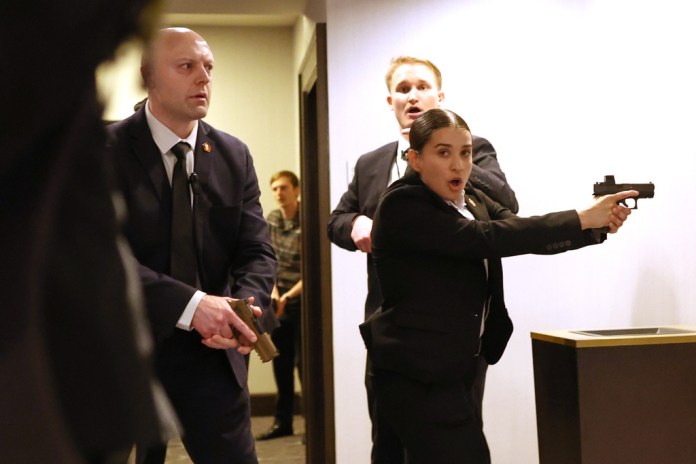
Secret Service director denies agent was wounded by friendly fire
Coveragetap to expand ▾Spectrum: Mostly Center🌍US: 2 · Other: 2 · Asia: 1
- The Secret Service director has publicly denied that a Secret Service agent was wounded by friendly fire at the Correspondents' Dinner (per mb.ntd.com).
- President Donald Trump supported the director's statement, asserting that the agent was not hit by friendly fire (per mb.ntd.com).
- There have been no official reports or evidence provided to substantiate the claim of friendly fire (per mb.ntd.com).
In a recent development, the Secret Service director has firmly denied allegations that a Secret Service agent was wounded by friendly fire during the Correspondents' Dinner.
This statement comes in response to circulating rumors and speculation about the nature of the incident, which took place at a high-profile event attended by numerous government officials and media representatives. President Donald Trump has echoed the director's denial, stating unequivocally that the agent was not hit by friendly fire.
This alignment between the Secret Service and the President aims to quell any doubts regarding the incident's circumstances. The Correspondents' Dinner, known for its gathering of influential figures, was the backdrop for this incident, which has since drawn significant attention.
Despite the rumors, no official reports or evidence have been presented to support the claim of friendly fire. The denial by the Secret Service director highlights the agency's commitment to maintaining transparency and addressing public concerns about security measures at major events.
This incident has brought renewed focus on the protocols and safety measures in place to protect attendees at such gatherings. As the situation unfolds, the Secret Service and the administration continue to monitor and address any emerging details. The emphasis remains on ensuring the safety and security of all individuals involved in high-profile events.
The incident underscores the challenges faced by security agencies in managing and safeguarding large-scale events, particularly in an era of heightened vigilance and scrutiny. The Secret Service's response reflects its dedication to upholding its responsibilities and maintaining public trust.
- The incident at the Correspondents' Dinner raises concerns about the safety protocols in place at high-profile events, impacting the confidence of attendees and organizers.
- The Secret Service's denial of friendly fire allegations aims to preserve the agency's credibility and reassure the public about its operational integrity.
- President Trump's involvement in addressing the incident underscores the political significance of maintaining security and transparency at events involving government officials.
- Whether the Secret Service releases further details or evidence regarding the incident.
- Any official investigation or review of security protocols at the Correspondents' Dinner.
- Potential statements or actions from President Trump or other government officials in response to ongoing scrutiny.
Left- and right-leaning outlets are covering this story differently — in which facts to emphasize, which context to include, and how to frame causes and consequences.
4 specific areas where coverage diverges — see below.
- The source emphasizes the denial of friendly fire by both the Secret Service director and President Trump, without presenting alternative perspectives.
- The claim of friendly fire remains unverified, with no evidence provided to support it.
- No source mentions any prior incidents or security breaches at similar events that could contextualize the current scrutiny.
- President Trump stated that the agent was not hit by friendly fire, aligning with the Secret Service director's denial.