
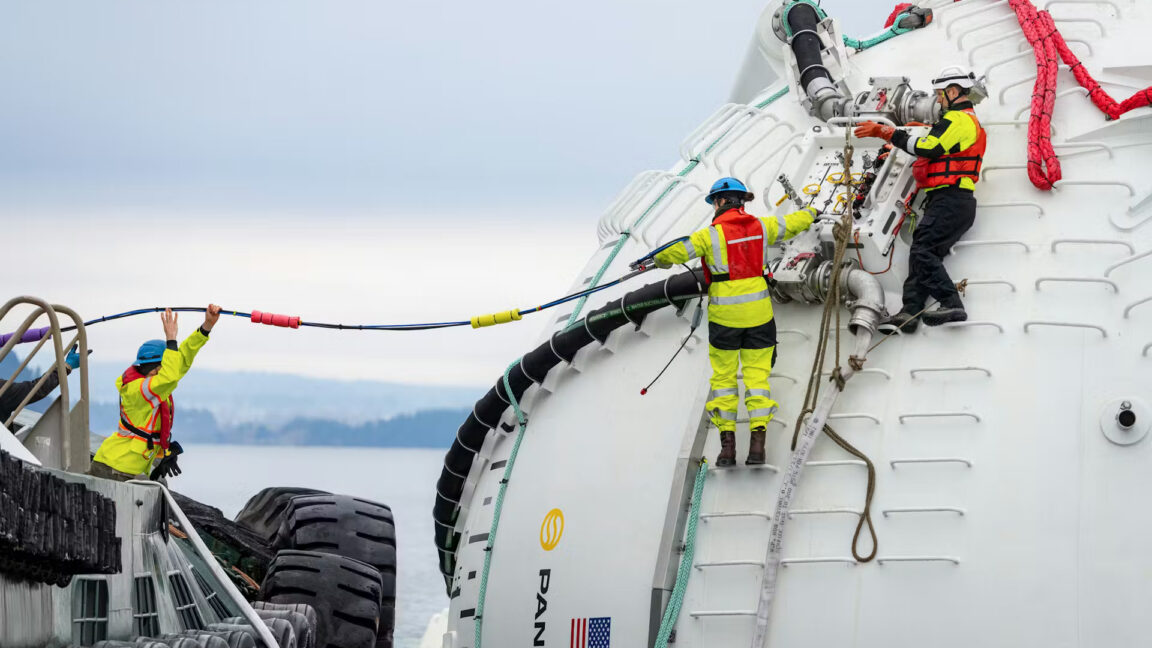
Silicon Valley bets $200M on AI data centers floating in the ocean
Coveragetap to expand ▾Spectrum: Center Only🌍US: 1 · Asia: 1
- Silicon Valley investors, including Peter Thiel, are backing ocean-based AI data centers with a $200 million investment (per arstechnica.com).
- The company Panthalassa is leading this initiative, focusing on deploying AI data centers powered by wave energy (per arstechnica.com).
- The floating data centers, known as nodes, will use the ocean's ambient temperature for cooling, reducing electricity and fresh water usage (per arstechnica.com).
- The latest prototype, Ocean-3, is scheduled for testing in the northern Pacific Ocean later in 2026 (per arstechnica.com).
The floating data centers, referred to as nodes, will harness wave energy to power AI chips and utilize the ocean's naturally low ambient temperature for cooling, significantly reducing the need for electricity and fresh water. The latest prototype, Ocean-3, is set to be tested in the northern Pacific Ocean later this year.
Measuring approximately 85 meters in length, the Ocean-3 node is designed to stand as tall as iconic structures like London's Big Ben or New York City's Flatiron Building. These nodes will not only generate their own electrical power but also transmit AI model outputs to customers around the globe via satellite links.
Panthalassa's initiative comes at a time when tech companies are grappling with the increasing demands of AI data processing and the environmental impact of traditional data centers. By situating these facilities in the ocean, Panthalassa hopes to leverage the natural environment to provide a sustainable solution to these challenges.
The company has secured a $140 million investment to establish a pilot manufacturing facility near Portland, Oregon, which will expedite the deployment of these wave-powered nodes. This investment reflects a growing interest in alternative energy solutions within the tech industry, as companies seek to balance technological advancement with environmental responsibility.
As the project progresses, it will be crucial to monitor the effectiveness of these ocean-based data centers in terms of energy efficiency and cooling capabilities. The success of this venture could pave the way for a new era of sustainable data processing, potentially influencing how tech companies approach infrastructure development in the future.
While the concept of ocean-based data centers is still in its early stages, the backing from prominent investors and the innovative approach to energy and cooling challenges position Panthalassa as a key player in the evolution of AI infrastructure. The outcome of the Ocean-3 prototype testing will likely determine the viability and scalability of this ambitious project.
- Tech companies face increasing energy and cooling demands for AI data centers, impacting operational costs and environmental sustainability.
- Silicon Valley investors, including Peter Thiel, stand to benefit from successful deployment of ocean-based data centers, potentially setting a new industry standard.
- Communities near Portland, Oregon, may experience economic benefits from the establishment of Panthalassa's pilot manufacturing facility.
- The testing of the Ocean-3 prototype in the northern Pacific Ocean later in 2026.
- Completion of Panthalassa's pilot manufacturing facility near Portland, Oregon, funded by the $140 million investment.
- Potential expansion of ocean-based data centers if the Ocean-3 prototype proves successful.
- No source mentions the potential environmental impact of deploying data centers in the ocean, such as effects on marine life.
- The economic interests of other tech companies in similar sustainable data center solutions are not discussed.