
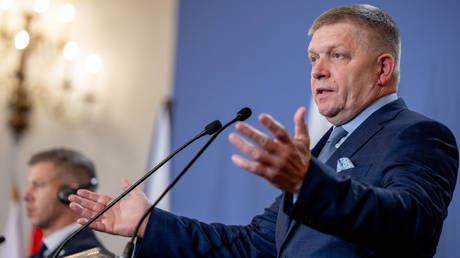
Slovak PM Robert Fico warns West seeks pretext for Russia-NATO war, says NATO could order troops
Topic: defense & securityRegion: EuropeUpdated: i2 outletsSources: 5⚠ Bias gap — sources divergeSpectrum: Mostly Center⏱ 3 min read
Story Summary
SITUATION
Slovak Prime Minister Robert Fico accused Western powers of seeking a “pretext” for a major Russia-NATO conflict and warned that Europe is moving dangerously close to a direct clash (per rt.com). He said Bratislava could be pressured by NATO to commit thousands of troops if Article 5 were invoked, a prospect he presented as a threat to Slovakia’s sovereignty (per rt.com).
Coveragetap to expand ▾Spectrum: Mostly Center🌍US: 1 · Europe: 1
Political Spectrum
Position is inferred from coverage mix.
i2 outlets · Center
Left
Center
Right
Left: 0
Center: 1
Right: 1
Geography Coverage
Distribution of where coverage is coming from.
i2 unique outlets · Dominant: US/Canada
KEY FACTS
- Slovak Prime Minister Robert Fico accused the West of seeking a “pretext” for a major Russia-NATO conflict (per rt.com)
- Fico warned that Europe is moving dangerously close to a direct clash between Russia and NATO (per rt.com)
- Fico said Bratislava could be pressured by NATO to commit thousands of troops if Article 5 is invoked (per rt.com)
- The remarks were presented by Fico as a warning about how Western actions could lead to direct confrontation (per rt.com)
HISTORICAL CONTEXT
The immediate backdrop is the wider Europe–Russia security crisis that has intensified since Russia’s full‑scale invasion of Ukraine on February 24, 2022, and has overlapped with a separate Middle East war that began in March 2026 when the United States and Israel launched coordinated strikes against Iranian facilities; Western and NATO responses to Russian actions in Europe have been framed as deterrence measures while Iranian operations in 2026 have been described by Tehran as retaliatory to the US–Israeli campaign.
The present posture of heightened NATO–Russia confrontation is rooted in Alliance decisions to reinforce its eastern flank after Moscow’s annexation of Crimea on March 18, 2014; that annexation followed a February–March 2014 chain of events in Ukraine that included the removal of President Viktor Yanukovych and a disputed Crimean referendum on March 16, 2014, which Moscow used as its stated legal justification.
Brief
Slovak Prime Minister Robert Fico accused Western governments of seeking a “pretext” for a large-scale Russia-NATO war and warned that such maneuvering could force Slovakia into taking part.
Fico told audiences that Europe is moving dangerously close to a direct clash and that, if NATO’s collective-defense clause Article 5 were invoked, Bratislava could be ordered to provide thousands of troops — a possibility he described as external pressure on Slovak sovereignty (per rt.com).
Fico framed the West as actively looking for conditions that would justify expanded confrontation with Russia and used the prospect of compelled troop commitments to underline his warning (per rt.com).
The prime minister positioned his comments as a defense of Slovakia’s autonomy: he argued that NATO membership should not automatically translate into automatic deployment of Slovak forces under external pressure (per rt.com).
The rt.com piece reports Fico’s claims without additional corroborating sources or opposing official reactions, leaving his characterization of Western intent as his stated interpretation rather than independently verified fact (per rt.com).
Given the single-source reporting, the immediate consequences Fico highlighted are political pressure within Slovakia over alliance commitments and a domestic debate about how far Bratislava should follow NATO requests (per rt.com).
Why it matters
- Slovak citizens face the concrete cost of potential compulsory troop deployments: Fico warned Slovakia could be pressured to send thousands of soldiers under Article 5 (per rt.com).
- Slovak political institutions and decision-makers bear the mechanism of harm — external alliance pressure that could override domestic choice about deployments (per rt.com).
- Western governments conducting policies Fico labels as seeking a “pretext” would benefit from broader justification to escalate confrontation with Russia, according to Fico’s claim (per rt.com).
- Russian strategic messaging benefits politically if NATO members fracture or debate mutual commitments; Fico’s public warning amplifies that debate within an EU and NATO ally (per rt.com).
What to watch next
- Whether Robert Fico or the Slovak government issues follow-up statements clarifying if he proposes any formal change to Slovakia’s NATO commitments (per rt.com).
- Whether NATO officials publicly respond to Fico’s claim about potential orders to send troops under Article 5 (per rt.com).
- Whether parliamentary discussion or votes in Bratislava occur over force-deployment rules or limits on automatic troop commitments (per rt.com).
- Whether other EU or NATO leaders reference Fico’s warning in upcoming summit statements or bilateral meetings (per rt.com).
Where sources differ
7 dimensionsBias gap0.70 / 2.0
Left- and right-leaning outlets are covering this story differently — in which facts to emphasize, which context to include, and how to frame causes and consequences.
Center (4)
bignewsnetwork.combignewsnetwork.comeadaily.comcaliber.az
Right-leaning (1)
rt_world+0.70
Slovak Prime Minister Robert Fico accused the West of seeking a “pretext” for a major Russia-NATO conflict and warned that Europe is moving dangerously close to a direct clash. He …
7 specific areas where coverage diverges — see below.
Framing differences
?- Only rt.com is in this pack; it frames the West as seeking a “pretext” and emphasizes Fico’s warning about forced troop commitments (per rt.com).
Disputed or unclear
?- No other source in this pack corroborates or disputes Fico’s claim that the West is seeking a pretext or that NATO would compel Slovakia to send thousands of troops (per rt.com).
Omitted context
?- No source in this pack mentions any specific Western action that Fico identifies as the alleged “pretext,” leaving the triggering acts unnamed (per rt.com).
- No source in this pack provides independent verification of the claim that NATO could order Slovakia to send thousands of troops or the legal/political mechanism for such an order (per rt.com).
- No source in this pack reports any reaction from NATO, EU institutions, or Western capitals to Fico’s statements (per rt.com).
- No source in this pack provides data on Slovak military size or current troop-readiness that would show feasibility of sending “thousands of troops” (per rt.com).
Conflicting figures
?- Only rt.com mentions 'thousands of troops' but gives no precise figure (per rt.com).
Disputed causality
?- rt.com attributes causality to the West 'seeking a pretext' leading to a potential Russia-NATO clash as asserted by Fico; no other source in this pack confirms that causal chain (per rt.com).
Attribution disputes
?- rt.com attributes the claim that the West seeks a pretext and the warning about forced troop commitments directly to Robert Fico (per rt.com).
Sources
5 of 5 linked articles
NATO member warns bloc seeking pretext for war with Russia
rt.com15h agoRight
↗
West seeking pretext for major Russia-NATO war Fico
bignewsnetwork.com16h agoLeft
↗
NATO member warns bloc seeking pretext for war with Russia
bignewsnetwork.com16h agoLeft
↗
Slovakia will not fulfill the 5th article of NATO for the sake of war with Russia — Fico
eadaily.com17h agoLeft
↗
Slovak PM warns of search for pretext for NATO-Russia conflict
caliber.az19h agoLeft
↗