
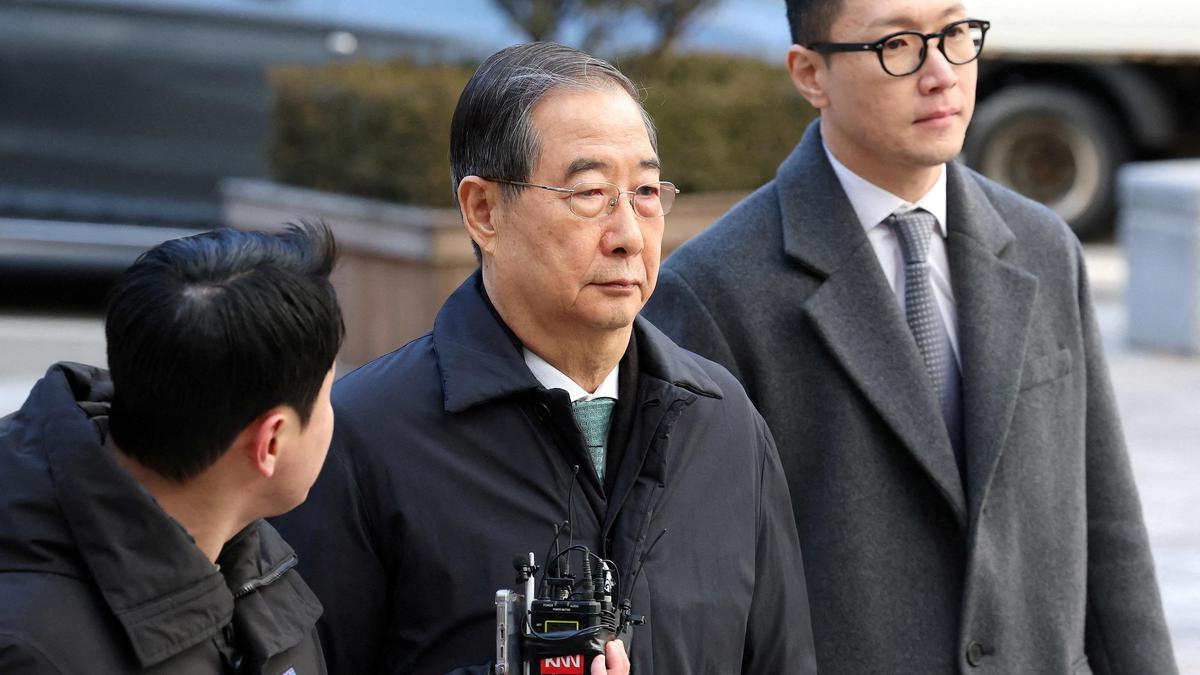
South Korean Court Cuts Ex-PM Han Duck-soo's Sentence in Martial Law Case
Coveragetap to expand ▾Spectrum: Center Only🌍Other: 3 · ME: 1 · Asia: 1
- Han Duck-soo was convicted of rebellion for his involvement in then-President Yoon Suk Yeol's imposition of martial law in December 2024 (per thehindu.com).
- The original sentence was handed down by a Seoul court in January (per thehindu.com).
- Han Duck-soo was a key appointee of President Yoon Suk Yeol during the martial law period (per thehindu.com).
- The appeals court's decision may influence future cases involving political figures and accountability (per thehindu.com).
In a notable legal development, a South Korean appeals court has reduced the prison sentence of former Prime Minister Han Duck-soo from 23 years to 15 years. This decision comes after Han was convicted of rebellion for his involvement in the imposition of martial law by then-President Yoon Suk Yeol in December 2024.
The original sentence was delivered by a Seoul court in January, reflecting the gravity of the charges against Han, who was a prominent figure in Yoon's administration. The reduction of Han's sentence by eight years is significant, as it highlights the evolving judicial approach to political accountability in South Korea.
Han's conviction stemmed from his role in supporting the martial law, which was widely criticized both domestically and internationally. The appeals court's decision may set a precedent for how similar cases are handled in the future, potentially affecting other political figures facing legal scrutiny.
This case has drawn considerable attention due to its implications for South Korea's political and legal systems. The reduction in Han's sentence could be seen as a move towards leniency, or as a reflection of the complexities involved in adjudicating cases of political rebellion.
It also raises questions about the balance between justice and political considerations in the country's legal proceedings. Observers note that this decision could influence public perception of the judiciary's independence and its role in holding political leaders accountable.
The case has been closely watched by both supporters and critics of the former administration, as it touches on broader issues of governance and the rule of law in South Korea. As the legal process continues, the implications of this decision will likely be debated among legal experts and political analysts.
The outcome may also impact future legal strategies for those involved in similar cases, as well as the broader discourse on political accountability in South Korea. Overall, the reduction of Han Duck-soo's sentence underscores the ongoing challenges and debates surrounding political accountability and judicial independence in South Korea.
- The South Korean public bears the concrete costs of potential shifts in judicial accountability, as changes in legal precedents can affect public trust in the legal system.
- Political figures in South Korea may benefit from the conditions that produced this event, as the reduction in Han Duck-soo's sentence could signal a more lenient approach to political accountability.
- The legal community in South Korea faces the challenge of balancing justice and political considerations, which could impact future legal proceedings and public perception of judicial independence.
- Whether the South Korean judiciary will apply similar leniency in future cases involving political figures.
- Public and political reactions to the appeals court's decision, which could influence future legal reforms.
- Any potential appeals or further legal actions taken by Han Duck-soo or related parties in response to the sentence reduction.
- news.google.com emphasizes the reduction in years as a significant legal shift, while thehindu.com focuses on the context of Han's conviction and its implications.
- No source mentions the specific legal arguments presented by Han Duck-soo's defense that led to the sentence reduction.
- The broader political context and public opinion surrounding the 2024 martial law imposition are not detailed in the sources.