
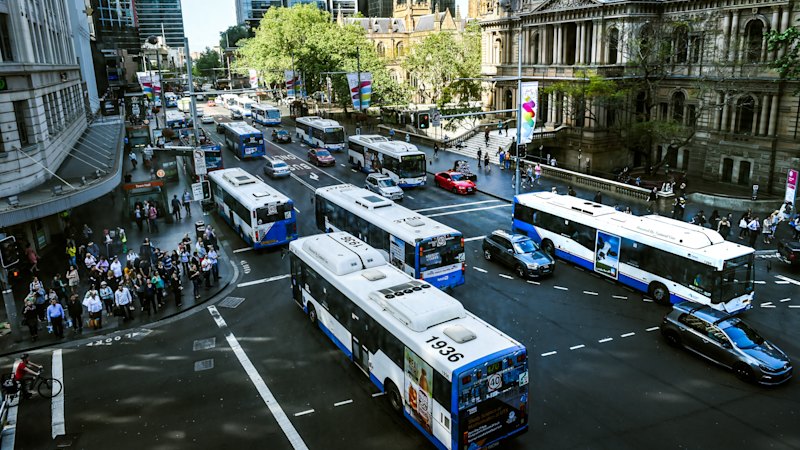
State and City unveil $25.8m plan to pedestrianise northern George Street, making outdoor dining permanent
Topic: generalRegion: asia pacificUpdated: i1 outletsSources: 1Spectrum: Left Only⏱ 2 min read⚠ 48h+ old
Story Summary
SITUATION
The state government and the City of Sydney unveiled a $25.8 million plan to permanently pedestrianise the northernmost 2.5-kilometre stretch of George Street, converting vehicle lanes into wide footpaths and making temporary outdoor dining permanent (per smh.com.au). Construction is expected to begin in 2027 with completion due by late 2028, and the scheme will remove traffic lights and formalise outdoor dining areas (per smh.com.au).
Coveragetap to expand ▾Spectrum: Left Only🌍Asia: 1
Political Spectrum
Position is inferred from coverage mix.
i1 outlets · Center
Left
Center
Right
Left: 1
Center: 0
Right: 0
Geography Coverage
Distribution of where coverage is coming from.
i1 unique outlets · Dominant: Asia
KEY FACTS
- The plan costs $25.8 million and was unveiled by the state government and the City of Sydney (per smh.com.au).
- The scheme will permanently pedestrianise the northernmost 2.5-kilometre stretch of the George Street corridor (per smh.com.au).
- Temporary outdoor dining spaces created earlier will be made permanent under the plan (per smh.com.au).
HISTORICAL CONTEXT
The immediate backdrop is the wider international crisis: since March 2026 the United States and Israel have conducted coordinated strikes on Iranian infrastructure, and those strikes have produced a region-wide security shock that is reshaping Australian government priorities and urban resilience planning.
Domestically, the policy shift builds on city and state regulatory frameworks: emergency COVID-era relaxations of alfresco-dining and footpath use introduced in March 2020 by the New South Wales government and subsequent temporary approvals issued by the City of Sydney through 2020–21.
Brief
The New South Wales state government and the City of Sydney have unveiled a $25.8 million design and delivery package to permanently pedestrianise the northernmost 2.5-kilometre stretch of George Street, converting current vehicle lanes into wide footpaths and formalising alfresco dining (per smh.com.au).
The plan removes traffic lights along the corridor, locks in outdoor dining areas that were introduced as temporary measures, and sets a construction window starting in 2027 with a target finish by late 2028 (per smh.com.au).
City and state officials framed the project as the completion of a long-running transformation of George Street’s northern section; the announcement presents the work as an investment in public space and hospitality precincts, while also implying a permanent change to vehicle access in the city centre (per smh.com.au).
Business and pedestrian access will be reshaped: vehicular lanes will become continuous pedestrian space, which the council says will accommodate wider foot traffic and outdoor dining but will also require rerouting of traffic and potential changes to deliveries and kerbside access (per smh.com.au).
The package formalises alfresco setups that were introduced on a temporary basis, signalling municipal support for expanded outdoor dining as a lasting feature of central Sydney’s streetscape (per smh.com.au).
The schedule released with the announcement places construction start in 2027 and completion by late 2028, giving businesses and transport planners a clear timeframe to prepare for the transition (per smh.com.au). Implementation will hinge on detailed design and delivery work funded by the announced $25.8 million commitment from state and city budgets (per smh.com.au).
Why it matters
- Residents and hospitality workers in the northern George Street precinct bear the concrete costs and benefits: businesses will face a physical redesign of loading and delivery patterns while gaining permanent alfresco capacity tied to the $25.8 million project (per smh.com.au).
- Commuters and drivers who use central Sydney routes will be directly affected by the conversion of vehicle lanes to pedestrian footpaths and the removal of traffic lights, requiring rerouting and traffic-management changes enforced by the City of Sydney (per smh.com.au).
- The City of Sydney and the state government stand to benefit politically and economically by formalising outdoor dining as a permanent draw for shoppers and diners in the CBD, using the $25.8 million investment to reshape central-city commerce (per smh.com.au).
What to watch next
- Whether the City of Sydney and the state government begin construction in 2027 as scheduled (per smh.com.au).
- How the City of Sydney and state planners finalise detailed designs that specify kerbside delivery, parking relocations and traffic rerouting prior to the 2027 start (per smh.com.au).
- Whether affected businesses alter operations or lodge formal submissions during the detailed design phase before late 2028 completion (per smh.com.au).
Where sources differ
7 dimensionsFraming differences
?- Only smh.com.au is in this source pack; it frames the announcement as completion of George Street’s transformation and an investment in public space (per smh.com.au).
Disputed or unclear
?- No other outlets provided alternate figures or disputes; the timeline, cost and scope are reported only by smh.com.au in this pack (per smh.com.au).
Omitted context
?- No source in this pack details how citywide traffic will be rerouted around the closed lanes, including specific alternative arterial routes for vehicles.
- No source quantifies expected economic impacts on individual businesses (losses or gains) from the permanent pedestrianisation.
- No source mentions any formal approvals required from state planning bodies, environmental assessments, or community consultation outcomes tied to the project.
Conflicting figures
?- Only one set of figures appears: $25.8 million cost and 2.5 kilometres of corridor, with a construction window starting in 2027 and completion by late 2028 (per smh.com.au).
Disputed causality
?- The source attributes the shift to formalise temporary outdoor dining into permanent infrastructure as the motivating action; no upstream trigger or opposition campaign is named (per smh.com.au).
Attribution disputes
?- The announcement and figures are attributed to the state government and the City of Sydney (per smh.com.au).
Sources
1 of 1 linked articles