
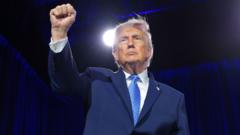
Supreme Court Expands Trump's Power Over Federal Agencies
Topic: politicsRegion: North AmericaUpdated: i3 outletsSources: 6⚠ Bias gap — sources divergeSpectrum: Mostly Center⏱ 4 min read📡 Wire pickup
Story Summary
SITUATION
The Supreme Court ruled that Donald Trump can fire agency heads at will, undermining Congress's authority. The ruling, however, does not extend to members of the Federal Reserve's board of governors, who cannot be dismissed without cause.
Coveragetap to expand ▾Spectrum: Mostly Center🌍US: 2 · Europe: 2 · Other: 2
Political Spectrum
Position is inferred from coverage mix.
i3 outlets · Center
Left
Center
Right
Left: 1
Center: 5
Right: 0
Geography Coverage
Distribution of where coverage is coming from.
i3 unique outlets · Dominant: US/Canada
KEY FACTS
- US Supreme Court has dealt heavy defeats to Trump, while expanding his power
- By President Donald Trump's standards, his response to the Supreme Court ruling against him on birthright citizenship was rather tepid.
- And while this decision was a blow to Trump, it brings to an end a Supreme Court term that has mostly continued a trend of recent years.
HISTORICAL CONTEXT
The current political landscape in the United States is heavily influenced by the ongoing tensions between the executive branch and Congress, particularly in light of the Supreme Court's recent rulings that have shifted the balance of power.
This shift is occurring against the backdrop of an increasingly polarized political environment, which has been exacerbated by the presidency of Donald Trump, who took office on January 20, 2025. Since his inauguration, Trump has pursued an agenda that emphasizes executive authority, often at the expense of legislative oversight.
Brief
In a landmark decision, the Supreme Court has significantly expanded President Donald Trump's authority over federal agencies by ruling that he can dismiss agency heads at will. This ruling overturns the long-standing precedent established by Humphrey’s Executor, which had previously limited presidential power in this regard.
The Court's decision also nullifies the Federal Trade Commission Act, a law that has governed agency operations for over a century, marking a profound shift in the balance of power between the executive branch and Congress. Critics argue that this ruling undermines the legislative branch's authority and sets a dangerous precedent for future administrations.
However, the Court did clarify that Trump does not have the authority to fire members of the Federal Reserve's board of governors without cause, maintaining some checks on presidential power in this specific area.
This ruling is part of a broader trend observed in recent years, where the judiciary has increasingly sided with executive authority, raising concerns about the implications for democratic governance.
As the political landscape evolves, this decision may embolden Trump to further consolidate power within federal agencies, potentially reshaping the administrative state for years to come.
Where sources differ
Bias gap0.50 / 2.0
Left- and right-leaning outlets are covering this story differently — in which facts to emphasize, which context to include, and how to frame causes and consequences.
Left-leaning (1)
guardian_us-0.50
The supreme court has again undermined the power of Congress | Moira Donegan The supreme court has again undermined the power of Congress | Moira Donegan The supreme court has agai…
Center (5)
bbc_worldmsn.comwashingtonpost.comthenation.comreuters.com
Sources
6 of 6 linked articles
US Supreme Court has dealt heavy defeats to Trump, while expanding his power
bbc.co.uk11h agoCenter
↗
Supreme Court expands Trump’s firing power, spares Fed governor
msn.com23h agoLeft
↗
The supreme court has again undermined the power of Congress
theguardian.comJun 30Left
↗
Supreme Court expands Trump’s power over the federal bureaucracy
washingtonpost.comJun 30Left
↗
The Supreme Court Just Gave Trump a Terrifying New Power
thenation.comJun 30Left
↗
Supreme Court backs Trump's FTC firing, expands presidential power
reuters.comJun 29Left
↗