
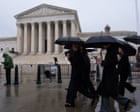
Supreme court’s Voting Rights Act ruling cited misleading data from DoJ
Coveragetap to expand ▾Spectrum: Mostly Center🌍Other: 3 · Europe: 2 · US: 1
- The Supreme Court's ruling on the Voting Rights Act cited data from the Department of Justice that was later found to be misleading (per news.google.com).
- The ruling has significant implications for voting rights protections in the United States (per news.google.com).
- The Department of Justice's data was central to the court's decision, raising questions about the accuracy and reliability of information used in judicial rulings (per news.google.com).
- The ruling has been met with criticism from voting rights advocates who fear it could undermine protections for minority voters (per theguardian.com).
- The decision has prompted calls for greater scrutiny of the data and methodologies used in court decisions (per news.google.com).
The ruling, which has significant implications for voting rights protections in the United States, has been met with criticism from voting rights advocates who fear it could undermine protections for minority voters. The Department of Justice's data, which played a central role in the court's decision, has been called into question for its accuracy and reliability.
This has led to calls for greater scrutiny of the data and methodologies used in judicial rulings, highlighting the importance of accurate information in the legal process. Some commentators suggest that the court's decision reflects a broader trend of politicization within the judiciary, raising concerns about the impartiality of the court.
The ruling has sparked a broader conversation about the role of the judiciary in shaping public policy, with differing perspectives on its implications. While some view the decision as a necessary step to address issues within the Voting Rights Act, others see it as a setback for voting rights protections.
The debate underscores the ongoing tension between legal principles and political considerations in the judicial process. As the implications of the ruling continue to unfold,
- The ruling could undermine protections for minority voters, potentially affecting their ability to participate in elections.
- Voting rights advocates fear the decision may lead to increased voter suppression efforts, particularly in states with a history of discriminatory practices.
- The decision raises concerns about the accuracy and reliability of data used in judicial rulings, highlighting the need for greater scrutiny and accountability.
- The ruling reflects broader trends of politicization within the judiciary, raising questions about the impartiality of the court.
- Whether the Department of Justice addresses the inaccuracies in the data cited by the Supreme Court.
- Potential legislative action to strengthen voting rights protections in response to the ruling.
- Future court cases that may be influenced by the precedent set by this ruling.
Left- and right-leaning outlets are covering this story differently — in which facts to emphasize, which context to include, and how to frame causes and consequences.
3 specific areas where coverage diverges — see below.
- The Guardian emphasizes the political motivations behind the ruling, while news.google.com focuses on the implications for voting rights protections.
- The accuracy of the Department of Justice's data cited in the ruling remains a point of contention.
- No source mentions the specific prior actions or decisions that led to the Supreme Court's ruling on the Voting Rights Act.