
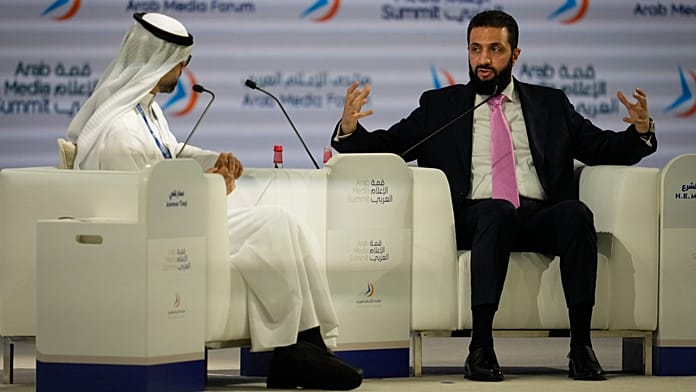
Walid al‑Moallem al‑Sharaa Warns 'Escalation Is On the Way,' Urges Regional Calm
Topic: geopoliticsRegion: europeUpdated: i2 outletsSources: 2Spectrum: Center Only⏱ 3 min read⚠ 48h+ old
Story Summary
SITUATION
Syrian Deputy Prime Minister and Foreign Minister Walid al‑Moallem al‑Sharaa warned escalation is "on the way" and urged regional powers to keep calm and keep diplomatic channels open (per euronews). Iranian President Masoud Pezeshkian said Tehran is not at war with Saudi Arabia, called for regional cooperation on peace and security, and distanced Tehran from Houthi actions (per Al Jazeera).
Coveragetap to expand ▾Spectrum: Center Only🌍Europe: 1 · ME: 1
Political Spectrum
Position is inferred from coverage mix.
i2 outlets · Center
Left
Center
Right
Left: 0
Center: 2
Right: 0
Geography Coverage
Distribution of where coverage is coming from.
i2 unique outlets · Dominant: Europe
KEY FACTS
- Walid al‑Moallem al‑Sharaa warned escalation is "on the way" and said any miscalculation could trigger wider hostilities (per euronews)
- Al‑Sharaa urged regional powers to keep calm, keep diplomatic channels open and act responsibly to avoid a larger conflict (per euronews)
- Masoud Pezeshkian called for regional countries to work together to establish peace and security (per Al Jazeera)
HISTORICAL CONTEXT
The immediate backdrop is the broader regional crisis that followed the United States and Israel’s coordinated military campaign against Iran that began with strikes in March 2026, a campaign the United States and Israeli officials framed as targeting Iranian power plants, air defenses and military infrastructure in response to a series of Iranian attacks on allied shipping and strikes on bases used by US and partner forces.
That campaign produced repeated Iranian military responses throughout 2026 aimed at degrading the coercive effect of the strikes and deterring further attacks.
Brief
Syrian Deputy Prime Minister and Foreign Minister Walid al‑Moallem al‑Sharaa warned escalation is "on the way" and urged regional powers to keep calm and maintain diplomatic channels to avoid a wider conflict, according to euronews.
Al‑Sharaa framed the current moment as precarious and warned that any miscalculation could trigger broader hostilities, placing responsibility on regional actors to act responsibly.
Iranian President Masoud Pezeshkian, in remarks carried by Al Jazeera, likewise sought to lower temperatures: he said Tehran is not at war with Saudi Arabia, described the Houthis as having "their own issues," and urged regional countries to cooperate to establish peace and security.
The two statements together show Damascus signaling alarm about spillover even as Tehran formally rejects being in direct conflict with Riyadh and distances itself from Houthi actions. Neither source links these diplomatic appeals to a specific prior strike or incident in their excerpts, so the immediate trigger for these warnings is not named in the available texts.
That gap means policymakers and analysts must treat the remarks as preventive diplomacy rather than documented responses to a single, identified action. Al‑Sharaa emphasized the risk of miscalculation and called for calm and open channels; Pezeshkian emphasized non-belligerence between Tehran and Riyadh and urged cooperative security measures.
These parallel appeals suggest Syrian and Iranian officials are trying to manage escalation dynamics among regional proxies and states while publicly signaling restraint.
The authoritative facts in the sources are statements of intent and warning rather than new military moves; confirming any linked incidents or operational shifts will require reporting beyond the excerpts provided here.
Why it matters
- Syrian civilians face the concrete risk of being killed by "wider hostilities" if miscalculations occur, because Walid al‑Moallem al‑Sharaa warned miscalculation could trigger broader fighting (per euronews). 2) Populations in countries bordering Yemen and the Red Sea could suffer disruption to shipping and livelihoods if Iran‑Saudi tensions escalate, given Masoud Pezeshkian's need to deny Tehran is at war with Saudi Arabia and to distance Tehran from the Houthis (per Al Jazeera). 3) Syrian and Iranian governments benefit from public de‑escalation messaging because it lowers immediate pressure on their diplomatic channels and reduces incentives for direct state-to-state confrontation (per euronews, Al Jazeera).
What to watch next
Whether Walid al‑Moallem al‑Sharaa issues follow-up diplomatic contacts with regional capitals or the UN within the next week. 2) Whether Masoud Pezeshkian engages Riyadh in direct talks or sends envoys to Saudi Arabia or Gulf states as a concrete step toward the cooperation he called for. 3) Whether Houthi statements or actions escalate in a way that Tehran either claims or disavows, clarifying Pezeshkian's comment that the Houthis have "their own issues". 4) Whether either Damascus or Tehran references a specific triggering incident in subsequent public statements, identifying what prompted today's warnings.
Where sources differ
7 dimensionsFraming differences
?- euronews emphasizes Syria's alarm and a warning that escalation is "on the way" (per euronews); Al Jazeera emphasizes Iran's denial of direct war with Saudi Arabia and calls for cooperation (per Al Jazeera)
Disputed or unclear
?- No source identifies a specific prior action or incident that triggered Walid al‑Moallem al‑Sharaa's warning or Masoud Pezeshkian's statements; the causal trigger is not documented in the provided excerpts
Omitted context
?- No source mentions any specific military strike, Houthi operation, or timeline that might have prompted these warnings.
- No source provides civilian casualty figures or concrete humanitarian impacts tied to the warnings.
- No source cites international legal or accountability processes (ICC, ICJ, UN) relevant to potential escalation.
- No source names economic actors or commercial stakes (shipping companies, insurers) affected by Red Sea or Gulf tensions.
Conflicting figures
?- Sources provide no numeric figures for casualties, dates of triggering incidents, or economic losses in the provided excerpts
Disputed causality
?- Euronews presents Al‑Sharaa's remarks as a warning about potential miscalculation leading to wider hostilities; Al Jazeera presents Pezeshkian's remarks as denial of war with Saudi Arabia and a call for cooperation. Neither source establishes which specific event, if any, precipitated these statements
Attribution disputes
?- Euronews attributes the warning about escalation to Walid al‑Moallem al‑Sharaa (per euronews); Al Jazeera attributes the denial of war and distancing from the Houthis to Masoud Pezeshkian (per Al Jazeera)
Sources
2 of 2 linked articles