
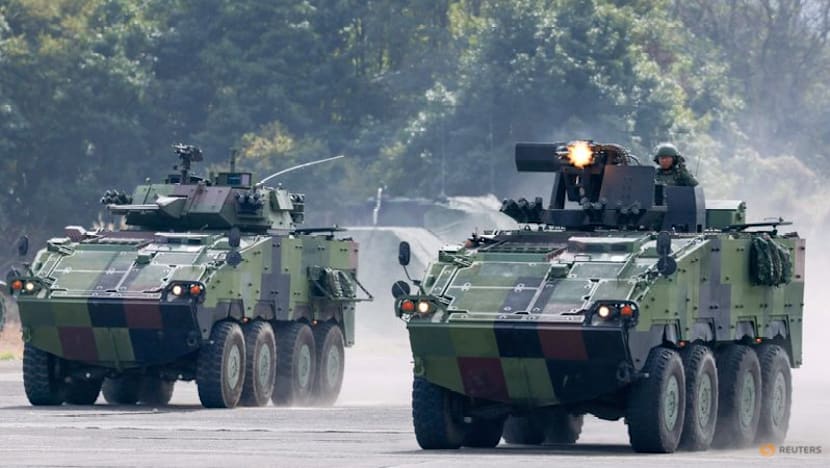
Thousands rally in Taiwan to boost defence spending amid China tensions
Topic: politicsRegion: AsiaUpdated: i3 outletsSources: 20Spectrum: Center OnlyFiltered: US/Canada (4/17)· Clear⏱ 4 min read📡 Wire pickup: 4⚠ 3d+ old
Story Summary
SITUATION
Thousands rallied in Taipei to support higher defense spending after a US military official announced a pause on a $14 billion arms sale to Taiwan. The protest reflects growing concerns over military pressure from China on the self-ruled island (per Al Jazeera).
Coveragetap to expand ▾Spectrum: Center Only🌍Other: 9 · US: 4 · Asia: 3 · ME: 1
Political Spectrum
Position is inferred from coverage mix.
i3 outlets · Center
Left
Center
Right
Left: 2
Center: 15
Right: 0
Geography Coverage
Distribution of where coverage is coming from.
i3 unique outlets · Dominant: Global
KEY FACTS
- The rally was triggered by a US military official's announcement that Washington is pausing a $14 billion arms sale to Taiwan to conserve munitions for its war on Iran (per Al Jazeera).
- Taiwan's parliament approved a $25 billion defense spending bill after months of political wrangling, which opposition lawmakers claim will primarily fund US weapons (per Japan Times).
- The approved budget falls short of the Taiwanese government's proposed budget of nearly $40 billion (per Japan Times).
- The US has been a key ally of Taiwan, providing military support amid concerns over China's assertiveness in the region (per Al Jazeera).
- The political climate in Taiwan has shifted towards prioritizing defense spending in response to perceived threats from China (per Japan Times).
HISTORICAL CONTEXT
The approval of Taiwan's NT$780 billion defense budget by its parliament is a pivotal moment in the island's ongoing efforts to fortify its military capabilities in the face of persistent threats from China. This decision is not just a reaction to immediate military pressures but is deeply rooted in Taiwan's complex political and historical landscape.
The immediate backdrop to this decision can be traced to the political stalemate that characterized Taiwan's defense budget discussions in early 2023. The Legislative Yuan, Taiwan's unicameral parliament, was embroiled in partisan divisions over the proposed defense spending, which was initially set at a higher figure.
Brief
Thousands of people gathered in Taipei to advocate for increased defense spending, driven by escalating military pressures from China and a recent announcement from a US military official regarding a pause on a significant arms sale to Taiwan.
The protest highlights the urgency felt by many Taiwanese citizens as they seek to bolster their island's defenses amid fears of potential aggression from Beijing, which considers Taiwan a breakaway province.
In a related development, Taiwan's parliament recently approved a $25 billion defense spending bill after extensive negotiations, although this amount is significantly lower than the nearly $40 billion initially proposed by the government.
Opposition lawmakers have expressed concerns that the funds will primarily be used to purchase US weapons, reflecting Taiwan's reliance on American military support.
The backdrop of these events is a broader geopolitical landscape where the US is reallocating military resources to address its commitments in the ongoing conflict in Iran, further complicating Taiwan's defense strategy.
As tensions with China continue to rise, the Taiwanese government faces increasing pressure to enhance its military capabilities and ensure national security, a sentiment echoed by the demonstrators in Taipei.
This rally and the legislative actions underscore a pivotal moment in Taiwan's defense policy, as the island navigates its relationship with both the US and China in a rapidly changing regional environment.
Why it matters
- Taiwanese citizens are advocating for increased defense spending to counter potential military threats from China, reflecting a growing sense of urgency regarding national security.
- The $25 billion defense spending bill approved by Taiwan's parliament is significantly lower than the government's proposed budget, potentially limiting the island's military capabilities (per Japan Times).
- The pause on the $14 billion arms sale from the US to Taiwan indicates a shift in US military priorities, which may impact Taiwan's defense strategy amid rising tensions with China (per Al Jazeera).
What to watch next
- Whether Taiwan's government revises its defense budget proposal in light of public pressure and geopolitical developments.
- The impact of the US military's decision to pause the $14 billion arms sale on Taiwan's defense capabilities.
- Any further protests or public demonstrations in Taiwan advocating for increased military spending or changes in defense policy.
Where sources differ
1 dimensionFraming differences
?- Al Jazeera emphasizes the immediate trigger of the rally as the US arms sale pause, while Japan Times focuses on the legislative approval of the defense spending bill.
Sources
4 of 17 linked articles · Filter: US/Canada
Protests in Taipei after parliament limits defense spending
reuters.comMay 23Left
↗
Hundreds rally in Taipei for defence spending after parliament cuts funds
reuters.comMay 23Left
↗
Taiwan Breaks Political Deadlock to Approve $25 Billion U.S. Arms Purchase
nytimes.comMay 8Left
↗
Taiwan Passes Special Defense Budget to Better Deter China
bloomberg.comMay 8Left
↗