
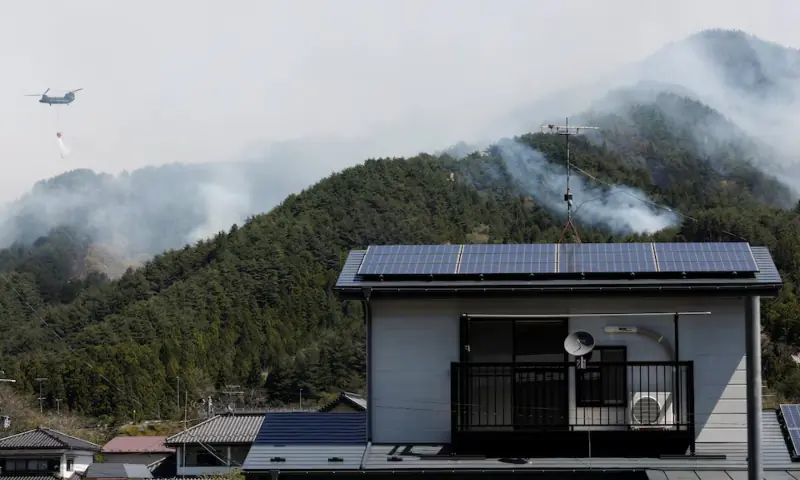
Japan Controls Massive Wildfire After 11-Day Effort in Iwate Region
Coveragetap to expand ▾Spectrum: Center Only🌍Other: 2 · ME: 1 · Asia: 1
- The wildfire in northern Japan was reportedly the second largest in over 30 years (per dawn.com).
- The firefighting efforts lasted for 11 days before the fire was brought under control (per news.google.com).
Japan has successfully contained one of its largest wildfires in decades after an intense 11-day battle. The wildfire, which scorched approximately 1,600 hectares of forest in the mountainous Iwate region, was reportedly the second largest in over 30 years. The affected area is nearly five times the size of New York City's Central Park, highlighting the scale of the disaster.
The firefighting efforts involved hundreds of firefighters and more than 1,000 military personnel, who worked tirelessly to bring the blaze under control. The fire began in late April, although the exact start date was not specified in the reports. Despite the successful containment, the cause of the fire has not been detailed in the available sources.
The scale of the operation underscores the severity of the wildfire, which posed a significant threat to the region's forests and potentially to nearby communities. The coordinated response by Japan's emergency services and military highlights the country's capacity to manage large-scale natural disasters.
While the immediate threat has been mitigated, the incident raises questions about the underlying factors contributing to such large wildfires. Climate change and land management practices are often cited as contributing factors to the increasing frequency and intensity of wildfires globally.
The successful containment of the fire is a testament to the dedication and coordination of Japan's emergency services. However, it also serves as a reminder of the ongoing challenges posed by natural disasters and the need for continued vigilance and preparedness.
As Japan assesses the damage and begins recovery efforts, attention may turn to investigating the fire's origins and implementing measures to prevent future occurrences. The incident highlights the importance of understanding and addressing the root causes of wildfires to protect both natural and human environments.
- The residents of the Iwate region bear the concrete costs, facing potential displacement and environmental damage due to the wildfire's destruction of 1,600 hectares of forest.
- Japan's emergency services and military benefit from demonstrating their capacity to manage large-scale natural disasters, reinforcing public confidence in their disaster response capabilities.
- The incident underscores the importance of addressing climate change and land management practices, which are contributing factors to the increasing frequency and intensity of wildfires globally.
- Whether Japanese authorities identify the cause of the wildfire and implement preventive measures.
- The assessment of environmental damage and recovery efforts in the Iwate region.
- Potential policy changes in Japan regarding wildfire management and prevention strategies.
- Both sources agree on the scale and containment of the wildfire, but neither provides detailed information on the cause.
- The exact start date of the fire is not specified in the sources.
- No source mentions the potential impact of climate change or land management practices on the frequency of wildfires.
- Both sources agree on the size of the affected area as 1,600 hectares.
- Sources do not provide information on what specifically triggered the wildfire.
- No source attributes responsibility for the wildfire to any specific party.