
US Employment Remains Strong Despite Slowed Job Growth
Coveragetap to expand ▾Spectrum: Mixed🌍US: 1 · Other: 1
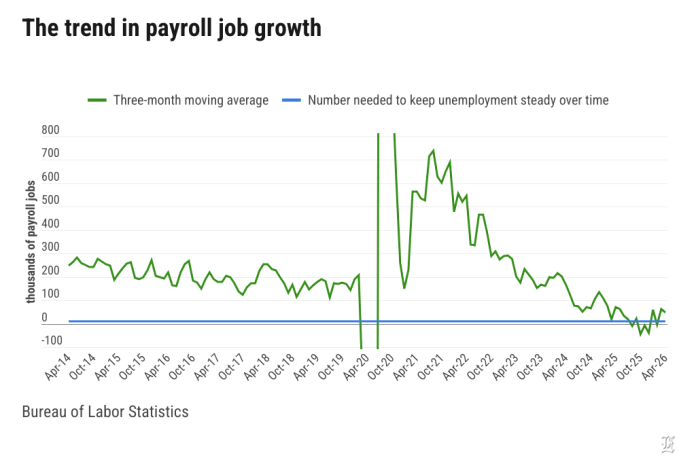
- Job growth has slowed, with a three-month moving average of 48,000 job gains in April (per washingtonexaminer.com).
- The current job growth is sufficient to keep pace with population growth and maintain low unemployment (per washingtonexaminer.com).
The latest jobs report from the United States reveals that the economy added 115,000 jobs in April, while the unemployment rate remained at a low 4.3%. This performance, although slower than in recent years, continues to support a healthy employment rate, particularly among prime-age workers aged 25 to 54, whose employment levels are near historical highs.
The Bureau of Labor Statistics data indicates a trend of slowing job growth, with the three-month moving average of job gains at 48,000 in April. Despite this slowdown, the job growth is still adequate to match population increases and sustain low unemployment rates.
Downward revisions to the job numbers for February and March have contributed to the perception of a slowing trend, yet the overall employment landscape remains robust. Analysts suggest that while the pace of job creation has decelerated, the current levels are sufficient to maintain economic stability.
The focus now shifts to how these trends will influence future economic policies and labor market strategies.
- Prime-age workers benefit from near all-time high employment levels, ensuring economic stability for this demographic.
- The US economy's ability to maintain low unemployment rates despite slower job growth supports consumer confidence and spending.
- Downward revisions to previous job numbers highlight the need for accurate data to inform policy decisions.
- Whether the US economy can sustain job growth sufficient to keep pace with population increases in the coming months.
- Potential policy adjustments by the Federal Reserve in response to the current employment trends.
- Upcoming revisions to job growth data for May and June, which could further influence economic outlooks.
Left- and right-leaning outlets are covering this story differently — in which facts to emphasize, which context to include, and how to frame causes and consequences.
1 specific area where coverage diverges — see below.
- No source mentions the potential impact of international economic conditions on US job growth.
- The influence of technological advancements on employment trends was not discussed.
- No source provided detailed analysis of sector-specific job growth or decline.