
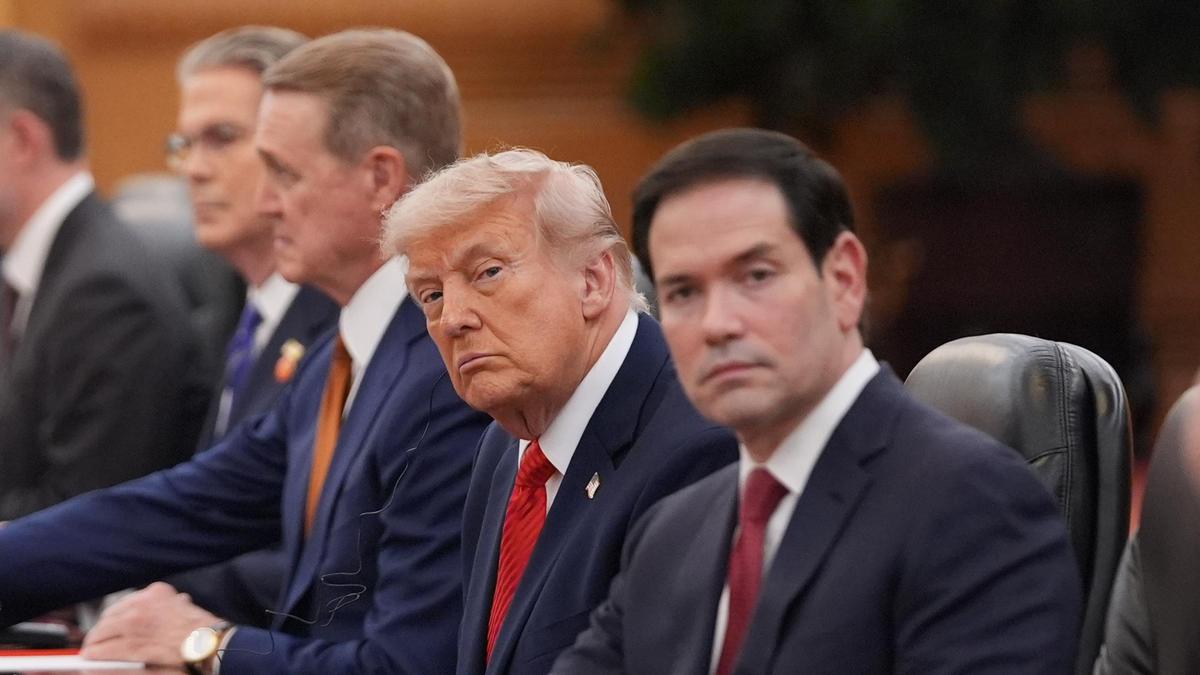
Rubio calls on China to play an ‘active’ role in ending Iran war, despite Trump rhetoric
Coveragetap to expand ▾Spectrum: Mixed🌍Europe: 2 · Asia: 2 · Other: 2 · US: 1 · ME: 1
- to persuade China to play ‘more active role’ in resolving Iran war crisis, says Marco Rubio U.S.
- Secretary of State Marco Rubio has said Washington hopes to convince Beijing during the talks between President Donald Trump and his Chinese counterpart to play a “more active role” in resolving the Iran war crisis.
- We hope to convince them to play a more active role in getting Iran to walk away from what they’re doing now and trying to do now in the Persian Gulf,” he said.
- Rubio is part of a muscular US delegation accompanying Trump to China, the first of such visit by a US president in close to a decade.
- When departing for Beijing on Tuesday, Trump told reporters that he planned to have a “long talk” with the Chinese leader about the Iran war, adding that “good things are going to happen”.
- But Trump also said he did not think he needed Xi’s help with Iran and that the US would “win it one way or the other, peacefully or otherwise”.
- US seeking to convince China to pressure Iran – Rubio Rubio argued that helping the US would ultimately benefit China’s export-oriented economy.
The ongoing debate regarding the role of the Senate in the U.S. government has gained prominence as political dynamics shift. Critics argue that the Senate has become overly compliant with executive directives, potentially undermining its constitutional role as a check on presidential power.
This perspective is fueled by recent legislative actions that some view as lacking sufficient scrutiny and debate. On the other hand, proponents of a complementary Senate argue that collaboration with the executive branch is essential for effective governance, especially in times of crisis.
They contend that a unified approach can lead to more efficient decision-making and policy implementation. The current political climate, marked by heightened partisanship and significant national challenges, has intensified these discussions.
As the Senate grapples with its identity and responsibilities, the implications for legislative effectiveness and accountability remain a critical concern for observers of American politics.
- Rubio's call for China to take a more active role in resolving the Iran war highlights the strategic importance of Sino-American cooperation in addressing global conflicts that directly impact energy markets and regional security.
- Should China engage more constructively, it could lead to a de-escalation of tensions in the Persian Gulf, benefiting not only U.S. allies in the region but also global oil consumers facing price volatility.
- Conversely, if the U.S. continues to dismiss China's potential contributions, it risks further isolating itself diplomatically and may exacerbate the conflict, negatively affecting millions who rely on stability in the region for their livelihoods.
- Watch for the Senate Foreign Relations Committee to schedule a hearing on U.S.-China relations within the next two weeks, focusing on China's involvement in global conflicts.
- Anticipate a statement from the White House regarding its stance on China's role in the Iran war, expected within 72 hours as diplomatic discussions intensify.
- Monitor the upcoming G20 summit, where leaders, including President Biden, may address the implications of China's actions in the Middle East before the event in November.
- Expect a response from China’s Foreign Ministry regarding Rubio's call for active involvement in the Iran conflict, likely to be issued within the next week.
- Keep an eye on congressional debates over potential sanctions or legislative measures aimed at China, anticipated to take place before the end of the current legislative session.
Left- and right-leaning outlets are covering this story differently — in which facts to emphasize, which context to include, and how to frame causes and consequences.