
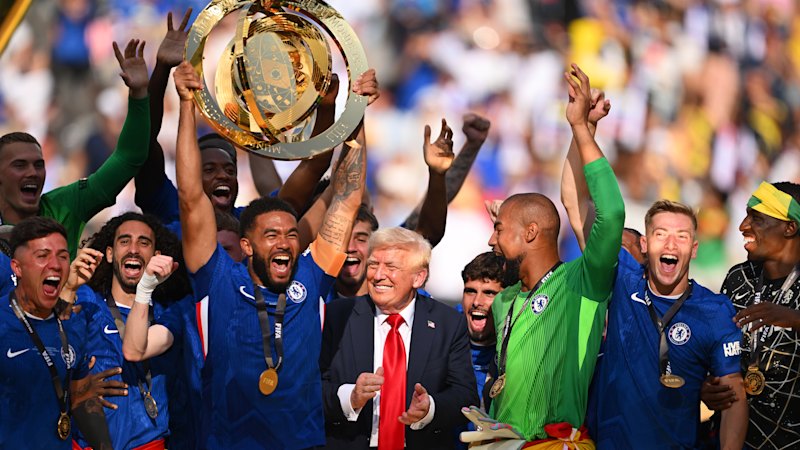
Trump's Oval Office Trophy Highlights Issues in Global Football Governance
Topic: generalRegion: North AmericaUpdated: i1 outletsSources: 1Spectrum: Left OnlyFiltered: Asia (1/1)· Clear⏱ 4 min read
Story Summary
SITUATION
The trophy displayed in Trump's Oval Office symbolizes significant flaws in world football governance. Critics argue that its presence underscores the absurdity of FIFA's operations and the potential for a restructured tournament format that lacks credibility (per smh.com.au).
Coveragetap to expand ▾Spectrum: Left Only🌍Asia: 1
Political Spectrum
Position is inferred from coverage mix.
i1 outlets · Center
Left
Center
Right
Left: 1
Center: 0
Right: 0
Geography Coverage
Distribution of where coverage is coming from.
i1 unique outlets · Dominant: Asia
KEY FACTS
- The trophy displayed in Donald Trump's Oval Office represents the ongoing criticism of FIFA's governance, particularly regarding its tournament formats.
- Critics of FIFA argue that the trophy's presence in the Oval Office highlights operational absurdities within the organization.
- The ongoing conflict between the United States and Iran, which escalated in March 2026, has impacted various sectors, including sports governance.
- In March 2026, the U.S. and Israel initiated military strikes against Iranian military targets, drawing international scrutiny.
- The geopolitical tensions resulting from the U.S.-Iran conflict have led to increased scrutiny of political leaders' actions in non-political arenas, including sports.
HISTORICAL CONTEXT
The display of the trophy in Donald Trump's Oval Office serves as a focal point for ongoing discussions about the governance of global football, particularly in light of recent controversies surrounding FIFA and its operations.
The immediate backdrop to this event includes the 2022 FIFA World Cup held in Qatar, which was marred by allegations of corruption, human rights violations, and logistical challenges. The tournament's organization raised questions about FIFA's decision-making processes, particularly regarding the selection of host nations.
Brief
The trophy displayed in Donald Trump's Oval Office has become a focal point for criticism regarding governance issues in global football. This particular trophy, one of only three in existence for the Club World Cup, symbolizes the absurdities and controversies that plague the sport today.
Critics argue that its presence in such a prominent location trivializes the serious governance challenges facing football, especially as the sport grapples with proposals to alter the frequency of major tournaments.
Recently, discussions have emerged about the possibility of hosting the Club World Cup every two years instead of the traditional four, a move that has sparked debate among fans and officials alike.
Cole Palmer, who was awarded man of the match in a recent final, expressed his confusion about the trophy's significance, further illustrating the disconnect between the sport's elite and its fanbase. The trophy has also gained notoriety on social media, becoming a meme during presidential announcements and high-level meetings, which some argue diminishes its value.
As football continues to evolve, the ongoing dialogue about its governance and commercialization remains critical, with many calling for reforms to ensure the sport's integrity and connection to its global audience.
Why it matters
- The presence of the trophy in Trump's Oval Office highlights the deep-seated issues within FIFA's governance, raising concerns among players, fans, and stakeholders about the integrity of international football.
- As the geopolitical tensions between the U.S. and Iran escalate, the scrutiny on sports governance intensifies, potentially undermining the credibility of tournaments that rely on fair play and transparency.
- This situation could lead to diminished trust among fans and sponsors, ultimately affecting funding and support for grassroots football initiatives in regions already struggling with political instability.
What to watch next
- FIFA is expected to announce a review of its governance structure within the next 30 days, aiming to address ongoing criticisms and improve transparency.
- The Asian Football Confederation (AFC) will hold a meeting next week to discuss potential reforms in tournament formats, focusing on enhancing credibility and fairness.
- Key stakeholders, including major football clubs and national federations, are set to convene within 72 hours to strategize on a unified response to the governance issues highlighted by the trophy's presence.
- A coalition of football reform advocates plans to release a comprehensive report by the end of the month, detailing proposed changes to FIFA's operational practices and tournament structures.
Sources
1 of 1 linked articles · Filter: Asia