
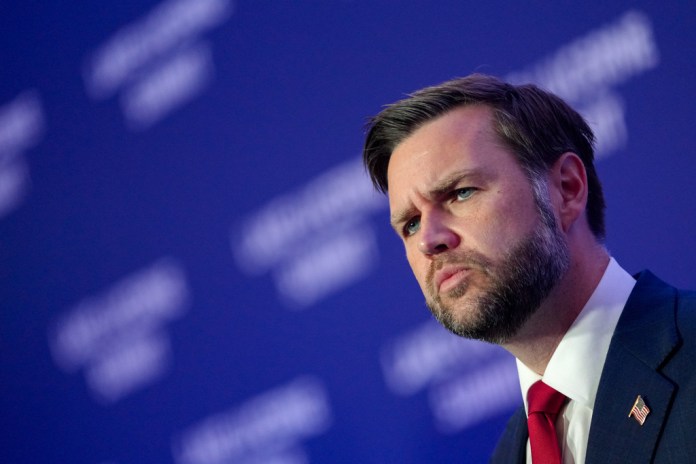
Vice President JD Vance Champions Peace Efforts in Iran Negotiations
Coveragetap to expand ▾Spectrum: Mostly Center🌍US: 2 · Europe: 1
- One longtime GOP operative, a veteran of Trump’s past two presidential campaigns, said that Vance has been an important part of addressing criticisms of the Iran deal coming from within the president’s own party.
- “The vice president has been pushing to avoid a war with Iran since Day 1.
- Vance plays good cop amid Iran talks Vice President JD Vance has become the face of the Iran deal, leaving two immediate tasks before him: negotiate a final peace deal and ultimately sell it to the public.
- Vice President JD Vance has become the face of the Iran deal, leaving two immediate tasks before him: negotiate a final peace deal and ultimately sell it to the public.
- “Couple that with the fact that Vance has been a critical player in advancing talks to this point already, and I think that the president trusts him 100% on the issue.
Vice President JD Vance is taking a prominent role in the ongoing negotiations regarding the Iran deal, emphasizing the need for peace and a resolution to avoid military conflict. Since assuming office, Vance has consistently advocated for diplomatic engagement with Iran, positioning himself as a key player in shaping the administration's approach to the negotiations.
His responsibilities include not only negotiating the terms of a final peace deal but also addressing the concerns and criticisms that arise from within the Republican Party, particularly those aligned with President Donald Trump.
Vance's strategy involves framing Trump's more aggressive public statements as reactions to perceived provocations from Iran, which he refers to as 'trash talk.' This framing is intended to maintain cohesion within the party while advancing the negotiations.
As the situation develops, Vance's ability to balance these internal dynamics with the demands of international diplomacy will be crucial in determining the outcome of the talks and the potential for lasting peace in the region.
- The success of Vice President JD Vance's peace negotiations with Iran could significantly alter the security landscape for U.S. allies in the Middle East, particularly Israel, by reducing the immediate threat of military escalation.
- A peaceful resolution could also stabilize oil markets, benefiting global economies that rely on energy imports, while alleviating the humanitarian crisis faced by Iranian civilians affected by ongoing sanctions and military actions.
- If Vance can effectively communicate the benefits of the deal to the American public, it may foster greater bipartisan support for diplomatic solutions over military interventions, reshaping U.S. foreign policy in the region for years to come.
- Watch for a statement from Secretary of State Antony Blinken regarding the U.S. stance on Iran's nuclear program, expected within 48 hours.
- Anticipate a response from Iranian officials on the proposed peace framework, likely to be released before the end of the week.
- Look for a joint press conference featuring Vice President JD Vance and Canadian Prime Minister Justin Trudeau, scheduled for next Tuesday, to discuss North American diplomatic efforts.
- Expect a briefing from the National Security Council on the implications of the negotiations for U.S. foreign policy, set to occur within the next 72 hours.
- Monitor upcoming discussions in the United Nations Security Council regarding sanctions on Iran, anticipated to take place before the June summit.
Left- and right-leaning outlets are covering this story differently — in which facts to emphasize, which context to include, and how to frame causes and consequences.