
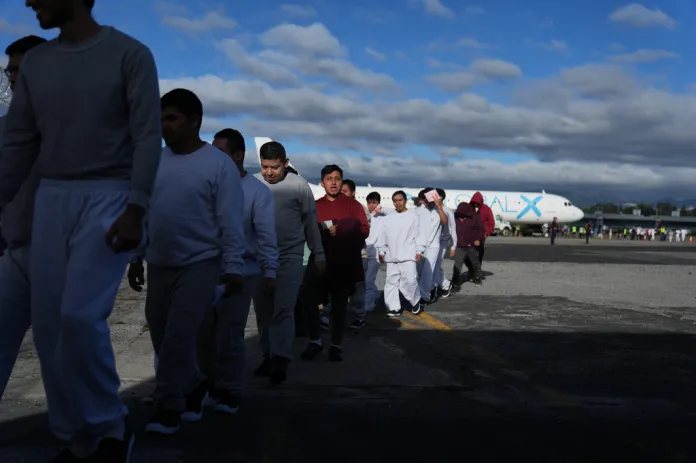
Trump administration flies about 23,000 migrants to third countries under new deportation deals
Topic: generalRegion: North AmericaUpdated: i1 outletsSources: 1Spectrum: Right Only⏱ 3 min read
Story Summary
SITUATION
The Trump administration has flown roughly 23,000 migrants to third countries that are not their homes using deals with about 35 governments to expand deportations. Advocates say the practice pressures undocumented immigrants and differs from traditional safe-third-country agreements because migrants cannot opt in, while officials say it increases removals (per Washington Examiner).
Coveragetap to expand ▾Spectrum: Right Only🌍US: 1
Political Spectrum
Position is inferred from coverage mix.
i1 outlets · Right
Left
Center
Right
Left: 0
Center: 0
Right: 1
Geography Coverage
Distribution of where coverage is coming from.
i1 unique outlets · Dominant: US/Canada
KEY FACTS
- Approximately 23,000 individuals have been flown from the United States to countries where they have no citizenship, family ties, or personal connections (per Washington Examiner).
- The administration has secured deals with roughly 35 countries to receive deported individuals who are not originally from those destinations (per Washington Examiner).
- Departments involved include the Department of Homeland Security and the Department of State, and Immigration and Customs Enforcement has increased flights under the policy (per Washington Examiner).
- The policy is being used to pressure undocumented immigrants to leave voluntarily or be sent abroad, rather than as an opt-in safe-third-country program (per Washington Examiner).
- The practice historically was used rarely but now represents a small percentage of more than 1 million illegal immigrants DHS says it removed during the second Trump administration (per Washington Examiner).
- Mexico has historically been the biggest partner in accepting deported immigrants who were not originally from Mexico (per Washington Examiner).
HISTORICAL CONTEXT
The immediate backdrop is an intensified U.S. immigration-enforcement drive under the Trump administration that builds on expanded removal authorities and interagency coordination since 2025.
Structurally, current practices rest on the Immigration and Nationality Act (codified 1952-06-27), the Illegal Immigration Reform and Immigrant Responsibility Act of 1996 (IIRIRA, enacted 1996-09-30) which broadened expedited removal, and the post‑9/11 reorganization that created the Department of Homeland Security (Homeland Security Act, signed 2002-11-25) and U.S.
Brief
The Trump administration has accelerated deportations by flying roughly 23,000 migrants to third countries that are not their countries of citizenship, using agreements with about 35 governments to expand the pool of destinations (per Washington Examiner).
U.S. officials from the Department of Homeland Security and the Department of State, working with Immigration and Customs Enforcement, have increased charter flights under those deals to remove people whose home governments will not accept them (per Washington Examiner).
Advocates and critics describe the program as a pressure tactic that nudges undocumented migrants toward voluntary departure or forces removal to nations where they have no ties; the administration frames it as a tool to increase overall removals (per Washington Examiner).
The deals differ from conventional safe-third-country arrangements because migrants are not given an opt-in choice to accept transfer to the receiving state; instead, the policy moves people directly under negotiated terms with partner governments (per Washington Examiner).
Officials say the flights account for a small fraction of the more than 1 million removals DHS says it has carried out during the second Trump administration, but the program's use marks a notable shift from past practice when third-country deportations were rare (per Washington Examiner).
Mexico remains, historically, the largest partner in accepting non-Mexican deportees, though the recent round of agreements spreads destinations across roughly 35 states willing to receive transfers (per Washington Examiner).
Humanitarian groups warn that sending people to countries where they lack family, legal status, or protection can expose migrants to new vulnerabilities; critics also question the legal and diplomatic mechanics of transferring people without opt-in procedures (per Washington Examiner).
The administration argues financial incentives and diplomatic pressure secured participation from partner governments and that broader use of third-country removals helps Customs and Border Protection and ICE manage migration flows (per Washington Examiner).
For now, the program's scale — about 23,000 flights-based removals — is verifiable in government tallies cited by the outlet, but independent verification of conditions in receiving countries and the long-term outcomes for transferred migrants is not provided in the reporting (per Washington Examiner).
Why it matters
- - Migrants sent: About 23,000 migrants face being placed in countries where they have no citizenship or family ties, exposing that specific population to legal and protection gaps (per Washington Examiner). - Enforcement impact: The Department of Homeland Security, Department of State, and ICE expanded flight removals, shifting enforcement capacity toward third-country transfers and affecting how ICE allocates removal resources (per Washington Examiner). - Recipient incentives: Roughly 35 governments accepting transfers received financial or diplomatic inducements, benefitting those governments and U.S. diplomatic leverage while shifting humanitarian burdens onto specific migrant populations (per Washington Examiner). - Legal and procedural stakes: The lack of an opt-in option distinguishes this practice from safe-third-country frameworks, creating legal and due-process questions for the migrants affected (per Washington Examiner).
What to watch next
Whether the Department of Homeland Security and Immigration and Customs Enforcement increase the number of third-country flights above the reported ~23,000 total this year (per Washington Examiner). 2) Whether the Department of State secures additional agreements beyond the reported roughly 35 participating countries by the end of the fiscal year (per Washington Examiner). 3) Whether Congress or courts challenge the policy’s lack of opt-in procedures in specific litigation or legislation in the next session (per Washington Examiner). 4) Whether Mexico’s historical role changes if Mexico or other major partners alter acceptance policies for non-citizen deportees (per Washington Examiner).
Where sources differ
7 dimensionsFraming differences
?- Only Washington Examiner is in this pack; it frames the policy as an administration-driven acceleration of deportations and emphasizes pressure tactics and financial/diplomatic inducements (per Washington Examiner).
Disputed or unclear
?- No source in this pack disputes the 23,000 figure or the ~35 participating countries; independent verification of outcomes for transferred migrants is not provided (per Washington Examiner).
Omitted context
?- No source mentions the legal processes governing migrant consent or specific court rulings that might constrain forced third-country transfers.
- No source provides independent reporting on conditions or legal status outcomes for migrants after transfer to the receiving countries.
- No source names which specific 35 countries agreed to receive transfers or the amounts of financial incentives provided to them.
Conflicting figures
?- Washington Examiner reports ~23,000 migrants flown and roughly 35 partner countries; no alternative figures appear in this pack (per Washington Examiner).
Disputed causality
?- The reporting attributes the expansion to deals struck by the administration and to ICE increasing flights, but does not cite a prior triggering event beyond policy decisions by DHS and State (per Washington Examiner).
Attribution disputes
?- Washington Examiner attributes the policy to actions by the Department of Homeland Security, the Department of State, and Immigration and Customs Enforcement (per Washington Examiner).
Sources
1 of 1 linked articles