
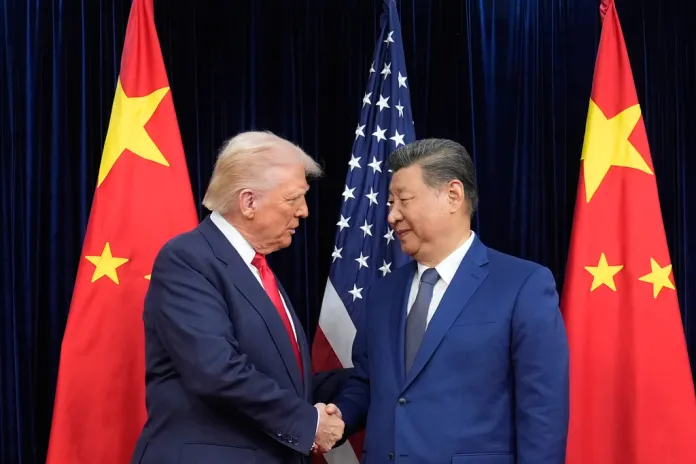
Trump and Xi to Meet Amid Rising Global Tensions and Economic Instability
Coveragetap to expand ▾Spectrum: Right Only🌍US: 1
- President Donald Trump and Chinese President Xi Jinping will meet later this month (per washingtonexaminer.com).
- The meeting is seen as a chance to forge a new path for U.S.-China relations, breaking away from cycles of mistrust (per washingtonexaminer.com).
- President Trump is recognized for understanding the economic competition between the U.S. and China (per washingtonexaminer.com).
- There is a consensus in Washington urging Trump to take necessary actions to reorient the relationship with China (per washingtonexaminer.com).
President Donald Trump and Chinese President Xi Jinping are preparing for a pivotal meeting later this month, set against a backdrop of global economic instability and rising oil prices. This meeting is seen as a crucial opportunity to address the deteriorating relations between the United States and China, which have been marked by cycles of mistrust and security concerns.
Both leaders are under pressure to stabilize the situation as regional conflicts continue to simmer, threatening further economic disruption. The meeting comes at a time when both nations are seeking to assert control over an increasingly unstable global economy. Rising oil prices have exacerbated economic challenges, adding urgency to the discussions between the two leaders.
The potential for this meeting to reshape U.S.-China relations is significant, as it offers a chance to move beyond the entrenched patterns of competition and suspicion that have characterized their interactions in recent years.
President Trump is noted for his approach to the China challenge, recognizing the economic competition between the two countries and advocating for measures to avoid confrontation. This perspective is seen as a departure from previous administrations, which often struggled to balance economic interests with security concerns.
In Washington, there is a prevailing consensus urging Trump to take decisive actions that could reorient the relationship with China. This includes addressing trade imbalances and security issues that have long been points of contention. However, the path forward is fraught with challenges, as both nations must navigate complex geopolitical dynamics and domestic pressures.
The stakes are high for both leaders, as the outcome of this meeting could set the tone for future interactions and influence global economic stability. For President Xi, maintaining a stable relationship with the United States is crucial for China's economic growth and regional influence.
Similarly, President Trump is keen to demonstrate his ability to manage international relations effectively, particularly in the face of domestic political pressures. As the world watches, the meeting between Trump and Xi represents a critical juncture in U.S.-China relations.
The potential to forge a new path forward is tempered by the realities of economic competition and geopolitical tensions, making this a meeting of significant consequence for both nations and the broader international community.
- The global economy faces instability due to rising oil prices, impacting consumers and businesses worldwide.
- U.S.-China relations are at a critical juncture, with potential impacts on global trade and security.
- President Trump's approach to China could redefine economic and security dynamics between the two nations.
- The outcome of the Trump-Xi meeting could influence regional conflicts and economic policies globally.
- Whether President Trump takes decisive actions to reorient U.S.-China relations following the meeting.
- The impact of the Trump-Xi meeting on global oil prices and economic stability.
- Potential shifts in U.S. and China trade policies as a result of the discussions.
- No significant framing differences noted as only one source was provided.
- No disputed or unclear facts noted as only one source was provided.
- No source mentions the specific regional conflicts contributing to global instability.
- No differing figures noted as only one source was provided.
- No causality disagreements noted as only one source was provided.
- No differing attributions noted as only one source was provided.