
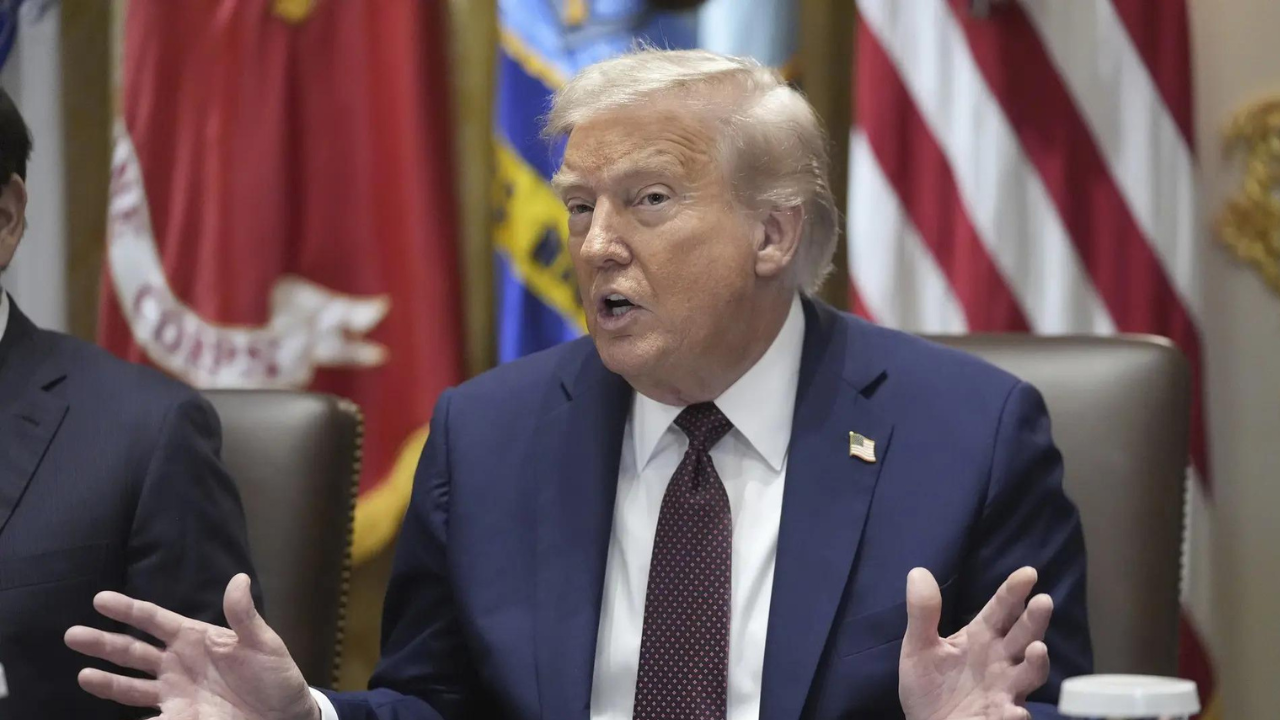
Trump says Iran war is nearing its end; will meet Gulf leaders at UN to shape postwar plan
Topic: defense & securityRegion: North AmericaUpdated: i3 outletsSources: 6Spectrum: Mostly Center⏱ 3 min read📡 Wire pickup
Story Summary
SITUATION
US President Donald Trump said he hopes the war with Iran is nearing its end and told reporters he had heard from Iran directly (per straitstimes.com). Axios reported he is expected to meet leaders and foreign ministers from Gulf Cooperation Council countries on the sidelines of the UN General Assembly to discuss postwar strategy, a meeting the State Department began inviting participants to (per timesofindia.indiatimes.com).
Coveragetap to expand ▾Spectrum: Mostly Center🌍Asia: 2 · ME: 1
Political Spectrum
Position is inferred from coverage mix.
i3 outlets · Center
Left
Center
Right
Left: 1
Center: 2
Right: 0
Geography Coverage
Distribution of where coverage is coming from.
i3 unique outlets · Dominant: Asia
KEY FACTS
- US President Donald Trump said he hoped the war with Iran was nearing its end and told reporters he had heard from Iran "directly" (per straitstimes.com)
- Axios reported that Trump is expected to meet Gulf Cooperation Council leaders on the sidelines of the UN General Assembly to discuss a postwar strategy (per straitstimes.com)
- Three sources told Axios that Trump will meet leaders and foreign ministers from Gulf Cooperation Council countries in New York next Tuesday to discuss next steps in the war with Iran and postwar plans (per timesofindia.indiatimes.com)
- The US State Department sent initial invitations for the meeting on Wednesday and the meeting is expected to include Saudi Arabia, the UAE, Qatar, Bahrain, Kuwait and Oman (per timesofindia.indiatimes.com)
- straitstimes.com dated its reporting by noting Trump spoke on Sept 16 when he said he hoped the war was nearing its end (per straitstimes.com)
HISTORICAL CONTEXT
The immediate backdrop is the active March 2026 US–Israel military campaign against Iran, a coordinated round of strikes that targeted Iranian power plants, air‑defense systems and military infrastructure; Iranian missile and drone launches throughout 2026 have been publicly framed by Tehran as responsive military actions to that campaign.
Structurally, the current confrontation sits atop the collapse of the 2015 Joint Comprehensive Plan of Action (JCPOA), from which the United States formally withdrew in May 2018 under President Donald Trump; Tehran responded to that withdrawal by gradually exceeding the JCPOA’s enrichment and stockpile limits in the months and years that followed.
Brief
US President Donald Trump told reporters he had heard from Iran "directly" and said he hoped the war with Iran was nearing its end, a claim reported by straitstimes.com.
Axios, cited by both outlets, says the White House plans to use next week’s UN General Assembly in New York to convene Gulf Cooperation Council leaders and foreign ministers to sketch a postwar strategy; the State Department sent initial invitations this week and the meeting is expected to include Saudi Arabia, the UAE, Qatar, Bahrain, Kuwait and Oman (per timesofindia.indiatimes.com).
The two outlets differ in emphasis: straitstimes.com highlights Trump’s public comment on Sept 16 about hearing from Iran, while timesofindia.indiatimes.com emphasizes the logistics and guest list for a scheduled New York meeting sourced to three unnamed Axios sources.
Neither outlet provides names of the Axios sources or a detailed agenda for the meeting, so confirmed objectives remain limited to “next steps” and “postwar plans” as described in the reporting (per timesofindia.indiatimes.com; straitstimes.com).
Trump’s statement and the planned Gulf meeting come as the administration seeks partner buy-in for how to manage the conflict’s aftermath and regional security arrangements; the outlets show the US presenting the New York meeting as an initial coordination step rather than a finalized plan (per timesofindia.indiatimes.com, straitstimes.com).
The reporting confirms invitations were issued by the State Department but does not document which additional Arab or Muslim leaders beyond the GCC list will attend or what concrete commitments—military, economic, or diplomatic—might emerge from the discussions (per timesofindia.indiatimes.com).
For now, the verified facts are limited to Trump’s public comment about Iran, Axios’s report of an expected Gulf leaders meeting at the UN, and the State Department’s initial invitations to GCC members; claims about postwar strategy content remain unconfirmed by the cited outlets (per straitstimes.com; timesofindia.indiatimes.com).
Why it matters
- - Residents of Gulf Cooperation Council countries bear concrete political and security costs if the postwar plan includes new military basing or defense commitments; those mechanics are currently undefined in the State Department invitations described in reporting (per timesofindia.indiatimes.com). - US diplomatic leverage with Saudi Arabia, the UAE, Qatar, Bahrain, Kuwait and Oman stands to increase if those governments formally coordinate on postwar arrangements that align with Trump administration aims; Axios reported the planned meeting seeks that coordination (per timesofindia.indiatimes.com). - Iranian and Gulf populations face the risk of continued military operations unless parties agree on specific de-escalation steps; sources confirm only that invitations were sent and that Trump says he has heard from Iran, not that a ceasefire or exit plan is agreed (per straitstimes.com; timesofindia.indiatimes.com).
What to watch next
Whether leaders and foreign ministers from Saudi Arabia, the UAE, Qatar, Bahrain, Kuwait and Oman attend the UN meeting that Axios says is planned for next Tuesday (per timesofindia.indiatimes.com). 2) Whether the US State Department circulates a documented agenda or readout specifying military, economic, or diplomatic postwar commitments by the time of the UN meeting (per timesofindia.indiatimes.com). 3) Whether President Donald Trump provides evidence or officials produce corroboration for his statement that he "had heard from Iran directly" before or at the UN meetings (per straitstimes.com).
Where sources differ
7 dimensionsFraming differences
?- straitstimes.com foregrounds Trump’s Sept 16 comment that he had heard from Iran directly and that the war may be nearing its end; timesofindia.indiatimes.com foregrounds Axios’s sourcing about a planned meeting and the State Department invitations without repeating Trump’s quoted line (per straitstimes.com; timesofindia.indiatimes.com).
Disputed or unclear
?- Neither source confirms the meeting’s final attendee list beyond the GCC members named by timesofindia.indiatimes.com, and neither source verifies the meeting’s agenda or outcomes (per timesofindia.indiatimes.com; straitstimes.com).
Omitted context
?- No source in this pack mentions prior triggering military or diplomatic actions that led to the current US-Iran war phase, nor do they provide civilian casualty figures tied to recent strikes; neither source cites ICC/ICJ procedures or named economic interests behind postwar proposals.
Conflicting figures
?- timesofindia.indiatimes.com names the six Gulf states expected to be invited: Saudi Arabia, the UAE, Qatar, Bahrain, Kuwait and Oman; straitstimes.com reports Trump spoke on Sept 16 (per timesofindia.indiatimes.com; straitstimes.com).
Disputed causality
?- straitstimes.com reports Trump said he had "heard from Iran directly" and framed the war as nearing its end; timesofindia.indiatimes.com reports a separate Axios-sourced diplomatic meeting plan—neither source establishes that the claimed contact with Iran directly caused the scheduling of the Gulf meeting.
Attribution disputes
?- straitstimes.com attributes the quote about hearing from Iran directly to President Donald Trump; timesofindia.indiatimes.com attributes the planned meeting and guest list to three unnamed sources cited by Axios (per straitstimes.com; timesofindia.indiatimes.com).
Related Developments2 stories
Trump Meets Skeptical World Leaders at UN After Six Months of War with Iran, Energy Costs Rise
President Donald Trump will face skeptical world leaders at the United Nations after his decision to launch a war between US forces and Iran produced six months of conflict. That war has driven regional instability and higher energy prices, leaving US allies refusing his requests for assistance and threatening his standing ahead of November's midterm elections (per Straitstimes).
19h ago
Houthi drone and missile strikes damage Saudi East-West oil pipeline as Saudi jets hit Yemen
Houthi fighters launched drones and missiles that damaged Saudi Arabia's East‑West oil pipeline, and Saudi aircraft struck targets in Yemen. Outlets differ on emphasis: coverage highlights pipeline damage and Saudi strikes broadly, while political commentary links the fighting to hopes President Donald Trump expressed about an end to the Iran war (per thehindu.com, news.google.com).
1d ago
Sources
6 of 6 linked articles
Trump again voices hope Iran war is nearing its end
timesofisrael.comSep 17Left
↗
'Iran reached out directly, hopefully towards end of war': Donald Trump says Tehran wants to make a deal
m.dailyhunt.inSep 17Left
↗
Trump hopes Iran war nearing end as Houthi-Saudi fighting escalates
reuters.comSep 17Left
↗
Trump says 'hopefully we are towards end' of Iran war
straitstimes.comSep 17Left
↗
Trump to meet Gulf leaders at UN over Iran war, postwar strategy: Report
timesofindia.indiatimes.comSep 17Left
↗
Trump says war nearing conclusion, claims Iran directly reached out to US
saudigazette.com.saSep 17Left
↗