
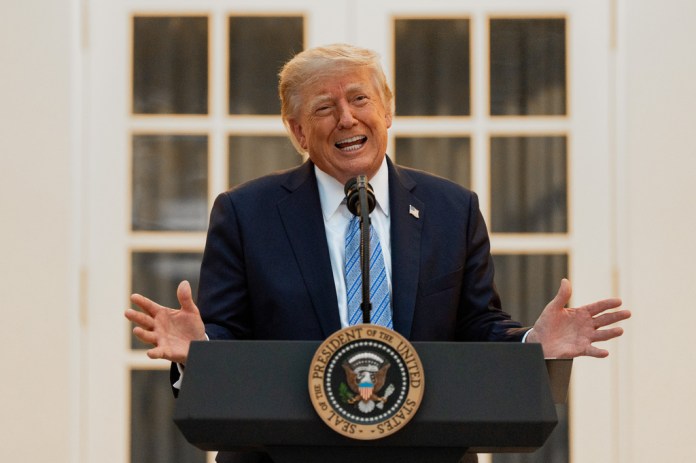
Supreme Court, judge and Fed curtail key Trump initiatives, White House fights back
Coveragetap to expand ▾Spectrum: Mostly Center🌍US: 1 · Asia: 1
- President Donald Trump attacked the Supreme Court on Tuesday after the ruling and posted video of the Kennedy Center’s corrosion and deterioration (per Washington Examiner)
- Trump defended his Federal Reserve chairman pick Kevin Warsh following a Federal Reserve rate hike and noted Warsh voted with other policymakers to address elevated inflation (per Washington Examiner)
- Trump posted on Truth Social that the only control needed for AI was “a STRONG AND SMART (High IQ!) PRESIDENT, and the U.S.A. has that, in spades!” (per Washington Examiner)
The Supreme Court blocked the Trump administration’s new limits on mail-in ballots, and a federal judge separately barred adding President Donald Trump’s name to the Kennedy Center, precipitating a rare, multi-front setback for the White House (per Washington Examiner).
The rulings prompted an immediate public counterattack from the president: he attacked the Court, posted footage highlighting the Kennedy Center’s corrosion, and sought to shift attention toward personnel and economic policy by defending his Federal Reserve pick Kevin Warsh after the Fed raised interest rates (per Washington Examiner).
Trump framed his public messaging as both institutional critique and political theatre, using Truth Social to proclaim that AI only needs “a STRONG AND SMART (High IQ!) PRESIDENT,” and by posting images intended to embarrass the judiciary and supporters of the Kennedy Center ruling (per Washington Examiner).
The White House justified its Fed advocacy by noting Warsh voted alongside other policymakers to address elevated inflation; Trump presented that defense as proof of sound economic judgment despite the court and judge undercutting two of his domestic priorities (per Washington Examiner).
Reporting in the Examiner emphasizes Trump's combative, personalized response to the legal setbacks rather than legal strategy or appeals, portraying the president as shifting to public pressure tactics; the article does not present significant contrary sourcing that frames the rulings as routine judicial checks on executive overreach (per Washington Examiner).
These simultaneous legal and policy reversals complicate the administration’s short-term agenda by removing two high-visibility domestic wins and forcing the White House to choose whether to pursue further litigation, legislative fixes, or continued public pressure campaigns; the Examiner documents the immediate actions taken by the president but does not specify next legal steps (per Washington Examiner).
- - Kennedy Center visitors and the institution’s board bear reputational and operational costs from the litigation and public spectacle: the judge’s block prevents the planned renaming and the president’s posted footage foregrounds physical deterioration as a political issue (per Washington Examiner). - Voters who rely on mail-in ballots face uncertainty about the rules governing absentee and mail voting because the Supreme Court blocked the administration’s new limits, potentially affecting ballot access procedures in upcoming elections (per Washington Examiner). - President Donald Trump and his political team lose two high-visibility policy and legacy wins—naming the Kennedy Center and new mail-in ballot rules—reducing immediate domestic policy leverage; Trump’s defense of Kevin Warsh signals he seeks to shore up economic credibility (per Washington Examiner). - Kevin Warsh and the Federal Reserve’s policymaking gain public scrutiny: Trump’s public defense ties Warsh’s rate-vote to the administration’s inflation narrative and elevates Warsh politically (per Washington Examiner).
Whether President Donald Trump pursues an appeal or other legal action to overturn the Kennedy Center naming block in the courts. 2) Whether the administration seeks emergency or legislative changes to mail-in ballot rules after the Supreme Court blocked the new restrictions. 3) Whether Kevin Warsh receives further public endorsements from the White House or faces confirmation-related pushback following the Fed rate decision. 4) Whether Trump continues to use Truth Social and public postings about the Kennedy Center to pressure judicial or cultural actors in the coming weeks.
Left- and right-leaning outlets are covering this story differently — in which facts to emphasize, which context to include, and how to frame causes and consequences.
7 specific areas where coverage diverges — see below.
- Washington Examiner frames Trump’s actions as an aggressive, public counterattack—attacking the Court and posting footage of the Kennedy Center’s deterioration—without providing alternate outlets’ perspectives (per Washington Examiner)
- No source in this pack disputes the sequence of events; however, the Examiner does not provide opposing legal or institutional defenses from the Supreme Court, the judge, or the Kennedy Center board (per Washington Examiner)
- No source in this pack mentions the specific legal grounds the Supreme Court used to block the mail-in ballot restrictions; readers lack details of the Court’s rationale (per Washington Examiner).
- No source mentions the identity of the judge or the precise legal basis for blocking the Kennedy Center name change (per Washington Examiner).
- No source provides numbers on how many voters or jurisdictions would be affected by the blocked mail-in ballot restrictions (per Washington Examiner).
- No source discusses potential legislative routes or timelines for the administration to change voting rules after the Court’s decision (per Washington Examiner).
- The pack contains no differing numerical figures for the same quantity; specific vote counts, dollar amounts, or casualty figures are not provided (per Washington Examiner)
- The article presents the president’s public attacks as a response to the court and judge rulings, and it names those rulings as triggers for his actions (per Washington Examiner)
- Washington Examiner attributes the facts above to the White House’s actions and to President Donald Trump’s posts and statements; no other outlet attribution is present (per Washington Examiner)