
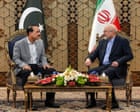
US and Iran close to temporary truce, Pakistani officials claim
Topic: defense & securityRegion: Middle EastUpdated: i4 outletsSources: 32⚠ Bias gap — sources divergeSpectrum: Center Only⏱ 4 min read📡 Wire pickup: 2⚠ 3d+ old
Story Summary
SITUATION
Trump says Iran ceasefire deal in final stages, to be ‘announced shortly’ Trump says Iran ceasefire deal in final stages, to be ‘announced shortly’
- The Washington Post
Coveragetap to expand ▾Spectrum: Center Only🌍Other: 16 · US: 6 · Europe: 4 · Asia: 2 · ME: 1
Political Spectrum
Position is inferred from coverage mix.
i4 outlets · Center
Left
Center
Right
Left: 4
Center: 25
Right: 0
Geography Coverage
Distribution of where coverage is coming from.
i4 unique outlets · Dominant: Global
KEY FACTS
- Trump says Iran ceasefire deal in final stages, to be ‘announced shortly’
- Trump says Iran ceasefire deal in final stages, to be ‘announced shortly’ - The Washington Post
- Trump says negotiators are getting closer to Iran deal, media interviews show - The Economic Times
- Iran's top negotiator says Tehran will not compromise on its rights
HISTORICAL CONTEXT
The geopolitical tensions between the United States and Iran have reached a critical juncture in 2026, as former President Donald Trump publicly urges Iran to 'get smart soon' and accept a nuclear deal. This statement comes amid a backdrop of heightened military conflict and diplomatic strife, underscoring the complex dynamics that have long characterized US-Iran relations.
The immediate context of Trump's remarks is the coordinated military strikes launched by the United States and Israel against Iran in early March 2026. This military campaign is part of a broader strategy aimed at countering Iran's nuclear ambitions, which the US and its allies perceive as a significant threat to regional and global security.
Brief
Pakistani officials have reported that the United States and Iran are nearing a temporary truce, with a basic interim deal potentially being finalized over the weekend. This development comes amid a flurry of diplomatic activity aimed at preventing renewed US strikes on Iran, which have been a significant concern following recent escalations in the region.
Iranian officials, including top negotiator Mohammad Baqer Qalibaf, have made it clear that while they are engaging in talks, they will not compromise on what they consider their national rights. This stance reflects Iran's ongoing efforts to assert its position amidst the backdrop of military tensions and a fragile ceasefire.
President Trump has indicated that the ceasefire deal is in its final stages, suggesting a possible resolution could be imminent. However, he has also warned that the US is prepared to take further military action if necessary, highlighting the precarious nature of the current negotiations.
The situation remains fluid, with both sides testing each other's resolve through a mix of diplomatic overtures and military posturing. As the US reviews Iran's proposals, the outcome of these discussions could significantly impact the ongoing conflict in the Middle East.
Where sources differ
Bias gap0.50 / 2.0
Left- and right-leaning outlets are covering this story differently — in which facts to emphasize, which context to include, and how to frame causes and consequences.
Left-leaning (4)
guardian_world-0.50
Trump to meet with US negotiators to decide on Iran’s ceasefire proposal Iran hosts Pakistani delegation amid diplomatic flurry to avert new US strikes Iran’s top negotiator said e…
washingtonpost.com-0.35
Trump says Iran ceasefire deal in final stages, to be ‘announced shortly’ Trump says Iran ceasefire deal in final stages, to be ‘announced shortly’ - The Washington Post
middle_east_eye-0.35
Iran's top negotiator says Tehran will not compromise on its rights Iran's top negotiator says Tehran will not compromise on its rights Iran's top negotiator says Tehran will not c…
nytimes.com-0.30
Trump Weighs His Options in Carrying Out New Strikes in Iran. Reporting is limited at this stage.
Center (25)
m.economictimes.comwboc.commoneycontrol.comcaliber.azm.economictimes.comcryptobriefing.commsn.comndtv.commsn.comyahoo.commsn.comapnews.comtimes_of_indiam.economictimes.comtheguardian.comreuters.commsn.comfrance24.commsn.comdw.comnbcnews.comthemountaineer.comdjournal.comabs-cbn.comthehill.com
Sources
29 of 29 linked articles
Trump says Iran ceasefire deal in final stages, to be ‘announced shortly’
washingtonpost.comMay 23Left
↗
Trump to meet with US negotiators to decide on Iran’s ceasefire proposal
theguardian.comMay 23Left
↗
Trump says negotiators are getting closer to Iran deal, media interviews show
m.economictimes.comMay 23Left
↗
Iran and US signal some progress in talks as Trump weighs striking again
wboc.comMay 23Left
↗
Trump weighs fresh Iran strikes as nuclear talks stall and oil route tensions rise
moneycontrol.comMay 23Left
↗
Iran's top negotiator says Tehran will not compromise on its rights
middleeasteye.netMay 23Left
↗