
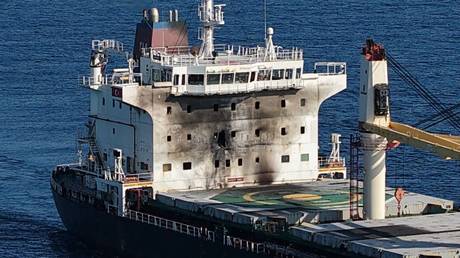
Turkish crew asks ICC to probe Ukrainian drone strike that killed sailor
Coveragetap to expand ▾Spectrum: Mostly Center🌍Europe: 1 · Asia: 1
- The filing alleges the strike occurred on July 22 and killed one sailor and injured two others (per rt.com).
- RT's report frames the accused actor as Ukraine (alleging a Ukrainian drone strike) while noting the complaint is an allegation seeking ICC inquiry (per rt.com).
The crew of the Turkish cargo vessel Reyhan Sari asked the International Criminal Court to open an investigation into what they allege was a Ukrainian drone strike that killed one sailor and wounded two others.
According to the complaint reported by RT, the attack occurred on July 22 and the plaintiffs asked the ICC to treat the incident as a possible crime against humanity, listing 12 crew members, the victim’s family and the ship owner among those bringing the case.
RT’s account presents the incident as an allegation lodged by the victims and emphasizes the plaintiffs’ demand for international legal scrutiny; the report does not include immediate comment from Ukrainian officials or independent verification of the strike attribution.
The filing itself, as described by RT, frames the event as affecting a Turkish commercial crew on a cargo ship, and the complaint’s legal thrust is to move the matter from bilateral or military channels into the ICC’s investigatory and prosecutorial process.
Why now: the plaintiffs have framed the timing around the July 22 incident and are using the ICC mechanism to seek accountability beyond domestic courts or naval inquiries.
Confirmed facts in the current public reporting are limited to the complaint’s claims — namely the date named, the casualty figures reported by the plaintiffs, and the parties listed in the filing — while responsibility for the strike remains an allegation in need of independent corroboration.
Next steps will hinge on whether the ICC decides the complaint meets its jurisdictional and admissibility thresholds and whether investigators can establish the strike’s origin and chain of command.
This filing indicates the case may shift a maritime casualty arising from the broader regional conflict into international criminal-law processes, but RT’s report leaves open critical evidentiary questions that the ICC would have to resolve before any finding of criminal liability.
- Turkish sailors and the crew of Reyhan Sari bear concrete costs: one sailor killed and two sailors injured according to the plaintiffs’ complaint (per rt.com), with the mechanism of harm being a drone strike alleged to have struck a commercial vessel.
- The plaintiffs seek to transfer accountability to the International Criminal Court — if the ICC accepts jurisdiction, the investigation could subject named individuals and command structures to criminal inquiry (per rt.com).
- Ukraine — named in the complaint as the actor behind the drone strike (per rt.com) — faces reputational and legal risk if investigators corroborate the allegation, which could affect its military operations’ legal scrutiny.
- The ship owner and the victim’s family are named plaintiffs (per rt.com), signaling private parties are using international courts to pursue compensation and criminal accountability rather than solely domestic remedies.
- Whether the International Criminal Court declares the Reyhan Sari complaint admissible and opens a formal investigation by a named procedural deadline (per rt.com).
- Whether the ICC requests or obtains evidence tying the alleged July 22 strike to Ukrainian forces, including drone flight data, communications, or chain-of-command links (per rt.com).
- Whether Ukrainian authorities respond publicly to the allegation and provide exculpatory or corroborating evidence by the ICC’s initial review stage (per rt.com).
Left- and right-leaning outlets are covering this story differently — in which facts to emphasize, which context to include, and how to frame causes and consequences.
7 specific areas where coverage diverges — see below.
- Only RT is in this source set; RT frames the incident as an allegation against Ukraine and emphasizes the plaintiffs’ ICC complaint (per rt.com).
- No source in this pack independently verifies the strike’s origin, making attribution to Ukraine an allegation rather than a confirmed fact (per rt.com).
- No source mentioned any prior military action that allegedly triggered this drone strike or any maritime-incident investigation conducted by Turkish or other naval authorities.
- No source provided forensic or independent evidence (drone telemetry, imagery, wreck analysis) supporting the complaint’s attribution.
- No source cited ICC procedural steps, timelines, or precedent cases that would clarify how quickly the court might act on this complaint.
- No source discussed compensation claims, insurance claims, or the ship owner’s civil-law options beyond naming the owner as a plaintiff.
- All figures in the pack come from RT: the complaint alleges one killed and two injured and names 12 crew members (per rt.com).
- RT reports the complaint alleges a Ukrainian drone strike killed the sailor; no source in this pack documents an antecedent action that precipitated this specific strike.
- RT attributes the alleged strike to Ukraine via the plaintiffs’ complaint; no other outlet in this pack provides alternative attributions or corroboration (per rt.com).