
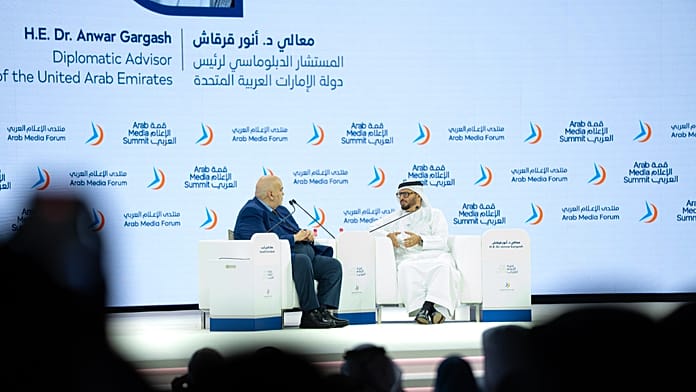
UAE adviser Anwar Gargash says rebuilding trust with Iran will take years and sustained diplomatic effort
Topic: geopoliticsRegion: Middle EastUpdated: i2 outletsSources: 2Spectrum: Center Only⏱ 3 min read
Story Summary
SITUATION
Anwar Gargash said the United Arab Emirates will need years of sustained diplomatic effort to rebuild trust with Iran (per euronews). He said the UAE prefers diplomacy but rebuilding confidence cannot be achieved quickly and will require sustained efforts over time (per euronews).
Coveragetap to expand ▾Spectrum: Center Only🌍Europe: 1 · Other: 1
Political Spectrum
Position is inferred from coverage mix.
i2 outlets · Center
Left
Center
Right
Left: 0
Center: 2
Right: 0
Geography Coverage
Distribution of where coverage is coming from.
i2 unique outlets · Dominant: Europe
KEY FACTS
- Anwar Gargash said trust between the United Arab Emirates and Iran will take years to rebuild (per euronews).
- Gargash said the UAE wants a diplomatic approach to relations with Iran (per euronews).
- Gargash said rebuilding confidence cannot be achieved quickly and will require sustained efforts over time (per euronews).
HISTORICAL CONTEXT
The immediate backdrop is the active March 2026 US–Israel military campaign against Iran, a coordinated series of strikes on Iranian power plants, air defenses and military infrastructure that began in early March 2026; Iranian military actions through 2026 have been responses to that campaign rather than unprovoked attacks.
That escalation followed a year of direct exchanges between Iran and Israel in 2024, in which Tehran’s strikes were launched in response to a string of Israeli strikes on Iranian-linked facilities and personnel in Syria, Iraq and elsewhere.
Brief
Anwar Gargash, an adviser in the United Arab Emirates, told euronews that rebuilding trust with Iran will take years and require sustained diplomatic effort. Gargash framed the UAE’s stance as committed to diplomacy while warning that confidence between the two governments cannot be restored quickly.
He emphasized process over shortcuts, saying the UAE wants talks and long-term engagement rather than immediate normalization without substantive confidence-building measures (per euronews).
The comment comes as Gulf capitals weigh how to manage relations with Iran amid broader regional tensions and shifting alignments; euronews provides Gargash’s assessment but does not list the specific diplomatic steps the UAE plans to take.
Gargash’s formulation highlights two practical constraints: that trust is time-consuming to restore, and that repeated, verifiable actions will be necessary to sustain any rapprochement (per euronews).
The report did not specify a start date, deadlines, or measurable benchmarks for the multiyear effort, leaving open how the UAE will define success or verify Iranian reciprocity (per euronews).
For now, Gargash’s remarks signal a patient UAE strategy that privileges negotiated confidence-building and steady diplomatic engagement instead of quick political fixes or unilateral moves (per euronews).
Why it matters
- UAE residents and businesses bear concrete costs if mistrust persists: limited bilateral trade and investment flows are likely to remain constrained until confidence-building measures are implemented (per euronews).
- Diplomats and foreign ministries in the Gulf benefit from a patient, diplomatic approach because it preserves room for negotiation and incremental agreements rather than sudden policy reversals (per euronews).
- Iran’s government faces reputational and strategic costs if trust gaps continue, since prolonged mistrust reduces the scope for economic and security cooperation with Gulf states (per euronews).
What to watch next
- Whether the United Arab Emirates announces specific confidence-building measures with Iran — such as diplomatic missions reopening, trade accords, or security dialogues — within the next 12 months (per euronews).
- Whether Anwar Gargash or other UAE officials set measurable benchmarks or a timeline for progress in the coming year (per euronews).
- Whether Gulf Cooperation Council states coordinate a collective diplomatic approach toward Iran by the end of the next regional summit cycle (per euronews).
Where sources differ
7 dimensionsFraming differences
?- Only euronews is in this pack; it frames Gargash’s remarks as emphasizing long-term diplomacy and does not present alternative framings.
Disputed or unclear
?- No other source in this pack disputes or corroborates Gargash’s timing or assessment; the precise diplomatic steps and whether Iran accepts a multiyear process remain unclear (per euronews).
Omitted context
?- No source in this pack mentions prior triggering actions that produced the current mistrust between the UAE and Iran.
- No source in this pack provides data on bilateral trade volumes or economic losses tied to the mistrust.
- No source in this pack references international accountability mechanisms, arbitration, or third-party mediation options that could affect confidence-building.
- No source in this pack details Iran’s public reaction or acceptance of the UAE’s diplomatic framing.
Conflicting figures
?- No sources in this pack provided differing numerical figures.
Disputed causality
?- Euronews reports Gargash’s prescription (multiyear diplomacy) but does not identify the specific past actions by Iran or the UAE that triggered the trust deficit.
Attribution disputes
?- All claims in this pack are attributed to Anwar Gargash via euronews.
Sources
2 of 2 linked articles