
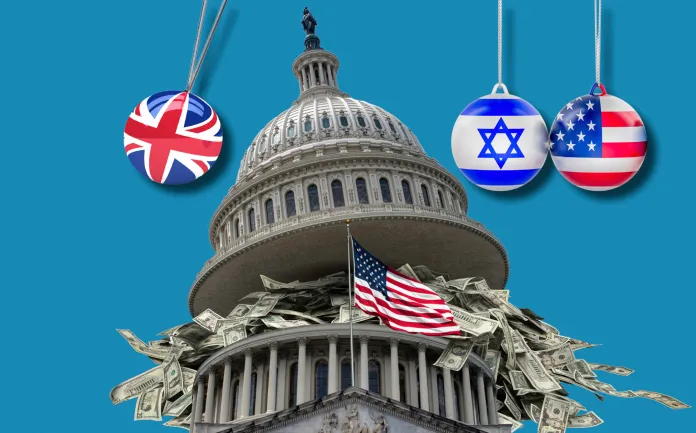
U.K. announces sweeping Israel boycott measures that could force U.S. firms to break U.S. anti‑boycott law
Topic: geopoliticsRegion: Middle EastUpdated: i1 outletsSources: 1Spectrum: Right Only⏱ 4 min read
Story Summary
SITUATION
The United Kingdom announced a sweeping set of boycott measures and sanctions aimed at Israel that the Washington Examiner says could force American companies that comply to violate U.S. federal anti‑boycott laws.
Coveragetap to expand ▾Spectrum: Right Only🌍US: 1
Political Spectrum
Position is inferred from coverage mix.
i1 outlets · Right
Left
Center
Right
Left: 0
Center: 0
Right: 1
Geography Coverage
Distribution of where coverage is coming from.
i1 unique outlets · Dominant: US/Canada
KEY FACTS
- The United Kingdom announced a sweeping set of boycott measures and sanctions aimed at Israel (per Washington Examiner).
- The Examiner warns that American companies that comply with the U.K. measures would violate U.S. federal anti‑boycott laws (per Washington Examiner).
- The article warns British Jews could be unable to buy, sell, or rent homes in the Jewish quarter of the Old City and that developers building in Jewish neighborhoods could face prosecution under the measures (per Washington Examiner).
- The Washington Examiner says the boycotts come after attempts to 'save' the two‑state solution and recognition of a Palestinian state failed and notes the boycotting governments invoke international law to justify applying the measures to what they call 'Israeli settlements' (per Washington Examiner).
HISTORICAL CONTEXT
The immediate backdrop is the wider Middle East war that began in March 2026, when the United States and Israel launched coordinated strikes against Iranian infrastructure, including power-generation facilities, air defenses and military sites; those strikes followed months of escalating exchanges in the region, including attacks on shipping and proxy strikes that raised tensions between Tehran and Western and regional governments.
Iranian military actions throughout 2026 have been framed by Tehran as responses to that U.S.–Israeli campaign, and the conflict has driven renewed diplomatic and economic contestation over Israel, the Palestinian territories and international law across European capitals.
Brief
The United Kingdom announced a sweeping package of boycott measures and sanctions aimed at Israel that, according to the Washington Examiner, will put American companies in direct conflict with U.S. anti‑boycott statutes.
The Examiner frames the U.K. move as unusually aggressive—calling it the most forceful set of measures taken by any non‑Muslim country—and highlights legal friction: compliance by U.S. firms with British demands could, the paper warns, amount to violating U.S. federal anti‑boycott laws.
The U.K. and other European governments, the Examiner says, justify the measures by citing international law and restricting activity they label tied to "Israeli settlements," but the piece questions the coherence of that legal basis.
The article also raises immediate social consequences inside Jerusalem, saying the measures could prevent British Jews from buying, selling or renting in the Jewish quarter of the Old City and could expose developers working in Jewish neighborhoods to prosecution.
Washington Examiner links the diplomatic turn to failed efforts to "save" the two‑state solution and recognition of a Palestinian state, presenting the boycotts as a policy escalation by Western governments frustrated at stalled political outcomes.
The Examiner's account is primarily legal and political: it stresses the risk of bilateral legal collision between the U.K.'s new measures and existing U.S. anti‑boycott law rather than documenting specific enforcement actions or listings of targeted entities.
That framing raises an immediate question for U.S. companies and regulators: whether U.S. firms will follow British orders and face U.S. legal exposure, or refuse and risk U.K. penalties—an unresolved operational and diplomatic dilemma highlighted throughout the piece.
Why it matters
- British Jews in Jerusalem risk losing housing access: the measures could bar them from buying, selling, or renting in the Jewish quarter of the Old City (per Washington Examiner), imposing direct property and residency costs on that community.
- U.S. companies face concrete legal exposure: American firms that comply with U.K. boycott demands risk violating U.S. federal anti‑boycott laws, creating potential fines or enforcement actions against U.S. corporate actors (per Washington Examiner).
- Developers in Jewish neighborhoods face prosecution risk under U.K. measures (per Washington Examiner), shifting legal liabilities from local real estate actors to internationally exposed contractors and investors.
- Western governments seeking to pressure Israel—here, the U.K.—stand to benefit politically by signaling stronger action on settlements; the Washington Examiner frames those governments as the actors driving the measures (per Washington Examiner).
What to watch next
- Whether the U.K. publishes implementing regulations or a list of targeted activities/entities within 30 days that would clarify which transactions trigger penalties (per Washington Examiner's description of a new measures package).
- Whether the U.S. Department of Justice or Commerce issues guidance or enforcement actions clarifying how U.S. anti‑boycott law will apply to compliance with U.K. measures (triggered by the Examiner's legal‑conflict claim).
- Whether British courts or prosecutors bring cases against property transactions or developers in Jewish neighborhoods under the announced measures (the Examiner warns of possible prosecutions).
- Whether other Western governments named by the Examiner—Canada and France—publish matching boycott or sanction policies and lists that expand the legal collision for multinational firms (per Washington Examiner).
Where sources differ
7 dimensionsFraming differences
?- Only the Washington Examiner is in this source pack; it frames the U.K. measures as legally incoherent and highly aggressive and emphasizes the clash with U.S. anti‑boycott law (per Washington Examiner).
Disputed or unclear
?- No other source in this pack disputes or corroborates the Examiner’s claims about legality, scale, or specific domestic impacts such as barring British Jews from housing or prosecuting developers; those claims remain uncorroborated in this dataset (per Washington Examiner).
Omitted context
?- No source here details any specific U.K. implementing regulations, lists of targeted companies/activities, or the precise legal text that would trigger prosecution—critical operational details are missing.
- No source mentions any U.S. Department of Justice, Commerce, or Treasury response or prior precedent for cross‑jurisdictional anti‑boycott conflicts, which readers would need to evaluate enforcement risk.
- No source provides data on how many U.S. companies operate in the affected sectors or in the Jerusalem neighborhoods cited, or the scale of potential economic exposure to quantify the risk.
- No source names Israeli government responses, affected Israeli businesses, or affected British Jewish residents or organizations’ reactions—first‑hand affected parties are not quoted here.
Conflicting figures
?- The Examiner uses qualitative descriptions (e.g., 'most aggressive') but does not provide numeric thresholds, lists, or specific penalty figures in the text provided (per Washington Examiner).
Disputed causality
?- The Examiner links the boycotts to failed efforts to preserve the two‑state solution and recognition of a Palestinian state, but no source here documents the decisionmaking process inside the U.K. government that produced the measures (per Washington Examiner).
Attribution disputes
?- The Washington Examiner attributes legal risk to a clash between U.K. measures and U.S. anti‑boycott law and attributes motive to Western governments' failed attempts to save the two‑state solution (per Washington Examiner).
Sources
1 of 1 linked articles