
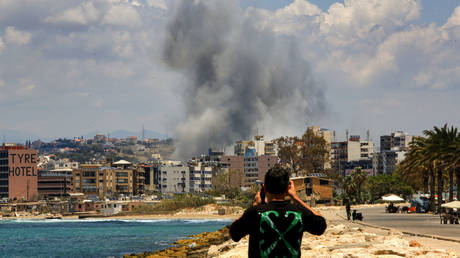
It must end.” She also called on Hezbollah to stop attacking Israel and lay down its arms.
Topic: defense & securityRegion: Middle EastUpdated: i2 outletsSources: 5⚠ Bias gap — sources divergeSpectrum: Mostly Center⏱ 4 min read⚠ 3d+ old
Story Summary
SITUATION
UK Foreign Secretary Yvette Cooper stated that Israeli attacks in Lebanon are killing civilians and must cease. She emphasized that the military escalation undermines diplomacy and called for all parties to respect the ceasefire and engage in negotiations.
Coveragetap to expand ▾Spectrum: Mostly Center🌍ME: 2 · Other: 2 · Europe: 1
Political Spectrum
Position is inferred from coverage mix.
i2 outlets · Center
Left
Center
Right
Left: 0
Center: 4
Right: 1
Geography Coverage
Distribution of where coverage is coming from.
i2 unique outlets · Dominant: Middle East
KEY FACTS
- Israeli attacks in Lebanon are killing civilians and must end, UK Foreign Secretary Yvette Cooper has said, after the Jewish state stepped up military activity against its northern neighbor.
- The Israel Defense Forces (IDF) has intensified airstrikes in recent days and moved deeper into Lebanese territory despite the ceasefire agreed in mid-April after more than a month of fighting.
- In a post on X on Monday, Cooper said Israel’s military escalation in Lebanon “has killed and displaced civilians, destroyed infrastructure, and eroded space for diplomacy.
- “All sides must respect the ceasefire and engage with negotiations in good faith,” the foreign secretary said.
- UK foreign minister says 'Israel' has "eroded space for diplomacy" in Lebanon - Roya News
HISTORICAL CONTEXT
The ongoing conflict between Israel and Lebanon has escalated significantly in recent months, particularly following the resurgence of hostilities that began in March 2026. This escalation is closely tied to the broader military campaign initiated by the United States and Israel against Iran, which has included coordinated airstrikes targeting Iranian military infrastructure.
As part of this regional conflict, Israel has intensified its military operations in Lebanon, citing the need to counter threats from Iranian-backed groups such as Hezbollah. The situation has led to an alarming increase in civilian casualties and displacement within Lebanon, prompting international calls for a ceasefire and diplomatic resolution.
Brief
UK Foreign Secretary Yvette Cooper has called for an immediate end to Israeli military actions in Lebanon, citing the killing of civilians and the undermining of diplomatic efforts. In a recent statement, Cooper condemned the intensified airstrikes by the Israel Defense Forces (IDF), which have escalated despite a ceasefire established in mid-April.
She highlighted the severe humanitarian impact of these actions, noting that they have resulted in civilian casualties, displacement, and destruction of infrastructure. The IDF's operations have included significant territorial advances, such as the recent seizure of Beaufort Castle, a historic site.
Cooper's remarks also included a call for Hezbollah to cease its attacks on Israel, emphasizing the need for all parties to adhere to the ceasefire and engage in negotiations. This escalation comes amid ongoing tensions in the region, as military actions continue to provoke international concern over the humanitarian situation in Lebanon.
The British government’s stance reflects a growing urgency for diplomatic solutions in the face of escalating violence.
Where sources differ
Bias gap0.70 / 2.0
Left- and right-leaning outlets are covering this story differently — in which facts to emphasize, which context to include, and how to frame causes and consequences.
Center (4)
en.royanews.tvpresstv.irlokmattimes.comtimesofisrael.com
Right-leaning (1)
rt_world+0.70
Israel’s Lebanon ‘escalation must end’ – UK Israel’s Lebanon ‘escalation must end’ – UK Israel’s Lebanon offensive ‘must end’ – UK West Jerusalem’s attacks are killing civilians an…
Sources
5 of 5 linked articles
Israel’s Lebanon ‘escalation must end’ – UK
rt.comJun 1Right
↗
UK foreign minister says 'Israel' has "eroded space for diplomacy" in Lebanon
en.royanews.tvJun 1Left
↗
UK foreign secretary admits Israeli aggression eroding diplomacy in Lebanon
presstv.irJun 1Left
↗
UK Foreign Minister Yvette Cooper demands end to Israel's "military escalation" in Lebanon, urges... - lokmattimes.com
lokmattimes.comJun 1Left
↗
British FM calls for Israel to end Lebanon operation, says Hezbollah must disarm
timesofisrael.comMay 31Left
↗