
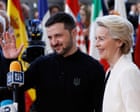
Ukraine and Moldova Launch EU Membership Talks Amid Ongoing Russian military actions
Topic: geopoliticsRegion: EuropeUpdated: i2 outletsSources: 5⚠ Bias gap — sources divergeSpectrum: Mostly Center⏱ 4 min read
Story Summary
SITUATION
Ukraine and Moldova have begun the first phase of EU membership negotiations, marking a significant step towards joining the bloc. This development follows intensified Russian bombardments of Ukrainian towns and cities, which have resulted in substantial losses for Russia without territorial gains.
Coveragetap to expand ▾Spectrum: Mostly Center🌍Other: 3 · Europe: 1 · Asia: 1
Political Spectrum
Position is inferred from coverage mix.
i2 outlets · Center
Left
Center
Right
Left: 1
Center: 4
Right: 0
Geography Coverage
Distribution of where coverage is coming from.
i2 unique outlets · Dominant: Global
KEY FACTS
- Ukraine and Moldova will take a decisive step towards joining the EU on Monday, as they embark on the first phase of membership negotiations.
- Ukraine and Moldova were quickly accepted as EU candidate countries in 2022, having filed applications days after Russia’s full-scale invasion.
- But despite a symbolic decision to open talks in June 2024, substantive negotiations were blocked by Hungary’s pro-Russian president, Viktor Orbán.
HISTORICAL CONTEXT
The ongoing conflict in Ukraine, which escalated dramatically with Russia's full-scale invasion on February 24, 2022, has significantly influenced the geopolitical landscape of Europe and the aspirations of neighboring countries.
In response to the invasion, Ukraine and Moldova submitted their applications for European Union (EU) membership in March 2022, seeking to align more closely with Western institutions and secure support against Russian aggression. The EU granted both countries candidate status in June 2022, marking a pivotal moment in their European integration efforts.
Brief
Ukraine and Moldova have officially commenced the first phase of their EU membership negotiations, a pivotal moment for both nations as they seek closer ties with Europe amid ongoing conflict with Russia.
This step follows a period of heightened Russian military actions, which has seen intensified bombardments across Ukrainian cities, resulting in considerable losses for Russian forces without significant territorial gains.
The EU's decision to engage in these negotiations comes after Ukraine and Moldova were granted candidate status in 2022, shortly after they applied in response to Russia's full-scale invasion. However, the path to substantive negotiations faced delays, notably due to opposition from Hungary's pro-Russian president, Viktor Orbán, who blocked progress until recently.
The launch of these negotiations is not only a symbolic victory for Ukraine and Moldova but also a strategic move by the EU to reinforce its influence in Eastern Europe at a time when Russian military actions poses a significant threat to regional stability.
As both countries navigate the complexities of EU accession, they will need to address various reforms and align their policies with EU standards, a process that will be closely monitored by EU officials and member states. The outcome of these negotiations could reshape the geopolitical landscape in Eastern Europe, particularly in the context of ongoing tensions with Russia.
Where sources differ
Bias gap0.50 / 2.0
Left- and right-leaning outlets are covering this story differently — in which facts to emphasize, which context to include, and how to frame causes and consequences.
Left-leaning (1)
guardian_world-0.50
Ukraine and Moldova to enter first phase of EU membership negotiations Ukraine and Moldova to enter first phase of EU membership negotiations Ukraine and Moldova start first phase …
Center (4)
sofiaglobe.comanewz.tvrnz.co.nzdevdiscourse.com
Sources
5 of 5 linked articles
Ukraine and Moldova to enter first phase of EU membership negotiations
theguardian.comJun 14Left
↗
EU accession talks with Ukraine and Moldova to begin on June 15
sofiaglobe.comJun 13Left
↗
EU envoys agree to membership talks for Ukraine and Moldova
anewz.tvJun 13Left
↗
EU envoys agree to first phase of membership talks for Ukraine and Moldova
rnz.co.nzJun 13Left
↗
EU Membership Talks Begin: A New Chapter for Ukraine and Moldova
devdiscourse.comJun 12Left
↗