
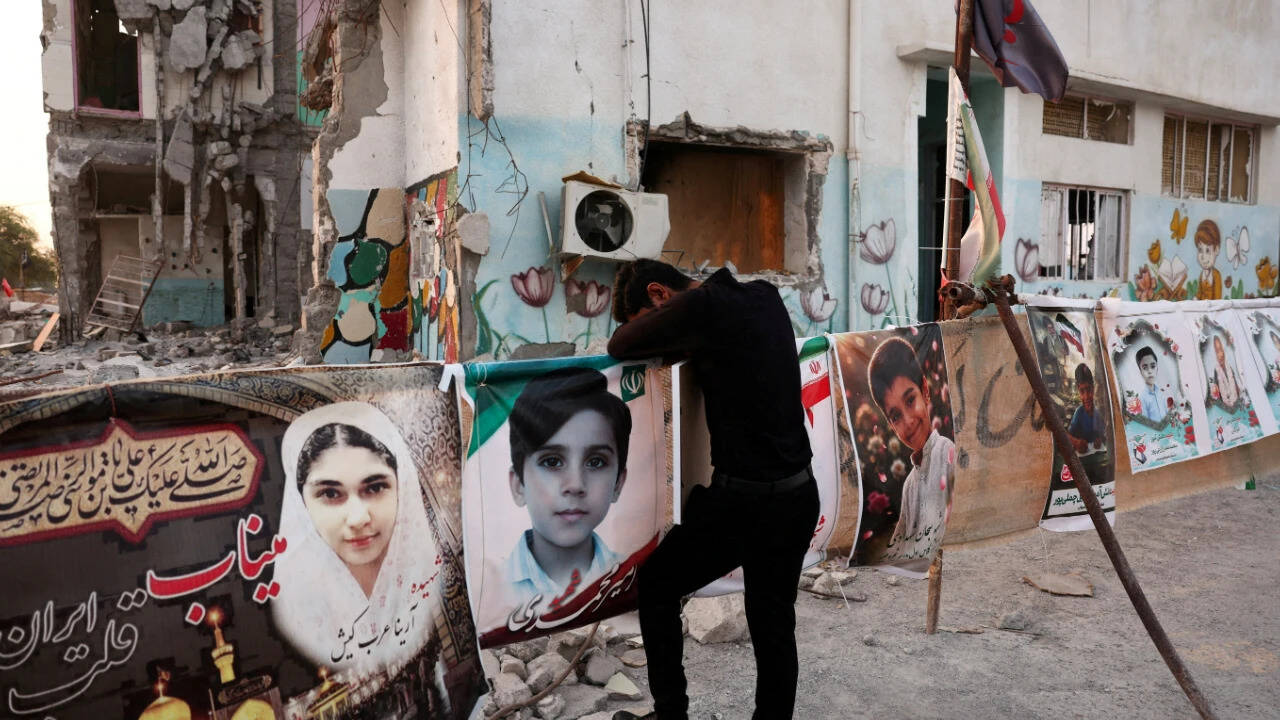
UN finds US likely committed war crimes in strikes that killed 156 at Minab school
Coveragetap to expand ▾Spectrum: Center Only🌍Asia: 2 · US: 1
- UN human rights experts found “reasonable grounds” that the United States committed war crimes in two strikes in Iran that killed over 150 civilians, including about 120 children.
- The mission examined two attacks after the US and Israel launched their war against Iran on February 28 and concluded the strikes were indiscriminate and caused civilian deaths and damage to civilian objects.
- A Tomahawk missile strike on Shajareh Tayyebeh Primary School in Minab, southern Iran, killed at least 156 people, including about 120 children, according to local authorities.
- Investigators found the school was clearly identifiable, had no information indicating military use, and survivors said the school was struck twice.
- The school was next to an Islamic Revolutionary Guard Corps naval complex that was also attacked, but experts concluded the school was the intended point of impact and not civilian casualties.
- The findings were published by the Independent International Fact-Finding Mission on Iran in a report to the UN Human Rights Council.
A U.N.-backed independent fact-finding mission concluded that U.S. Tomahawk strikes killed more than 150 people at the Shajareh Tayyebeh Primary School in Minab and killed 22 people in Lamerd, a finding that could prompt accountability efforts (per japantimes.co.jp).
The panel's assessment, delivered publicly in its report, directly names U.S. forces as the actors responsible for the strikes and tallies the high death toll at a school in Minab, a detail that elevates the allegations to potential violations of laws protecting civilians and schools in conflict.
The Pentagon says it is conducting an investigation into the incidents, while the White House publicly rejected the panel's findings, creating an immediate dispute between U.S. officials and the U.N.-backed mission (per japantimes.co.jp).
That split—an international fact-finding body asserting U.S. responsibility and U.S. institutions promising or already pursuing internal review while disputing the conclusions—frames the likely next phase: a contest over evidence, access, and whether external accountability mechanisms will take up the case.
The article notes that the report could spur accountability efforts, but provides no details on which courts or bodies might pursue charges or reparations, leaving open whether the findings will move beyond political denunciation to legal action (per japantimes.co.jp).
For now, the principal confirmed facts are the panel's attribution of the strikes to U.S. forces, the death tolls reported for Shajareh Tayyebeh Primary School in Minab and for Lamerd, and competing U.S. responses—an ongoing Pentagon probe and a White House rejection—which together set the terms for any further investigation or international scrutiny (per japantimes.co.jp).