
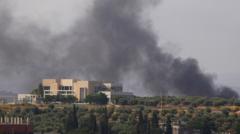
U.S. and Iran Near Agreement to End Ongoing Conflict
Topic: geopoliticsRegion: Middle EastUpdated: i6 outletsSources: 19⚠ Bias gap — sources divergeSpectrum: Mostly Center⏱ 4 min read📡 Wire pickup
Story Summary
SITUATION
The U.S. and Iran are reportedly close to an agreement to end a war that has caused significant damage to both sides.
Coveragetap to expand ▾Spectrum: Mostly Center🌍Other: 6 · Europe: 4 · ME: 3 · Asia: 3 · US: 2
Political Spectrum
Position is inferred from coverage mix.
i6 outlets · Center
Left
Center
Right
Left: 4
Center: 14
Right: 0
Geography Coverage
Distribution of where coverage is coming from.
i6 unique outlets · Dominant: Global
KEY FACTS
- Israel carries out air strikes on Lebanon, state media says, as Iran claims deal with US near
- The U.S. and Iran Might Actually Have a Deal
- The two sides say they are close to an agreement to end a war that has left everyone badly bruised.
HISTORICAL CONTEXT
The ongoing conflict between the United States and Iran escalated significantly in March 2026 when the U.S. and Israel launched a coordinated military campaign against Iran, targeting its power plants, air defenses, and military infrastructure.
This military action was a response to Iran's perceived threats and aggressive posturing in the region, which had been escalating since the breakdown of diplomatic relations and the subsequent sanctions imposed on Iran.
Brief
The U.S. and Iran are reportedly nearing an agreement to conclude their ongoing conflict, which has inflicted considerable damage on both nations. Negotiators from both sides have made substantial progress, drafting language that appears acceptable to both parties, although the specifics of a signing date and location remain unresolved.
President Trump has previously indicated that an agreement was within reach at least 38 times, but these claims have often been followed by new disputes or military escalations that pushed the potential deal further away.
The proposed agreement would not only aim to end hostilities but also initiate discussions regarding Iran's nuclear material, potentially establishing a framework for financial incentives contingent on Iran's compliance with its obligations.
This diplomatic effort is taking place against a backdrop of ongoing military actions, with both sides engaged in strikes and counterstrikes. As the situation develops, the focus will remain on whether the two nations can overcome their historical tensions and finalize a deal that has eluded them multiple times in the past.
Why it matters
- An agreement between the U.S. and Iran could significantly alleviate the humanitarian crisis affecting millions in both countries, particularly by easing sanctions that have crippled Iran's economy and limited access to essential goods.
- For Iranian citizens, this could mean improved living conditions and access to healthcare, while U.S. military personnel and their families would benefit from a reduction in conflict-related casualties and deployments.
- Additionally, a potential de-escalation in military tensions could pave the way for renewed diplomatic relations, fostering economic opportunities that could stabilize the region and reduce the risk of further military confrontations.
What to watch next
- The U.S. Congress is expected to vote on new sanctions against Iran within the next 72 hours if the agreement does not materialize.
- Iran's Foreign Minister is scheduled to meet with European Union officials next week to discuss potential economic incentives tied to the agreement.
- The Biden administration plans to hold a press briefing within the next 48 hours to outline the implications of the potential deal for U.S. foreign policy in the region.
- Regional allies, including Saudi Arabia and Israel, are likely to issue formal responses to the agreement before the upcoming June summit in Riyadh.
Where sources differ
Bias gap0.85 / 2.0
Left- and right-leaning outlets are covering this story differently — in which facts to emphasize, which context to include, and how to frame causes and consequences.
Left-leaning (4)
guardian_world-0.50
An ideological tug-of-war: the pressures facing Iran’s World Cup squad in US An ideological tug-of-war: the pressures facing Iran’s World Cup squad in US Iran to become first World…
the_atlantic-0.40
and Iran Might Actually Have a Deal and Iran Might Actually Have a Deal and Iran Might Actually Have a Deal and Iran Might Actually Have a Deal The two sides say they are close to …
arabnews.com-0.30
Hezbollah says it confronted Israeli troops advancing in south Lebanon - Arab News Hezbollah says it confronted Israeli troops advancing in south Lebanon - Arab News Hezbollah says…
aljazeera_en-0.20
Protests by angry young ultra-Orthodox men have become regular occurrences across Israel. Violence escalates in Israel amid ultra-Orthodox military draft protests Violence escalate…
Center (14)
bbc_worldabc_australiaapnews.comaol.comuk.news.yahoo.comndtv.comaol.comozarab.mediafacebook.comaa.com.trdemocrata.estimesofisrael.combbc.comddnews.gov.in
Sources
18 of 18 linked articles
Israel carries out air strikes on Lebanon, state media says, as Iran claims deal with US near
bbc.comJun 13Center
↗
Hezbollah says it confronted Israeli troops advancing in south Lebanon
arabnews.comJun 12Left
↗
The U.S. and Iran Might Actually Have a Deal
theatlantic.comJun 12Left
↗
How Israel's operation 'Eternal Darkness' in southern Lebanon is expanding
abc.net.auJun 12Center
↗
As officials again say Iran war could soon end, some Trump objectives are unfulfilled
apnews.comJun 12Left
↗
The Latest: Pakistan says US and Iran agree on ‘final’ text of a peace deal
aol.comJun 12Left
↗